


252. Drainage Map
Description
This section is from the book "The Villa Gardener", by J. C. Loudon. Also available from Amazon: The Villa Gardener.
252. Drainage Map
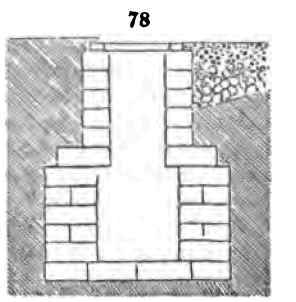
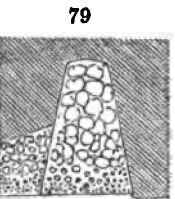
In all extensive establishments, and even in small ones, where the drainage is in any degree intricate, it is desirable to have a map exclusively devoted to the under-drains, which should be accurately laid down on it> and accompanied by sections and dimensions, taken in different parts of the course of the drains, and projected on the plan alongside of the points where they were taken. Every successive addition and alteration should be introduced in the plan when made, and accompanied by the date. The use of such a plan is twofold: 1. to show the precise situation of the drains already existing, when any new drain is to be made; and, 2., as a guide when any drain becomes stopped up, and the point of stoppage is uncertain. By penetrating into the suspected drains at different distances, though only^with a boring auger, or even in some cases with a crowbar, an immense deal of labour may be saved in detecting the seat of the evil; especially in cases where the principal servants have been changed since the drains were last opened.
253. The pleasure-grounds, in places of only two or three acres in extent, may generally be considered as including the whole of the grounds, with the exception of the space occupied by the house and offices, and by the kitchen• garden. The number and the direction of the walks through this space will depend on various circumstances, but chiefly on the taste of the family for flowers and shrubs, and the annual expense which they are willing to incur in keeping the grounds in order. In general, the walks should be so far apart, or so hidden or disguised by undulations of the surface or by planting, that more than one walk shall never be seen at a time. In irregular surfaces, therefore, it is obvious that the walks may be much more numerous than in such as are even or flat; and, in surfaces richly varied by groups of trees or shrubs, the walks may be closer together than where the surface is chiefly in naked glades of lawn. The cheapest-kept pleasure-ground is, generally, that in which there are fewest walks, and broadest glades of lawn; while the most expensive are those where the surface is full of inequalities, the groups of trees and shrubs numerous, and the glades of lawn narrow.
In general, in proportion as the surface of the ground is varied, so will be the beauty produced in any given space; more pictorial effect being found in one acre of undulations, than in three of level surface, the art and skill displayed being in both cases alike.
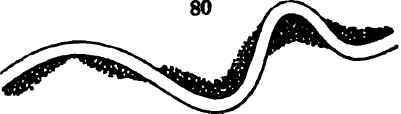
254. The direction of the walks should never appear to be forced, or to consist of bends made obviously for the sake of rendering the walk longer, or of avoiding a straight line. The direction may be straight or curvilinear, according as tie one or the other maybe required on account of the objects at which the walks are to touch; or apparently occasioned by obstructions on the ground, either natural or artificial. In curvilinear walks, no bend should ever be made that has not an obvious cause in the disposition of the flower-beds, or of the groups of trees and shrubs placed along its margin, or in the inequalities of the surface of the ground. Thus, if it be thought desirable to have a curved walk, as shown in fig. 80., flowers or shrubs should be planted, as shown by the dotted lines, to give an apparent reason for the curves. Straight walks, where they are introduced, should have an obvious reason visible for their being straight; such as an accompanying wall, a row of trees at regular distances, or a covering of trellis-work, etc.
In large places, the pleasure-ground, and consequently the walks belonging to it, are generally confined to grounds on one or on two sides of the mansion; while the grounds on the opposite side are considered in the nature of park scenery; but the grounds of country villas, such as those under discussion, are, as already observed, generally considered as consisting wholly of pleasure-ground; and, consequently, the walks are carried through' the scenery on the entrance front, as well as on the opposite side of the house, or what is called the lawn front. The grounds on the side next the entrance front, however, being more exposed to strangers coming along the approach road, have generally fewer walks, and these are accompanied by groups more frequently of trees and shrubs, than of flowers; and by scenery, generally in a subordinate style of decoration. As the main walk through the pleasure-grounds generally requires, on the side of the entrance front, to cross the approach road, if the surface be much varied, or expense be not an object, the walk may cross the approach on an archway thrown over it, or by a tunnel carried under it: in either case, the road being concealed from the spectator on the walk, and the walk from the spectator on the road, by planting.
The effect of this arrangement is greatly to increase the apparent extent of the grounds; and, indeed, in places where the surface is naturally varied, and the subsoil dry, the spectator may be led three or four times over the whole of the grounds, while, as he every moment enters on new scenery, he fancies he is traversing a place of three or four times its real extent. The great art of managing this description of scenery consists in the judicious use of tunnels, bridges, and raised surfaces in the form of wavy ridges, having their sides clothed with evergreens, and walks along their summits, and in the narrow winding valleys between them. Those who have never seen this kind of art applied to garden scenery will scarcely credit how easy it is by it to conceal one walk from another closely adjoining it; and what a magical effect may be produced in a very small space by this kind of landscape gardening.
255. On varied surfaces, the general principles which we have laid down for the direction of walks must be taken in connexion with the principle of displaying to advantage such distant views as are considered good, and disguising or concealing such as are indifferent or bad. The object is, to show as many handsome landscapes as possible, and to conceal all disagreeable objects. Thus, the walks which are conducted round any place should, as already observed, p. 157., conduct to all the fine and striking points of view; so that, while none of these escape the attention of the spectator, no inharmonious or offensive object obtrudes itself on his notice.
256. The breadth of pleasure-ground walks may bear some proportion to the size of the place; though they should seldom be narrower than 6 ft, and, except in the immediate neighbourhood of the house, should rarely be broader than 12 ft. In general, there ought to be a main walk proceeding from the house, and making, as it were, the tour of the place; and this walk, even in small residences, may commence at the house in a terrace parallel to the walks, and 10 ft. or 12 ft., or more, in breadth; and branch out to the right and left into main walks, commencing of the width of the terrace, or nearly so, and gradually diminishing, till they are at such a distance from the house as not to be seen by the eye of the spectator from the terrace, where they need not exceed the width of 6 ft. or 7 ft.; which width may be continued throughout the remainder of their length. This is done in the grounds at
Ken Wood, views of which are given in an after part of this work; and the effect is at once to increase the grandeur of the scenery about the house, and to add to the apparent grandeur and length of the walks proceeding from it.
The groups of trees and shrubs, or beds which are to be dug and kept planted with flowers, ought always to be separated from the walk by a verge or margin of turf; which, for the convenience of mowing, and of always presenting a healthy green surface, should not be less than 2 ft. in width. This applies to all the open parts of the pleasure-ground scenery; but, where the walk proceeds through dark shady woods, the trees and shrubs may be brought close up to it; and, the ground being clothed with the branches of the latter, their appearance will leave no room to regret the absence of turf. Even in open pleasure-ground scenery, a tree or a shrub may sometimes be planted close to the edge of the walk, and may occasionally project partially over it, for the sake of variety, and in order to produce particular effects. In this and every other case of the application of general principles and rules, such deviations may be made as are justified by the striking nature of the results; and it often happens that those features which principally distinguish one place from another, are either the results of fortunate accidents, or unavoidable deviations from ordinary rules.
Continue to:


My Books

