


257. Grate Walks
Description
This section is from the book "The Villa Gardener", by J. C. Loudon. Also available from Amazon: The Villa Gardener.
257. Grate Walks
Besides gravel walks, there ought, in every case where there is a lawn of an acre or two in extent, to be either broad margins of turf to the main walk, running parallel to the gravel, on which persons may walk abreast with those on the hard surface; or glades in the interior of the scenery, so contrived as to admit of two or three persons making the tour of the place on them, instead of doing so on the gravel. In short, it ought never to be forgotten, that the enjoyment of walking on turf is to most persons much greater than that of walking on gravel; and that the preference given to the latter material, for what may be called the every day walks of a place, is owing to its firmness and dryness in moist weather, or after rain.
258. The approach road, next to the house and offices, is one of the most important features of a place, not only on account of its uses, but because it is that by which an impression, favourable or unfavourable, is first made on a stranger. It is, or ought to be, a walk or road fit for horses or carriages, from the entrance-gate of the premises, to the entrance-door of the mansion; formed and kept in a high style of art, corresponding with that displayed in the other component parts of the residence. It should be as different from a turnpike-road or public lane as park scenery is from that of a common grass-field or meadow. As it may be advisable to consider this important feature somewhat in detail, we shall endeavour to show how a high character of art may be conferred upon it, in its direction, in the slope or inclination of its surface, and in its material, margin, and accompanying scenery.
259. The line of directum between the entrance-gate and the mansion, in places laid out in the geometrical style, is in general straight, in the form of an avenue; but in places laid out in the modern manner, and more especially in small residences like those under consideration, it is always more or less curvilinear. Now, in order to give these curves a character of art, they ought to have a certain uniformity in their degree of curvature; and the number of curves ought to be such as to give a character of regularity, or symmetry, to the whole line of road. To have a character of art, each separate curve ought to proceed, from its commencement to its termination, in an uniform uninterrupted degree of curvature; as opposed to the curves of natural paths, carried across meadows or commons, in which curves are often to be found of so undecided a character as to present tremulous-looking lines, instead of uniform bends or curvatures. To constitute regularity among the curves, they ought all to be nearly of the same length; to preserve unity, they ought to be so united as not readily to discover where the one curve begins and the other ends; and, to constitute symmetry in the entire road, the curvatures which form one half of it ought to be balanced by those of the other half.
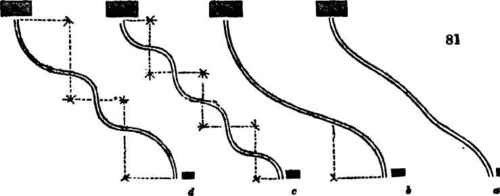
This may, perhaps, be more readily explained by lines than by description. In fig. 81., the lower extremity of each road, indicated by double lines, is supposed to be the entrance-gate, and its upper extremity the entrance-door of the mansion. Supposing the space between the gate and the mansion a common grass-field, with no interruption of trees or ditches, but with some very slight inequalities; then the track of road which would be formed between these two points by carts or carriages would probably be somewhat in the manner of the line a, which is not straight, and yet can scarcely he called curved. To render this line simply artistical, each curve may he made uniform in its degree of curvature, as shown at 6. To produce regularity in the line of curves, they ought to be all of the same length and curvature, as shown at c; and this line may be raised to a higher character, and rendered symmetrical, by forming the two extremities of two curves of the same size, and by uniting them with smaller curves, as at d. The proof that this last line is symmetrical is, that if separated into halves, neither half would form a whole; whereas this would be the case with the line c.
It may he useful to remark with reference to the first line (a), that all roads or lines formed by the traction of horses, or other draught animals guided by man, commence, say, after a gate has been gone through, by being inclined somewhat to the right; and terminate a little before the next gate, or other obstruction, by being turned somewhat to the left. This is supposed to be produced by the driver exercising his authority, by means of the whip and reins, at the beginning and ending of a line more than he does in the middle of it. Be that as it may, natural roads across fields, from one gate to another, will generally be found to consist of a short curve to the right immediately within the entrance-gate, a short turn to the left immediately within the gate of exit, and a nearly straight or indefinite line between the two. In ploughed fields, also, in former times, where an absolutely straight furrow was not, as at present, considered a desideratum, the direction of the furrow was serpentine, for the same reasons as those just given.
We state these facts here, to show that a curvilinear approach road is quite natural; though the imitation of it by man, in laying out a place, must, as in imitating nature artistically in other cases, not be a mere fac-simile repetition, but a resemblance according to art. In addition to the beauties of regularity and symmetry in the line of direction of an approach road, expression, or character, may be added. Thus, the expression of grandeur may be given by the increased size of the curves, and the general simplicity of the whole line (as shown at b); that of picturesque beauty, by very sudden changes in the direction of the curves, and by the partial introduction of irregularity; while a certain degree of elegance will be produced by gentle curves, some of which are very much prolonged, so as to be approaching to straight lines. The kind of artistical beauty least adapted to a curvilinear approach road, is regularity, as shown in the line c; which consists of a repetition of curves of the same form and magnitude, from one end to the other; and which, viewed merely as a curved line, and without reference to what might be effected by the adjoining scenery, if it were carried into execution, must be allowed to be monotonous.
The grand source of character, however, in the line of direction of an approach road, is produced by the intervention of objects, natural or artificial, which set at defiance both regularity and symmetry, such as a rock, the base or talus of a hill, a building, a group of old trees, a stream, a pond, or water in some other form; all of which most commonly occasion sudden and picturesque deviations from regularity in direction.
Continue to:


My Books

