


269. Trees
Description
This section is from the book "The Villa Gardener", by J. C. Loudon. Also available from Amazon: The Villa Gardener.
269. Trees
In every country, the plants which are indigenous, and found there when it is rescued from an uncultivated state, form but a very small number of those which will grow in it. Hence, with the progress of civlisa-tion, an immense accesion has been made, both to the useful and ornamental plants of every country. This, in Britain, has taken place more especially within the last three centuries; and the mode in which the newly-introduced plants have been distributed by landscape-gardeners, since the introduction of the modern style of art about the beginning of the eighteenth century, is as follows: - The different kinds of trees are distributed over the parks in scattered groups or clumps, as single trees, or in a belt or strip forming its boundary. The order in which the kinds are placed with reference to one another, is considered of little importance; but, till lately, it has generally been attempted to mix the foreign and the indigenous sorts indiscriminately together throughout every part of the park. In more conspicuous or favourable situations, such as near the house, or along the approach road, some of the more choice trees were planted singly, and protected with more care than the others.
The single trees and scattered groups, or clumps, were all guarded from the cattle by fences; and the boundary belt, commonly by a wall or close paling on the outside, and a hedge and ditch within. The ground was commonly dug or trenched before planting; and sometimes it was dug in the clumps and belts for two or three years afterwards. After this, the trees were left to themselves; thinning and pruning being more or less attended to in some cases, and altogether neglected in others. In consequence of the mixture of indigenous and foreign trees, and their after neglect, the indigenous and more vigorous-growing trees choked up, weakened, and ultimately destroyed the foreign kinds; so that, when the timber in such plantations arrived at an age to be cut down, there was seldom much which was good for anything that was not produced by the native trees of the country. To counteract the ill effects of this indiscriminate mode of planting, it is best to adopt some regular system of arranging trees in groups; so that those of the same kind should stand together, and yet a diversity of effect be produced.
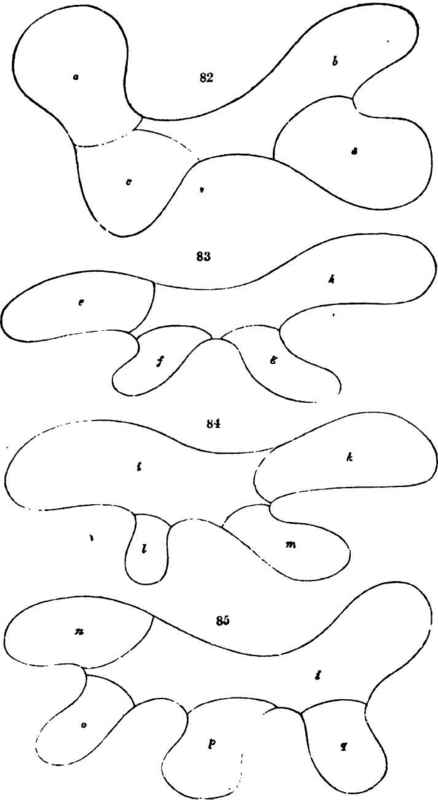
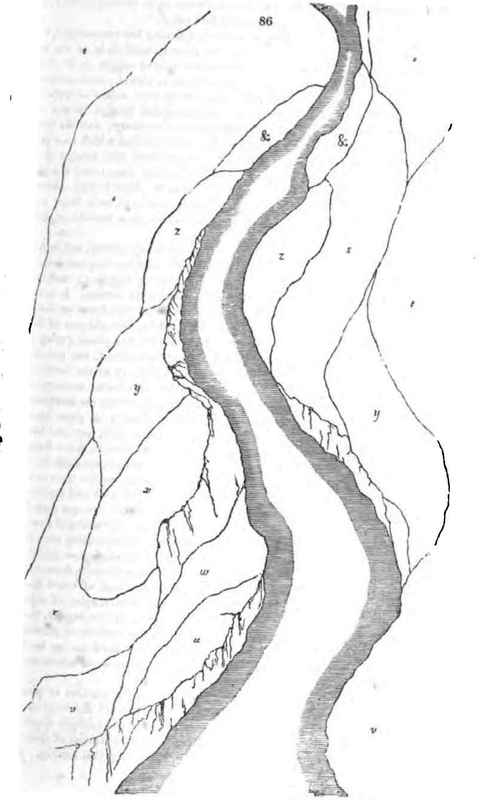
Mr. Glendinnmg has proposed a manner of doing this, which he described in the Gardener's Magazine, vol. xi., and which is shown in the diagrams figs. 82. to 86. In fig. 82., a is the English oak; b, the Turkey; c, the Lucombe; and d, the scarlet; and in fig, 83., e is the Fulham oak; f, the Ilex or evergreen oak; g, the variegated English; and A, the cork tree. In this manner two clumps are formed of oak trees, so arranged as to produce a great variety of foliage, and yet to prevent the stronger kinds from destroying the weaker ones. In the same manner pines and firs may be planted, as shown in figs. 84. and 85., in which "it may be the Scotch pine; ft, the larch; l the spruce fir; m, the stone pine; n, the pinaster; o, the silver fir; p, the Weymouth pine; and g, the Balm of Gilead fir. Where houses are built in the midst of romantic scenery," Mr. Glendinning continues, "by the sides of rivers or ravines, or on rocky eminences, the opposite and surrounding scenery may sometimes be much improved, without absolutely destroying its wild character, by the introduction and grouping of foreign as well as native plants.
Thus, in fig. 86., oaks may be planted at r, pines or firs at s, and the beech at t; while for low growths there may be hazel at u, yellow broom at v, sloe thorns at w, scarlet thorns at a?, rhododendrons at y, white broom at z, and the double-flowered furze at &."
270. The shrubs, since the modern style of gardening has commenced, have been planted in the pleasure-ground, in the same general style as the trees were in the park; that is to say, they have been placed singly, or in groups or clumps, over a lawn two or three acres or more in extent; and around it, or along one or more of its sides, in strips, which were called shrubberies. Here, as in the case of the trees, the indigenous and foreign shrubs were mixed up together in every part of the clumps and shrubbery; and the result, thirteen or fourteen years after planting, was similar to that which took place in the plantations in the park; viz. the more delicate and foreign plants were choked up and destroyed by the vigorous-growing trees; and old pleasure grounds, which had, perhaps, been originally planted with above a hundred kinds of shrubs, fifty years afterwards displayed only huge overgrown bushes, or low trees, consisting of not more than twenty or thirty indigenous species.
271. The flowers were distributed in the front of the shrubbery, and in front of the clumps in the pleasure-ground. Like the shrubs, they consisted of foreign and indigenous kinds indiscriminately mixed together; and, like them, the former were destroyed by Che latter and by the shrubs. It is only lately that beds wholly planted with flowers have been introduced on lawns; and, though what are called flower-gardens (that is, assemblages of beds wholly devoted to flowers) were to be met with in first-rate places during the latter half of the eighteenth century, yet, during that period, the principal places where they were planted were in the shrubbery or in the borders of the kitchen-garden. With the commencement of the present century, the practice of forming flower-gardens has increased; and, within the last twenty years, that of forming beds exclusively devoted to flowers on grass lawns, either in groups among the scattered shrubs, or by themselves, here and there along the walks, has become general.
The flowers planted in these flower-gardens and beds were, till lately, mixed together indiscriminately in the same manner as in planting the shrubs in the shrubbery, or the trees in the clumps and belts; and, wherever the plants were not taken up and replanted every two or three years, the same results took place, of the stronger destroying the weaker. A great improvement has been made in the planting of flowerbeds within the last twenty or thirty years. This consists in planting each bed with only one kind of flower, by which means a brilliant display of colour is produced; and in selecting for the flowers to be so planted those from warm climates, such as pelargoniums and fuchsias from the Cape of Good Hope and South America, etc, by which means a more brilliant display of colour is produced; the plants of warm countries far excelling, in this respect, those of colder climates. Such, in a few words, has been the practice of planters, landscape-gardeners, and flower-gardeners, in British gardens, up to the present time.
We shall now briefly inquire into the mode in which trees, shrubs, and flowers are distributed by nature.
272. In the natural scenery of every country, a certain number of plants will always be found congregated together, to which the soil and local situation are favourable. The number of species in these assemblages depends partly on the suitableness of the soil and climate for a great variety of species, and partly on the number of species naturally inhabiting that locality. In general, the greater number of species are found in alpine countries, on the sheltered sides of hills, where the soil is exceedingly various, and also the temperature, in consequence of the surface of the soil being exposed to the sun's rays at very different angles; as well as from other causes. The smallest number will generally be found in plains where the soil is wholly alluvial, and, perhaps, occasionally overflowed by a river; or in wastes, where the soil is a drifting sand. Even in the most favourable situations for a considerable number of species, that number, in a state of nature, and without the care of man, can never be great; because the stronger species, whether these acquire their strength from their nature, or from being placed in more favourable circumstances than other individuals of the same species, will soon weaken or destroy the others.
Hence it is, that, in a natural forest, the number of kinds of trees, shrubs, and other plants, present in any one place, is comparatively few. These few will generally be found to consist of a prevailing species of tree, with perhaps one, two, or three, in a hundred, of some other kind of tree; a prevailing kind of shrub, with some subordinate undergrowths; and as generally, a prevailing kind of flowering herbaceous plant, fern, grass, moss, or even fungus or lichen. It is to be remarked of this mode in which Nature distributes her plants, that it is much more simple, and at the same time better calculated to be productive of variety, than the mode which we have described as being adopted by gardeners. In consequence of one kind of tree, shrub, plant, etc, always prevailing in one place, the aspect and interest of that place must necessarily be different from another where the species which prevail are different. In traversing a natural forest, with a view to studying the different kinds of trees and shrubs produced in different localities within it, we shall find the following causes are principally in operation: - 1. Difference in the nature of the soil and the subsoil or rocks. 2. Difference in the capacity of the soil for retaining water. 3. Inclination of the surface, by which the water or rains is more or less thrown off. 4. The aspect of the surface, from which it is more or less heated, according to the direct or indi-rect influence on it of the sun. 5. The elevation of the surface above the level of the sea.
Hence, the greatest variety of trees, shrubs, and flowers, in any one country, will be found around the base and on the sides of its highest mountains.
Continue to:


My Books

