


Subsect. II. Ornamental Green Houses
Description
This section is from the book "The Villa Gardener", by J. C. Loudon. Also available from Amazon: The Villa Gardener.
Subsect. II. Ornamental Green Houses
533. A green-house is a house with a glazed roof and sides, in which plants are kept in pots; usually on wooden stages in the centre, but sometimes on the brickwork, casing the pipes or flues; or on shelves at the hack or sides of the house. The green-house differs somewhat from the plant cabinet, which is always an excrescence affixed to the house, and generally entered from the staircase or landing-place of the first floor; whereas the greenhouse is always built on the ground floor, and may be either attached to the house or not at pleasure. Some green-houses have no apparatus for heating; and those which have hot-water pipes, smoke flues, or any other mode of heating, have only a sufficient apparatus to keep up a moderate heat, say from 45° to 50°. When plant houses can be heated more than this, by artificial means, they are no longer called green-houses, but stoves. Greenhouses, without fire heat, are generally used for camellias, the Australian acacias, some of the Australian climbers, and most of the newly-introduced Chinese plants; in fact, all that are called hardy green-house plants, and which it is only necessary to preserve from the frost.
Green-houses, with fire-heat, are used for Mexican and Peruvian plants, and for those from the warm parts of Australia.
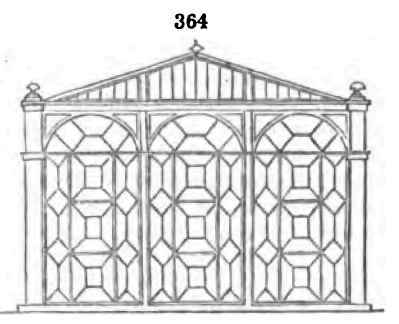
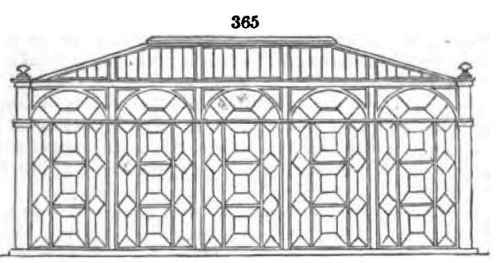
534. A small green-house, with ornamental glass, is shown in figs. 363. to 365. This house, which partakes of the nature of a plant cabinet, but is not attached to the dwelling-house, is not provided with any means of heating; and it is placed so as to shut out a disagreeable view from the drawing-room windows of a town or suburban dwelling; from which windows it is easily entered across a small paved court. As the object is to prevent any external objects being seen through the glased sides of the green-house, they are filled in with ground and coloured glass, disposed in an ornamental manner, as shown in figs. 364. and 365.; and the stage is also made ornamental, and is diversified with spaces for statues and vases, as indicated in the ground plan, fig, 363.

535. A green-house, with an ornamental stage, and a trellis for climbers. The stage is formed with angular points, so as to form a series of Vandyck, or lozenge-like projections, as shown in fig, 366. The principal feature in this house is the mode of arranging the stages for pots; the fanciful disposition of which has a very agreeable effect from the open space on one side, which is used as a kind of morning room by the ladies of the family, who sit there to work or read. Ornamental climbing plants are trained up the pillars, and along a light trellis in the roof, so as to afford an agreeable shade in the open space; while the angular shape of the stages, and the manner in which they are placed so as to intersect each other, allows ample space for walking between them. In the alcove, at one end of the house are placed a table and chairs, and a small cheffonier, or a set of book-cases.

536. A camellia-house may be used either as a conservatory, or for growing the plants in pots. It does not require any artificial heat, but there may be an air-tube down the centre, communicating with the open air, and furnished with ventilators, so as to admit a constant current of fresh air through the house at pleasure. Vines may be trained over the roof of this house to produce shade; and if this is not done, there must be a canvas on rollers used for that purpose. It must be observed that camellias do not like either too much sunlight, or too much heat; as the first camellias that were introduced were killed by being kept in a hot-house. A very slight protection from severe cold during frosty weather is all they require; but as they flower in winter and early spring, the flowers, especially the white, are frequently injured by the weather, when the plants are growing in the open air.
Continue to:


My Books

