


The Lowell Wire Fencing
Description
This section is from "The Horticulturist, And Journal Of Rural Art And Rural Taste", by P. Barry, A. J. Downing, J. Jay Smith, Peter B. Mead, F. W. Woodward, Henry T. Williams. Also available from Amazon: Horticulturist and Journal of Rural Art and Rural Taste.
The Lowell Wire Fencing
This fencing, manufactured by J. E. Butts & Co., Boston, Mass., we are disposed to think, would be found very useful in many places where it is unknown. The proprietors say: - Our Wire Fencing, represented by the within diagrams, for economy, strength, closeness, portability, elegance, and durability, may challenge competition with any fencing in the world.
Figure 1 is a diagram of a section of our fencing, with the roll from which it is unrolled. The posts are of wood, set from eight to twelve feet apart; but they may be of iron, or stone; or trees may be used in lieu of posts, where convenient. Rails are entirely dispensed with. The fence is raised from 4 to 12 inches from the ground, and is drawn straight and tight, or kept upon an exact level, or regular inclination, from end to end. Care is required to put it up substantially and neatly. Staples about three inches in length secure the fence to the posts; each lateral (or horizontal) wire being clasped with a staple at every post. But bolts, or screws with hooked heads, or wire twisted round the posts, answers every purpose. There are several descriptions of this fencing.
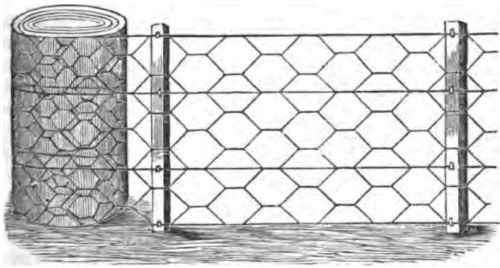
Fig. l.
No. 1 is 3 1/4 feet high, with meshes (or open spaces), 3 inches square; 4 lateral wires, of No. 10 wire (one-eighth of an inch in diameter), run through the body of the fence, which is No. 14 or 15 wire; and the weight is 10 lbs., and the price $2 per lineal rod (16 1/2 feet).
No. 2 is precisely like the first kind, except that there are but two lateral or straight wires in it - one at the top, and another at the bottom of the fence. This is 9 lbs., and $1 15 per rod.
No. 3 is 2 3/4 feet high, with meshes 3 inches square; it has three lateral No. 10 wires, with the body work of No, 14 wire. It is 7 1/4 lbs., and $1 50 per rod.
No. i is precisely like the third kind, save that the lateral wire in the middle is omitted. It is 6 3/4 lbs, and $1 37 1/2 per rod. These kinds are the best for cemeteries, gardens, door-yards, heneries, etc.
No. 5 is 16 inches high, with meshes three inches square; there are two (outside) lateral wires of No. 12 wire; the body is of No. 15. It is 4 1/4 lbs. and 75 cents per rod. It is used for ornamental garden work.
No, 6, extra, is 3 3/4 feet high, with meshes 6 inches square; it has four lateral No. 8 wires, with body work of No. 11 wire. It is 10 lbs., and $1 50 per rod. This kind makes the best and most practicable barrier against cattle, around fields, along canals, railroads, etc. Some of the railroad companies have already adopted it. Indeed, it is emphatically a railroad fence.
No. 7 is precisely like the sixth kind, except that the two middle lateral wires are omitted. It is 8 1/2 lbs. and $1 per rod. It is the cheapest sheep fence that can be erected; and, like the second kind, it is admirably adapted for trellis work for grape-Tines and roses, for garden arbors, etc., as seen by second diagram.
The prices given above are those at which we deliver the fence in rolls at the Boston Depot, for cash in all cases; the cost of transportation to be defrayed by the purchaser. A roll contains about twenty-fire rods; and less than one roll will not be sold, unless as a sample.
None of our fence is consigned; but a discount of twenty per cent, on the above prices is made to agents, retailers, and others, giving an order to the extent of $500; and any person or firm, who will make an effort to introduce our fence, can have an agency in anyplace where an exclusive agency is not already established, on application to the proprietors, giving suitable references as to his commercial responsibility. Retailers and agents are expected to advertise. An extensive field for the operation of agents is still open, especially in the West, Our fencing is varnished black with asphalt urn varnish, before leaving the mill; the varnish gives it a beautiful appearance, and protects it from the influence of the weather - from rust. If preserved from oxidization by this varnish, or by paint, or tar, or japanning, or galvanising, the fence will never wear out; but the varnish will require renewing once in every four or five years.
This fence is impassable to all stock; it does not "hold" the wind, and can never be blown down in a gale; no flood will wash it away, since it offers no resistance to the current; it excludes none of the solar rajs, so conducive to vegetation; it does not confine the heat, like board fences and walls, which is prejudicial to crops; it does not occupy and exhaust the soil, like hedges; it requires no repair, save an occasional replenishing of the varnish, and wherever it has been tried, it has given the most unqualified satisfaction. This last fact is attested by many hundred letters now in the hands of the manufacturers, written by scientific and practical farmers in all parts of the Union.
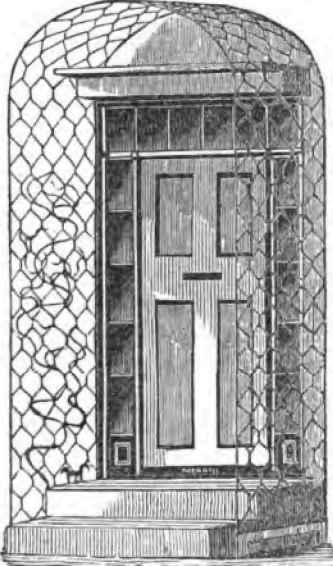
Fig. 2.
Our Window Netting is of various widths from 13 to 28 inches; its meshes are one inch square; it is of No. 17 or 18 wire, and varnished like the fence, and sold (at retail) at seven cents per square foot, being less than one-half the usual price. Fig, 3 represents another kind of this fencing, from sixteen inches to four feet high, with meshes of three inches. The body of this fencing is of No. 25 wire; the price from 75 cents to $1 50 per rod. This fence, in its several varieties, makes an admirable sheep, poultry, and garden fence; that four feet high serves for heneries.
[We should advise that this wire be galvanized, to prevent the necessity of painting or varnishing it every year or two, which would not only be expensive, but difficult when covered with vines. - Ed].
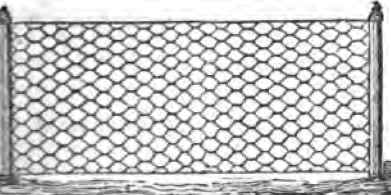
Fig. 3.
The Lowell Wire Fencing #1
Too low in height, too expensive for farming, and too frail for street fencing in the towns. Within the outer inclosure, they are sufficient, and quite ornamental. For economy, and good appearance, in that way, and for screens to run vines and climbing plants upon, I hope they will be adopted. Jeffreys.
Continue to:


My Books

