


Pears (4)
Description
This section is from "The Horticulturist, And Journal Of Rural Art And Rural Taste", by P. Barry, A. J. Downing, J. Jay Smith, Peter B. Mead, F. W. Woodward, Henry T. Williams. Also available from Amazon: Horticulturist and Journal of Rural Art and Rural Taste.
Pears (4)
The old Pear trees are pretty nearly used up; many of them entirely dead, and many more no better. Their almost leafless branches show conclusively that henceforth they will only be cumberers of the ground. Younger trees are doing better, and give some hopes of renewed fertility.
"How have the dwarfs stood it?" Ours are all alive, but not unscathed, for, in common with young standard trees, they have suffered more from blight the present summer, than in all the previous period of their existence; and what is worse, this blight continues to show itself. We are careful to remove all infected branches as soon as the disease develops itself, and keep the trees as free as possible from all appearance of its progression.
Pears #1
It must be remembered that few if any of our early pears ripen well if left on the tree. As soon as they will detach freely from the tree, at the base or junction of stem and tree, by raising them slightly, they should be gathered and laid away in dark shallow drawers and between layers of flannel. Two or three days will usually bring out their highest colors and mature their juices to the greatest perfection. -Metcalf's Early Strawberry, we notice, has been pronounced a failure in Southern Illinois, as not specially early.
Pears #2
The "Clapp's Favorite" was commended by Mr. Barry, of New York. He had found them fine a week after picking. They were sound - not vinous nor buttery, but melting.
Mr. Smith, of New York, called this fruit first-rate. Mr. Elliott coincided.
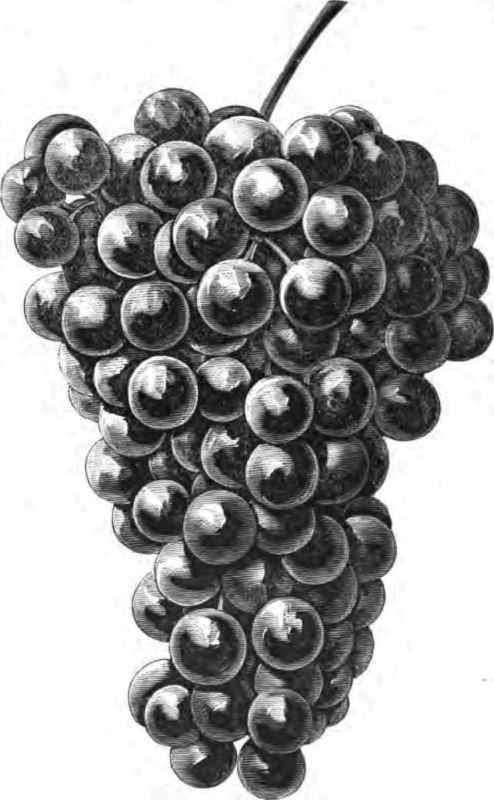
Fig. 171. - Cynthiana.
The President pronounced it the largest and handsomest early pear, productive, and lacking in nothing for a first-class pear.
The habit of the tree is excellent. It bears ten days earlier than the Bartlett.
Mr. Parry, of New Jersey, said it ripens in New Jersey two weeks earlier than the Bartlett, and is their best pear.
The "Edmunds" Mr. Barry called excellent at Rochester, New York. It was of a delicate straw color. Messrs. Wilder and Bronson also praised it.
The "Howell" was generally approved, and appeared successful everywhere.
The "Superfin" was commended on all hands as of first quality.
The "Sterling" was eulogized as handsome, sound, a good market fruit, but of moderate quality.
The "Beurre Diel" cracked badly in some places, though delicious in quality.
Dr. Warder said that his tree of this kind shed its foliage - which was worse than the cracking - and also cracked badly three years out of four.
The President said that in his orchards it uniformly shed its foliage and cracked.
Mr. Heaver, O., said that with him it never did either, but was an entire success!
In New York, Mr. Hoag found it generally shedding its leaves and the fruit cracking.
The "Beurre d'Anjou" won the praise of Messrs. Colman, Missouri, and Hoag and Bronson, New York.
President Wilder said it was, of course, his great favorite. It was known that he was its introducer, having imported it from Europe. His crop of it was one hundred bushels a year, and the marketmen engaged it of him beforehand. It bears abundantly; every pear is a good one, and will keep till January.
Several others joined in applauding this pear.
The "Sheldon" was commended by Messrs. Hooker, Bronson, and the President, and warmly praised as "tip-top" by Messrs. Trowbridge, Manning, and others.
The "Clairgeau" was much extolled on all hands for beauty, size, and flavor, and called early at Hermann.
The "Tyson" was held a success in the West, the tree being very good, fruit early, delicious, hangs well to the tree, and is abundant. The tree is often from seven to ten years coming into bearing, and slowness in this respect is a characteristic of it
The "Onondaga" was fine in St. Louis County, in Ohio, in Connecticut, and especially at Pittsburg and Cincinnati. An excellent market pear.
The "Easter Beurre" was No. 1 at Alton, and with care succeeds generally. It failed in Massachusetts. It needs a long season.
The "Lawrence" was pronounced good at Cincinnati, in New York, at Alton, in New Jersev, and in Massachusetts.
The "Winter Nellis" was reported small but excellent, ripening both early and late, in November and in April.
The "Flemish Beauty" appeared fine in Iowa, Ohio, Wisconsin, and Northern Illinois, and at Syracuse, N. Y., was regarded as the best pear. In some places the fruit rots at the core and drops. In Southern Illinois it loses its foliage too soon, and fails. Best and most profitable in Northern Indiana.
Mr. Heaver thought these differences due to varieties in soil.
Members represented it as good in both sandy and clayey soils, and sometimes bad in clayey. The President said that atmospheric changes and influences, beyond control, greatly affect the pear.
The "Vicar of Winkfield" received a bad reputation. It was the worst pear Dr. Claggett knew of. Mr. Husman thought it as good as a turnip. Some one remembered that it had been called the very best for baking! The President smilingly esteemed it for cooking, and said it required careful culture.
The President said that he had to present upon this subject the consolidated wisdom of the Massachusetts Agricultural Club, which had been in existence for twenty years. That Club had unanimously agreed upon recommending the following list of best pears for cultivation in that State:
Standards - Bartlett, Seckel, Urbaniste, Merriam, Sheldon, Beurre d'Anjou.
Second Series - Brandywine, Doyenne, Boussock, Beurre Bosc, Onondaga, Howell, Lawrence.
Third Series - Belle Lucrative, Paradise d'Automne, Beurre Superfin, Marie Louise, Beurre Clargeau, Vicar of Winkfield.
Cherries received but a few remarks, bringing out no new points worthy of mention, while peaches and apples were, from want of time, entirely omitted. Mr. Nelson, of Indiana, however, introduced the following, which were adopted:
Whereas the time left to this Convention for the discussion of the merits of the apple is entirely inadequate to do justice to this great staple and most important of all fruits; therefore Resolved, That growers of that fruit be requested to communicate with the General Fruit Committee in regard to the value and adaptation of different varieties to the different soils and climates, as well as the diseases of the fruit and the tree; and that said Committee may communicate the same to the Society at such time and in such manner as they shall deem expedient.
To this we now add that the Secretary at Cleveland, O., has made arrangements for the transmission, of sample fruits for comparison, or to receive names to his address free of charge, and those who have new varieties, or those of which the names are unknown, are invited to forward him samples.
Continue to:


My Books

