


Pears (9)
Description
This section is from "The Horticulturist, And Journal Of Rural Art And Rural Taste", by P. Barry, A. J. Downing, J. Jay Smith, Peter B. Mead, F. W. Woodward, Henry T. Williams. Also available from Amazon: Horticulturist and Journal of Rural Art and Rural Taste.
Pears (9)
While the general complaint, during the past summer and fall, was of severe drouth, all around us we were over-supplied with rain, having had a very wet season. The ground on which our specimen trees are located, is rather low and flat, consequently they have had an undue quantity of moisture, during the whole season, on account of which the fruit on the trees were similarly affected; that is, they contained a superabundance of juice, and were not so fine in quality. This we easily detected in the well-known fruits, such as Bartlett, Louise Bonne, etc.; and the new fruits, as well as nearly all others, partook of the same malady. (1) Therefore our specimens of fruits, although well grown and handsome in appearance, did not come up to their usual excellence; and the quality in 1853, would not compare, generally, with that of the same fruits in 1852. Some allowance, therefore, ought necessarily to be made for those described from their fruiting the past season only.
I will now notice some few misnomers in the trees received from Europe in 1850, and which have been tested for the past three years. They came from the nursery of Mr. Andre Leroy:
Beurre d'Anjou has proved to be the Brown Beurre.
Beurre d'Anjou Gris is identical with the above.
Doyenne d'Ete has borne nothing but fine Dutchess de Bervi.
Belle de Brusselles has proved to be much coarser, and far inferior to that variety, but not identified.
We had twelve trees of each of the above described fruits, each and all proving to be wrong, as stated size, shape, color, quality, and season, and without any hesitation we pronounce it, as well as Seigneur d'Esperin, the same as Belle Lucrative.
Beurre Lucrative is identical with the above.
De La Vault
This Pear never fruited until this season. We cut the first specimen September 6th, and upon tasting the same we were delighted, proclaiming it equal to the Bartlett. Its great similarity caused us to examine the tree minutely; and after tasting another specimen, we came to the unanimous conclusion that it was the Bart-letty and nothing else.
Lee Nonnee
This fruit we received from the same source, and came to us labelled Lee Nones. We found the name in Mr. Leroy's catalogue, among those of his lowest priced Pears. When he issued his next catalogue it was spelled Lee Nonnee, and placed in a list of. his Pears quoted at double the former price, but still without a description. Mr. Leroy, in his correspondence with us, says, "We have no trees of this kind, at present, in our collection, except one in our school of fruits, which has never, as yet, fruited in our nurseries, and we owe our knowledge of its merits to your notice of it We pronounce this Pear of the very highest excellence, combining the high flavor of the Seckel, with the delicious, melting qualities of the Belle Lucrative. Fruit - medium size, regularly turbinate. Skin - smooth, fine, clear, light yellow, covered with numerous small, brown dots. Stalk - from one and a half to two inches long, slender, inserted in a very slight depression. Calyx - small, closed and placed in a small, shallow basin. Flesh - whitish, very juicy, sweet, melting and delicious, with an exquisitely fine rich flavor and perfume. Ripens from the 10th to the last of September. The tree is a luxuriant grower, forming a handsome pyramid on the Quince, and an abundant bearer.
The fruit is uniform in both size and appearance.
Beurre Charron
This is another fruit received from Andre Leroy, and like the Lee Nonnes, came unheralded and unknown. The only notice we have had of it is in Mr. Leroy's catalogue, where it is entered under the head of "New species obtained at Angers," but without description, while about twenty others, in the same list, are particularly described. This is quite unlike the Lee Nonnes, in flavor, but nearly or quite equal to it in quality. Fruit - medium in size. Form - roundish-obovate. Skin - yellowish-green. Stalk - three-fourths of an inch long, set on without depression. Calyx - closed, and placed in a deep, and rather broad basin. Flesh - exceedingly melting, juicy, and perfumed, more like the Belle Lucrative, in its highest excellence, in these particulars, than any Pear we know. Ripens about the 10th of October. It grows well on the Quince.
Doyenne Defais
Fruit - above medium. Skin - yellow, with a fine red cheek. Stalk - about one inch, and inserted in a deep cavity. Calyx - open, placed in a deep, narrow basin. Flesh - white, fine-grained, very buttery, melting, rich, high flavored, and delicious. Very desirable indeed. Grows finely on the Quince. Season - middle of October.
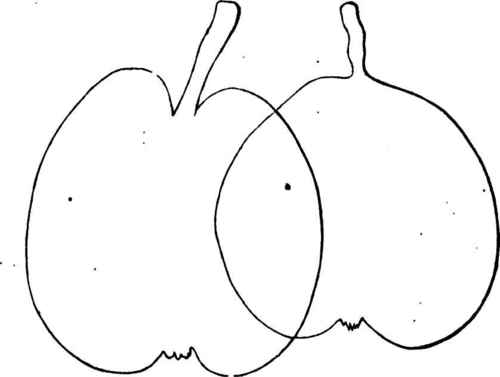
Dotenne defaes. BEURRE CHARRON.
Beurre Biemont
Fruit - medium, obovate, greenish-yellow, with a brown cheek. Stalk - quite obliquely inserted, without depression. Calyx - small, closed, and placed in a shallow cavitvable perfume. An excellent fruit, and promises well. Ripens from 18th to last of October. Grows well on the Quince.
Beurre Superfin
Fruit - large, fine yellow. Stalk - one inch, inserted without depression. Calyx - spreading, in a rather shallow basin. Flesh - yellowish-white, fine grained, buttery, very melting, extremely juicy, with a rich, subacid, vinous flavor Season - October 12th to 20th. A splendid Pear for those who prefer the high vinous characteristic We fully sustain the opinion of Col. Wilder, and hesitate not to call it a first-rate Pear.
Vizouziere
Fruit - small to medium, round. Skin - smooth and yellow. Stalk - an inch and a half long, slender, and deeply inserted. Calyx - open, and placed in a shallow basin. Flesh - very melting, juicy, sweet, agreeable, but with little or no perfume. Ripens latter part of September. This has fruited with us this season for the first time, and needs further trial. Grows well on Quince.
Continue to:


My Books

