


Pears (8)
Description
This section is from "The Horticulturist, And Journal Of Rural Art And Rural Taste", by P. Barry, A. J. Downing, J. Jay Smith, Peter B. Mead, F. W. Woodward, Henry T. Williams. Also available from Amazon: Horticulturist and Journal of Rural Art and Rural Taste.
Pears (8)
We present the readers of the Horticulturist with outlines of some new French Pears with high-sounding names, from a valued correspondent in Belgium; but we do so with a caution attached. It may save our friends from imposition.
No. 1, General De Lourmel
Large, round; dark green, spotted and waved with dull red and brown. Seedling, 1847; produced in 1853 - good quality. November. Cornice of Angers.
No. 2, Gintral Bosquet (Flon Grolleau)
Light green; slightly spotted with red. End of September. Second quality. Seedling, 1845; production 1853.
No. 3, Marichal Pellisier (Flon, Aine)
Light, olive green, with dull red on the sunny side. End of September. Second quality. Sown in 1845; produced in 1853.
No. 4, Lieutenant Poidevin
Yellowish-green, spotted with red and brown. Seedling of 1845; productive in 1853. Second quality. March to April. (Perhaps the most valuable, being late.) (Flon grolleau.) How pears of second, and only good quality tn September, when we are in the enjoyment of a host of delicious pears, can be admitted in catalogues on the faith of their high-sounding names, and large sizes, seems to us somewhat surprising. They are nearly ail very new, and of course will be unsteady till their standard value be settled or sealed by some years of cultivation. It is possible that some may improve in quality'; but our experience with foreign pears has made us acquainted with a circumstance which leaves us little hope of such a result. Pears of second quality, or deficient in high, juicy, buttery, and sugary characters, in their native transatlantic countries, are uniformly of third quality in this climate; while rich and generous fruits, as the Lucrative, Flemish Beauty, Beurre D'Anjou, etc. etc., are perhaps better, or, at least, as delicate and rich here as in England or Belgium - as good as in the South of France.
New Pears #1
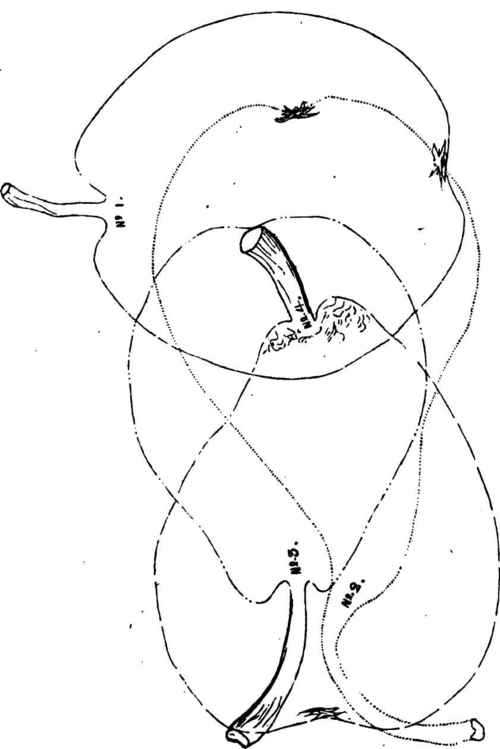
No. 1. General de Lourmel. No. 8. Marechal Pellssier.
No. 2. General Bosquet. No. 4. Lieutenant Poidevin.
We would not deter our amateurs from giving these, and all new varieties, ft fair test; on the contrary, we hare room and means enough, in our extensive land, to allow ns to make trials on large scales, in all kinds of soils, localities, and climates. If only one new variety out of a score, proves to be as valuable as the Beurre D'Anjoui for instance, we shall have lost neither our time nor our money. Meanwhile, let us sow and depend upon our native varieties a great deal more than upon immigrants of as uncertain character, and of doubtful adaptedness to our climate. Let us sow, gentlemen 1 When nature has done so much for us as to give as, in stray seedlings, such pears as the Dix, the Tyson, the Kingsessiog, and so many others, what may not be the result of our combined efforts to help that, bountiful mother, Nature '?
Continue to:


My Books

