


Plans For Green-Houses
Description
This section is from "The Horticulturist, And Journal Of Rural Art And Rural Taste", by P. Barry, A. J. Downing, J. Jay Smith, Peter B. Mead, F. W. Woodward, Henry T. Williams. Also available from Amazon: Horticulturist and Journal of Rural Art and Rural Taste.
Plans For Green-Houses
In giving my plans for an improvement in green-houses, I will first remark that the object is to improve the interior of such buildings, by doing away, in some instances, with the long and heavy-looking stages, and introducing something more light and elegant in appearance. You will see by the diagrams that the object is to group all the plants on circular and revolving stages, being so constructed that all the pots are hid from view. The object in this revolving stage is to give to all the plants an equal portion of sun and light. In fact, the plants on these stages will "know no East, no West, no North, no South;" being under the control of the operator, they can in an instant be changed at pleasure.
Fig. 1 is a span-roof house, that in some cases might be beneficial to commercial gardeners, as it may be placed east and west as well as north and south. This house is sixteen by forty feet in the clear, side walls three feet, height ten feet. B, B, front stages, two feet wide. J, J, walk, three feet wide, all round the house. D, showing the position of a circular stage, six feet in diameter at the base. This house will hold seven of these stages, by setting them so as not to touch. There will be little or no room lost in this system of staging plants, and it will have the advantage of bringing any portion of the plants to the sun when required. When the houses are filled with mixed plants, I think the grouping system would be of advantage, as they do not all require the same treatment the season round. And if ever such stages should be required they can be made very plain: the revolving part of the stage can be placed upon a wooden frame, running round in a cast-iron groove; the shelves can be cast whole, with plain open-work, say three bores to a shelf, leaving the pots in view, as in the present case.
I will now turn to what I call a model green-house (fig. 2). It is a house twenty-seven by forty feet, supposed to be a span-roof house - but I shall say nothing about the building, my remarks being confined to the fitting up of the interior. a, a, a, a, to receive the cast-iron cylinder, 2; this is of ornamental cast-iron, the pattern to be flowers and foliage - height, two feet six inches. 3, a moulding; over that, eight inches of ornamental work, of another style, to hide the first row of pots on the stage. About sixteen inches from the top of the cylinder, on the inside, is a strong flange, two or three inches wide, intended to carry the stage. 4, cross section, that supports the bearers. 5, rollers. 6, a straight piece of square iron, to receive the top, 7 ; the bearers passing in at 8, and secured with bolts at 9. The shelving to be cast a little hollowing, rising in the front about eight inches, to correspond with the ornamental work on the top of the cylinder, which rises in the back two inches.
An inch or two of fine sand, put on the shelves for the double purpose of taking up the drip from the pots, and absorbing it again in the house. g, cast-iron pipe, to act as the chimney, the upper part to correspond in workmanship with the stages. h, stage, eight feet in diameter; this can be made to revolve by attaching the bearers to a strong bolt round the chimney, i, cistern; the water to be conveyed under ground; the top of the cistern to be under the floor of the house. /, pump, also to be hid, by an ornamental shaft, not less than four feet high without the vase, to be cast round, square, or octagon (I suppose it ought to be round, to be in keeping with the stages). The spout of the pump screws on, and the handle is made to take off at pleasure. When the pump is not in use it is shut up in this column, by means of two movable panels. e, monumental shafts, or columns, varying in height, similar to the one above. b, stages, to correspond with the above, but of course stationary. c, corners, to group large plants or stages, as may be required. n, border, one foot wide, running all round the house, about two feet six inches deep, to be well drained and filled with suitable compost, for creepers to run up the rafters. k, four-inch brick wall; holes to be left in the first course of bricks, as an escape for the drainage from the border. m, a wall like k, without the openings. l, this place receives the heating apparatus, being two feet six inches wide in the clear. d, d, door, four feet wide.
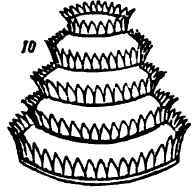
The whole of the floor to be covered with a neat cast-iron grating, to be cast in panels, to be taken up at pleasure. An ornamental flange runs all round the house, separating the border from the floor; the four stages, 10, to be finished with vases. Brackets may spring from the pilasters, or between the rafters, bearing an acorn cup or Magnolia flower, to receive a pot with some pendulous plant. All the vases for plants of that nature swinging from the roof in convenient places, ornamental baskets of iron filled with the same plants, a few neat iron chairs placed on the' floor in convenient places, to be bronzed. There is in this house a little over six hundred feet of staging, running measure. This house would be well adapted for a first class place, where a supply of plants in season could be supplied. As this is the iron age as well as the progressive, suppose both were applied to the beautifying of the buildings dedicated to Flora.
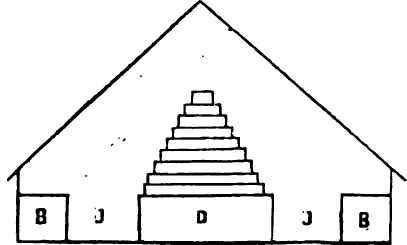
Fig. 1.
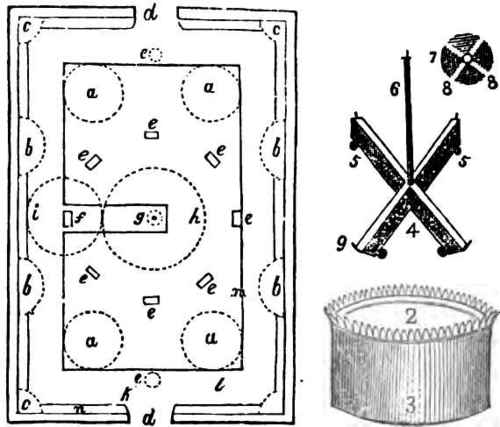
Fig. 2.
Continue to:


My Books

