


Plan of An Orchideous House
Description
This section is from "The Horticulturist, And Journal Of Rural Art And Rural Taste", by P. Barry, A. J. Downing, J. Jay Smith, Peter B. Mead, F. W. Woodward, Henry T. Williams. Also available from Amazon: Horticulturist and Journal of Rural Art and Rural Taste.
Plan of An Orchideous House
There are few tribes of plants so deserving the attention of amateurs as the Epiphytal species of Orchideae ; they are rich in every variety of color; some replete with aromatic perfumes, others emitting the most refreshing and delicate odors. Their flowers are mostly large, showy, and fantastic but all are interesting for their curious forms. They are of easy culture, bearing an incredible degree of heat or cold if applied at the proper season, and with due care is there one that ever saw those beautiful Cattleyas, elegant Oncidiums, curious Phalaenopsis, or showy Stanhopeas, but would wish to grace their collections with them? yet, strange to think, notwithstanding their many commendable qualities, how seldom even a solitary specimen is met with; this may be attributed to the fact that a specimen once procured and submitted to the treatment of a general collection, will soon cease to exist. It should not be inferred from such failures that they are more difficult to cultivate than other plants, but it illustrates the fallacious notion which many entertain, that plants from all parts of the globe must do equally well in one house.
To such an admixture the subject of this notice forms a grand exception; for to grow Orchideae to perfection, they must have a house of their own, so arranged as to imitate as near as possible the seasons and atmosphere of their natural climate, as much anxiety and expense is obviated by a proper beginning.
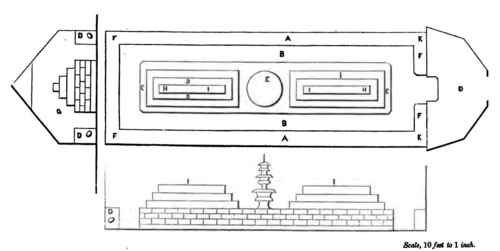
PLAN OF AN ORCHIDEOUs HOUSE.
I send the above plan and arrangement of a house which I found suited to their wants, for the benefit of those interested. It is a combination on a small scale of the best houses in England, by the author of "Centuary of Orchide," etc.
A, A, side shelves for plants, with tank and return pipe underneath; B, B, walks; C, C, plant stage; D, anteroom; E, fountain and aquarium; F, F, F, F, under the shelves are apartments for creepers. The stage is comprised of seven shelves, three on the sides and ends and one in the centre, sunk in pans half an inch deep in Yorkshire white flags; these pans are filled with clean round gravel, on which the pots are placed; when evaporation is required, the whole stage and walks, if needed, can be ingeniously overflowed in a few minutes from a tank on the roof of a garden shed which runs at right angles to the house at the end, G. This tank is supplied by a force-pump from a supply cistern, filled with rain water from the surrounding buildings; a pipe is carried from the tank, under the walk, and through the vault (under the arched shelves) to the fountain, with a tap at a convenient point, which turned at leisure, throws a constant stream and gives a genial and pleasant atmosphere; there is an overflow carrying the surplus water back again to the supply cistern.
There is also a brass stopper, fitted in the bottom of the pond, connected with a drain to carry off the water when necessary. Another pipe is brought from the tank, and under the walk is carried through the mason work and centre of the stage at H, and neatly laid along the centre of the pan, (the centre of this pan must be sufficiently deep that the pipe will not appear above the level of the shelf,) to I, the stage being divided by the pond. The pipe is here bent down and carried under the shelves, rises again at J, and is continued to the end. The holes in the pans must be cemented to prevent the escape of water; the pipe is perforated at twelve or fifteen inches apart, with a tap in a convenient place. The centre shelf must be water level; so must 2 and 2. etc, be on the same level; then the water flows equally to both sides. The side shelves are also of flag, with cast iron facing, supported by inch-thick iron bars, and made water tight with Roman cement. These are also covered with gravel, and can be watered with equal facility by branch-pipes from that which waters the stage.
At K, K, is a brass stopper to draw off the water when needed. Directly under those stoppers are hollow flags, with circular openings and drains connecting with that from the pond, which answer the double purpose of carrying off the surplus water from the shelves and from the walks when washing is needed. The walks are finished with Yorkshire flags; the side walls are five feet six inches high, having no upright glass; the sashes are single lights, and are fixed; (that is an objection which should be avoided, the tops should open in hot weather;) the ventilators are built in the side walls, one under each sash; there is also a ventilator in each gable end; the only entrance is through the anteroom (this is only necessary for a detached house); it serves to prevent a rush of cold air as well as prolong the period of blooming by changing from a moist to a drier atmosphere; the flooring is the same as in the house, and a shelf around it, with brass swivels from the ceiling for hanging plants; there are four large windows, one on each side, hung in the ordinary way. The house has an east and west aspect; this, I believe, a great desideratum for all plant-houses, as the sun will have less power at noon, they being naturally shade-loving plants.
A steep roof, fluted glass, and a judicious selection of creepers, will obviate much difficulty on this point.
Continue to:


My Books

