


Plan Of Hunting Park, Between The Built Part Of Philadelphia And Germantown
Description
This section is from "The Horticulturist, And Journal Of Rural Art And Rural Taste", by P. Barry, A. J. Downing, J. Jay Smith, Peter B. Mead, F. W. Woodward, Henry T. Williams. Also available from Amazon: Horticulturist and Journal of Rural Art and Rural Taste.
Plan Of Hunting Park, Between The Built Part Of Philadelphia And Germantown
To J. Jay Smith, Esq., - In fulfilment of a promise made you some time ago, I now hand you the design for the improvement of the Hunting Park, of Philadelphia, submitted by me in the fall of 1856. In order that the appropriateness of the design may be better understood, I will briefly describe the ground:
Hunting Park is about forty-six acres in extent, of an awkward, irregular outline; surface so flat that the level does not vary more than six feet throughout the whole extent; and, with the exception of about a dozen large hickories and oaks, was wholly destitute of trees or bushes, and so low, with reference to the surrounding country, that no distant views are obtained.
I have purposely omitted all references in the plan, and I may further add that the present engraving has been executed from a very imperfect photograph, which accounts for the indistinctness of many of the points, more particularly the entrance-gates, keepers' house, pavilions, summer house, fountains, etc. I have also materially abridged the description which accompanied the design, as it would be too lengthy for your pages.
W.S. Plan of Hunting Park.
"To ascertain principles of action, it is necessary first to consider the end in view".
The object of a city park is chiefly to afford the inhabitants means and facilities for healthful recreation. It should, therefore, be provided with ample shaded walks, rendered interesting by the arrangement of natural scenery, and such works of art as are in keeping with the locality.
This park, commanding no distant views, and not having within itself any striking features, it is evident that "variety and interest" must be accomplished wholly by the grouping of trees and shrubbery. Bold or striking architectural features, while they are unnecessary, would also be out of keeping with the situation. All necessary buildings should, therefore, be simple and expressive in design, altogether free from any approach to ostentatious display.
Hunting Park is too limited in extent for the formation of a distinct "Arboretum." This is not, however, much to be regretted, as the planting may be so varied as to embrace all hardy and useful trees; the same reason may be adduced in reference to a "Botanical Garden." Indeed, under any circumstances, it is questionable whether a garden of this description is fitted for a public park, under city government. These institutions, to be of real usefulness, must be accompanied with lectures on botany, etc, controlled by an efficient professional government. A mere botanical collection of plants, without these applied accessories, would be about as instructive to botanical students as a mere display of chemical apparatus would tend to the study of applied chemistry.
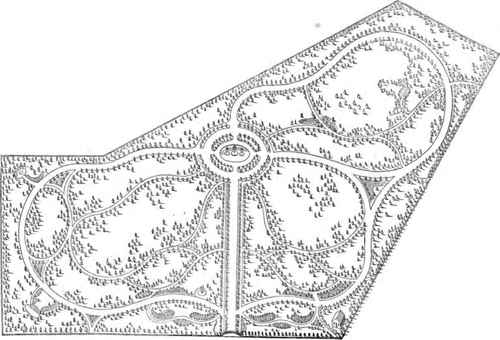
PLAN OF HUNTING PARK, PHILADELPHIA.
Designed And Laid Out By William Saubers.
I have no't adhered strictly to any particular style of landscape architecture. The geometric has been maintained so far as to embody a straight broad avenue, leading to a central feature. . There is, perhaps, no style of planting so well adapted for city parks as that which secures a sufficiency of broad promenades. In small pleasure grounds, intricacy and variety is secured by planting thick masses of shrubbery. For various reasons, dense masses of growth and thickets are not desirable in a public park. This plan may be classed as a near approach to what Downing happily termed the "Graceful," and Loudon the "Gardenesque " style of landscape gardening, as distinguished from the "Picturesque;" but no exact line of definition can be drawn between the two modes of planting. While, therefore, every opportunity will be taken to show the full development of individual trees, the effects produced by combination in irregular groupings, and the assemblage of variously formed and colored foliage will also be secured.
To the citizen contemplating landscape improvements, and to all desirous of studying the various forms and habits of trees, either as individual specimens for particular purposes, or the various combinations which they form in connection, this would be a place of useful and interesting resort. To further this object, as well as to excite general interest in trees, I propose that specimens of all hardy trees and shrubs, native and foreign, be appropriately introduced, so that the whole Park may be looked upon as serving the purpose of an arboretum; one, too, of a most useful character, and much more interesting than arboretums usually are. In my detailed plans and lists of trees for planting, I have kept this feature of a complete arboretum constantly and prominently in view.
I have not attempted to produce intricacy by an arrangement of tortuous or abrupt curving walks, but the various groups will be planted sufficiently thick, and intermixed with appropriate undergrowing plants, so as to produce a fresh change of scenery at every step, and thus avoid tameness of expression.
In planting parks of this description, the all-important object of shade must to a certain extent modify any style that may be adopted. I have shaded the roads and walks almost continuously on the south and west sides, taking every advantage to prevent monotony in the planting. The smaller walks are shaded with the Norway, sycamore and sugar maples, horse chestnuts, Lindens, and similar round-headed trees, and where one variety of tree is commenced on a continuous line, it should be continued until a change of scenery or branching of the walks gives a reason for changing the character of the trees. The same general principle should also characterize the groupings.
At various points where walks cross or take a similar course near each other, masses of low growing shrubbery have been introduced. These should be planted rather thickly, in ground previously well trenched and manured, so that a mixture of luxuriant foliage may be produced. If called upon, I will submit my ideas as to the individual arrangement necessary to produce the best effects in this species of planting.
The straight entrance avenue is 40 feet wide; on each side,in the centre of a border of grass 10 feet in width, is a row of the tulip tree (Liriodendron tulipifera). This tree is selected for this position on account of its peculiar fitness. It forms a tree of majestic proportions; trunk straight and columnar; foliage large, ample, and of rich green color; healthy, and free from the attacks of insects. It is also peculiarly American in its general character, and distinct from any other tree. Parallel to the tulip tree, is shown a row of the Red Maple (Acer Rubrum), selected on account of its various-colored foliage at various seasons - in spring full of scarlet flowers; foliage rich green during summer, changing to a bright scarlet color in the fall, in beautiful contrast with the yellowish color of the tulip at that season. These trees are both of average rapidity of growth.
A carriage drive, 30 feet wide, courses round the park. These roads all meet at the centre. The central portion may be reserved for a fountain, encircled with weeping willows, whose drooping branches will enter into pleasing contrast with the pointed growth of the tulip trees, which will be continued on the outside of the oval broad carriage way.
The space included between the carriage road and the boundary line of the park is to be wholly planted with evergreen trees. The evergreen planting will, at certain marked points, extend further into the interior of the park, but they are in connection with the marginal plantings, and kept as a distinct feature from the deciduous trees; on no account are they to be extensively intermixed, but blended into each other by trees of intermediate character, as the Carolina Cypress and larches; this will produce a pleasing effect during winter, when the deciduous trees are leafless: shelter the grounds from the rude blasts of early spring, and impart an "expression" which is never attained by an indiscriminate mixture of deciduous and evergreen trees.
A few of the more important effects to be realized may now be noticed or recapitulated:
1. To form distinct groups of the various species of trees and their varieties, such as the oaks, ashes, maples, etc, and arranging them with reference to their habit of growth, so that the individual groups may form distinct compositions.
2. Planting evergreens with a view of forming a distinct winter scenery, principally effected by keeping them apart from deciduous trees, and arranging them with reference to growth and color of foliage.
3. Gradually to blend the evergreen and deciduous plantings into a pleasing connection, by using trees partaking of the conical form of the former, as the larch, and meeting them with single specimens of handsome trees of both kinds, such as the hemlock on the one hand, and the Norway maple on the other.
4. Placing trees of rare character so that they will be conspicuous and command attention, by planting them in isolated positions where they can readily be inspected from the walks.
5. Planting with reference to the development of individual as well as combined beauty; the former by placing single specimens in prominent situations, the latter by contrasting foliage alone, or the general outline and habit of growth.
6. Giving depth to limited views, by forming curving outlines, and planting the convexities with trees of light colored foliage, and the recesses with heavy, or dark foliage, as the horse chesnut and purple beech.
7. Preserving a pleasing sky outline to all distinct groups, by introducing into the centre such as the Lombardy poplar, and filling up the margins by suitable undergrowth.
8. With reference to producing effect from the coloring of foliage in autumn, principally the dogwood, oaks, hickories, sweet and sour gums, sassafras, maples and tulip trees.
9. To plant the outlines of various groups with early spring flowering' trees, in order to produce a cheerful effect, such plants as the Judas tree, dogwood, chionanthus, flowering thorns, laburnum, magnolias, etc.
10. To imitate the pleasing variety of stems in natural scenery, by planting at irregular distances apart, some quite close, to form an appearance of two or more stems proceeding from one root; a pleasing variety will follow such treatment.
Continue to:


My Books

