


Plan Of Grounds
Description
This section is from "The Horticulturist, And Journal Of Rural Art And Rural Taste", by P. Barry, A. J. Downing, J. Jay Smith, Peter B. Mead, F. W. Woodward, Henry T. Williams. Also available from Amazon: Horticulturist and Journal of Rural Art and Rural Taste.
Plan Of Grounds
The following excellent plan of a rus in urbe garden and grounds, has been forwarded by one of our valued friends, who has described it, in a familiar letter so well as to leave ns nothing to do but copy his own remarks, which he will pardon, as, at his own request, he withholds his name. He remarks: -
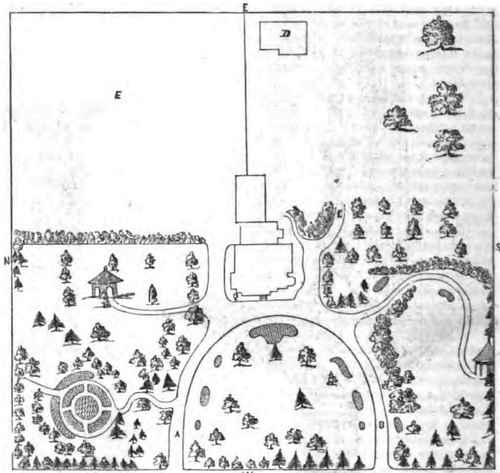
" In describing it, I would say that the grounds between the dwelling and street, should have been represented one-fourth longer, the land being a parallelogram, and two acres in extent. A is the main walk, leading from the street to the house. B, the carriage-road. C, road leading to the back yard and stable at D. E is the kitchen garden. This garden is sheltered by a screen of Privet on the west side, and a high, tight fence on the north. The ground in front of the house is sheltered by a screen composed chiefly of evergreens. This was done partly on the score of taste, and partly for the protection to be secured in winter. The trees used for this purpose are the White, Austrian, and Scotch Pines, American Arbor Vitae, Hemlock, Norway Spruce, and American Black Spruce. The screen between the two gates in front, is made of Norway Spruce. A portion of this is kept pruned low, in order to preserve a fine view from the piazza and parlor. On the north side of the mam walk, a path leads to a flower garden, chiefly of herbaceous perennials, dahlias, and annuals. This is surrounded by-shrubs and low trees, and is concealed from the street, and the other walks within the premises.
In the group of evergreens directly south, is a rustic seat, from which to enjoy the gar-den. The effect of this gay scene to one -coming upon it unexpectedly from the main walk, is quite striking. The lawn in front of the house has beds cut in the turf for herbaceous perenpials, perpetual roses, and various bedding plants. The trees are so arranged hers as to preserve a fine view of a broad ralley, a hillside and a distinguished literary institution. The prospect, tn other directions, being indifferent, and the winter winds very strong, the trees have been left to grow as they listed.
"There is a grass terrace on three sides of the house. On the northwest corner of this stands a vase; on the south side are beds of early flowering plants. Directly north of the house is a small collection of standard pear-trees; on the south side is a collection of dwarfs. These and the rear premises, are screened from the front view by a plantation of evergreens and low trees. A walk leads from the dwelling to a summer house, built around the trunk of a huge dm, standing near the south line of the premises. By the side of this walk are two oral beds of choice roses. This part of the grounds is secluded from the rest by low trees. Thus there are three distinct scenes in the pleasure grounds.
"There are the following somewhat rare ornamental trees on the premises: Virgilia lutva, Purple Sycamore, Japan Maidenhair tree, Kentucky Coffee, Deciduous Oypress, Tulip-tree, Magnolia acumiz ata, New American Weeping Willow, Weeping Linden, Weeping Purple Beech, European Weeping Ash, Caperdown Weeping Elm, Huntingdon, Cornish, Dutch Cork-Barked, English Cork-Barked, and Purple-Leaved Elm; Pinus Exoelea and P. Cembra; Siberian Arbor Vita, Picea jnchta, Abies Menzimi, Swedish Juniper, and English Yew.
"This is as far as I have yet attained. I shall probably modify the plan from year to year as I learn more. But this, as it now is, affords me great satisfaction, and strikes favorably many who visit it Perhaps it may famish some hints to others, imperfect as it is. The summer house is covered with honeysuckles and climbing roses *, the pillars to the piazza of my house, with Scarlet Monthly Honeysuckle and American Iry; and the south summer house with the same Ivy running up into the Elm which arches over it. The Elms in front of the house are trained high, so as to preserve the view under their branches, and the other trees are shrubs (Hibernice!), or low trees, kept low.
"But I must stop, or I shall soon be bringing my wife and children into the description".
Continue to:


My Books

