


Propagation Of Plants By Cuttings
Description
This section is from "The Horticulturist, And Journal Of Rural Art And Rural Taste", by P. Barry, A. J. Downing, J. Jay Smith, Peter B. Mead, F. W. Woodward, Henry T. Williams. Also available from Amazon: Horticulturist and Journal of Rural Art and Rural Taste.
Propagation Of Plants By Cuttings
This is one of the most common and universally practised modes of extending plants. A cutting is simply a part of a plant taken off and placed in a position to form roots, and become in all respects a living representation of the original from whence it was taken.
The peculiar constitutional conditions which will render a plant favorable or otherwise for this method of propagation, has not been ascertained, and the subject is well worthy of attention by physiologists. While many plants, such as the willow, will throw out roots from cuttings taken off almost at any state of maturity, there are also many that are difficult to increase by this mode, even under the most favorable circumstances known to cultivators.
Propagation Of Plants By Cuttings #1
It is of the greatest importance that the soil in which the cuttings are inserted should be of such a condition, that while it admits of a free passage of water, an equable and constant degree of moisture will still be maintained. It will often have been observed that in a pot full of cuttings those that are nearest the side of the pot will root soonest. This has been referred to the circumstance that the cuttings so placed are more directly influenced by air, which hastens the rooting process; no doubt there is less retained water at the sides than in the centre of a pot of earth, and in consequence more air. The absorbent material of the pot prevents saturation, the cuttings are there surrounded by a constant degree of moisture suited to their wants, and are less likely to be influenced by the result of unskilful waterings and deficient drainage. When the pots arc thoroughly drained and prepared, and under proper management, the cuttings will root with equal facility over the whole surface.
That the greatest necessity exists for a certain and equable amount of moisture in the soil, is further exemplified by the fact that all cuttings succeed best when planted in pure sand. In it we have a uniform material through which water will percolate freely and rapidly, a constant moisture can be maintained without saturation, provided that the drainage is sufficiently secure to allow free escape to superfluous water.
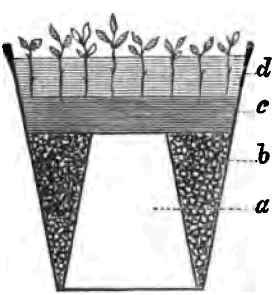
We have, therefore, the reason of the practice generally followed by florists in the propagation of roses and other plants; shallow boxes are prepared by placing a layer of sand two or three inches in depth, over a layer of material for drainage, such as broken charcoal, bricks, or potsherds, the bottom of the box being perforated for the ready egress of water. Delicate or rare cuttings are generally set in pots, and I have always succeeded, even with plants proverbially difficult to propagate, when planted in a pot prepared as shown by the following figure.
A small pot (a) is inverted inside of a larger one, and the space between the two filled with drainage, (b); over the drainage is placed a layer of soil, (c), and this is covered by a layer of sand, (J). This arrangement secures a perfect drainage, the chamber formed by the inverted pot places all the cuttings in equal condition with regard to their contiguity to air, and when the pot is inserted into a hotbed, or otherwise supplied with bottom heat, the heated air pervades the chamber, and has a salutary influence upon the base of the .cuttings.
In arranging these ingredients it is important to press them firmly, and after thoroughly wetting the sand the slips may be inserted in holes formed with a pointed stick, sufficiently large to avoid abrasion of the cutting when planting. When the pot is filled a sprinkling of water will settle the sand closely round the whole.
Continue to:


My Books

