


Propagation Of Plants By Cuttings Of The Green Wood
Description
This section is from "The Horticulturist, And Journal Of Rural Art And Rural Taste", by P. Barry, A. J. Downing, J. Jay Smith, Peter B. Mead, F. W. Woodward, Henry T. Williams. Also available from Amazon: Horticulturist and Journal of Rural Art and Rural Taste.
Propagation Of Plants By Cuttings Of The Green Wood
When propagating from the young growing wood or succulent stems of herbaceous plants, it should be borne in mind that we are operating with an active vegetation instead of one that is dormant.
In the cuttings made from ripe wood there is a supply of organized material from which roots are produced; but in those made from young growing wood, this is only in a state of transmutation, and the object is to accelerate this change, if possible.
To accomplish this, it is generally necessary to surround the cutting with a warm, moist, and somewhat confined atmosphere, so that the exhalation, which is very rapid in an open situation, can be controlled. For if the quantity of moisture given off by the leaves is greater than that absorbed, then they will surely droop, and an artificial application of water to revive them will often hasten their destruction.
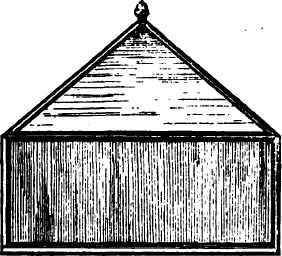
Fig. 105.
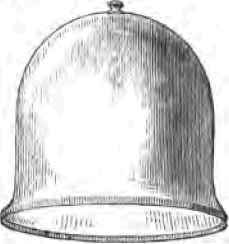
Fig. 106.
Various are the devices employed by propagators to produce that peculiar state of the atmosphere most suitable to the growth of different kinds of plants. Glass is the principal material used in erecting propagating-houses, because it is the most durable, and through it the plants receive light, which is indispensable to growth, while at the same time heat and moisture are under control of the operator.
While the professional gardener depends mainly upon the propagating-house to multiply those plants requiring artificial heat, the amateur produces the same results, although not so extensively, nor with so great a variety of plants, with the aid of the common hot-bed, or with the handglass, fig. 105, or bell-glass, fig. 106. Many kinds of plants can be readily propagated from green cuttings planted in the open ground, if covered with a common hand or bell glass. The soil in which the cuttings are planted should be composed in great part of pure sand, with very little vegetable matter, so that it shall not become sodden or heavy though watered ever so frequently. Some kinds of plants will grow readily from the green cuttings planted in pure sand and water, or in the latter without the addition of any earthy matter. The common oleander, grape, etc., are well-known examples that produce roots quite readily under these conditions, although no very extended growth can take place without the addition of mineral substances. Although water is one of the best materials known in which to strike cuttings, still the great difficulty is in transferring them from it to the soil without checking the growth.
In a confined atmosphere it can be done quite readily, but in an open one it is a very uncertain operation.

Fig. 107.
In preparing green wood cuttings, a large portion of the leaves should be allowed to remain, for the purpose of assisting in the preparation of the material required to produce roots.
In selecting the cuttings, it is generally best to slip them off close to the more mature wood, leaving the hip or ring of half ripened wood attached to its base; for as we stated in the chapter on "Ripe "Wood Cuttings" there is always a concentration of buds at this point, and more available organized matter at this place than elsewhere. A few of the lower leaves may then be removed, as shown in fig. 107.
This slipping off the young shoot is not always practicable, because some plants produce few or no lateral branches; in such cases the terminal shoots are usually selected, although with many kinds the entire stems may be divided into sections leaving only two buds upon each, one being placed below the surface and the other above.
No general rule can be given as to the exact time for separating the cuttings from the parent plan; with some it is better to take them off while the wood is very young, even when it first starts, while with others the wood should be almost mature. In some of the succulent plants, like the cactuses, stapelias, and others of similar structure, they are benefited by being dried somewhat before planting.
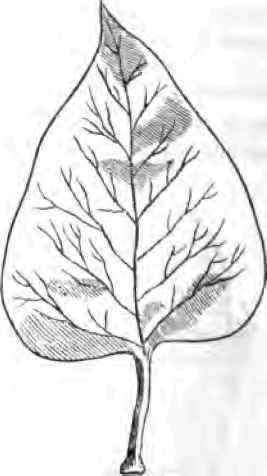
Fig. 108.
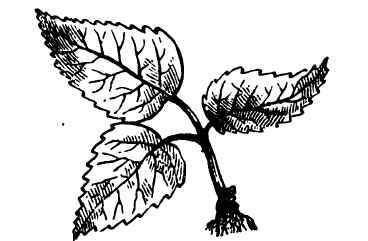
Fig. 109.
All the variations in structure, form of growth, the great difference in tenacity of life in plants, show us that practical experience is required to produce the best results, even by those who may have carefully studied all the theories ever advanced upon the subject.
Cuttings of the rose, currant, willow, and hundreds of other species of plants, grow readily with very ordinary care, either from the green or ripe wood, while the hickories, oaks, and many others are among the most difficult to propagate in this manner; the cause may or may not be known.
Continue to:


My Books

