


Propagation Of Plants By Cuttings. Management Of Cuttings Continued
Description
This section is from "The Horticulturist, And Journal Of Rural Art And Rural Taste", by P. Barry, A. J. Downing, J. Jay Smith, Peter B. Mead, F. W. Woodward, Henry T. Williams. Also available from Amazon: Horticulturist and Journal of Rural Art and Rural Taste.
Propagation Of Plants By Cuttings. Management Of Cuttings Continued
As remarked in a previous number, there is a certain state of maturity in all plants, at which period they can most readily be propagated. Some emit roots from young growths if • simply thrown in a warm, damp atmosphere; others, again, are easily increased from cuttings of matured wood; experiment only can decide the best mode of proceeding with new plants; although certain tribes, as the willow, will sufficiently indicate, by their alliance, the mode of treatment, yet no rule can be formed that will be general, as some individuals of a family may be rapidly propagated, while others are extremely difficult of increase.
The more succulent the cuttings, the more carefully must the agencies of growth be balanced; if subjected to aridity their contained moisture will be evaporated; hence it is necessary that their surrounding atmosphere should be so supplied with moisture as to prevent evaporation. In practice, various expedients may be adopted; close-fitting frames, or houses where extensive propagation is required; and small quantities may be isolated from external changes of atmosphere by covering with glasses; cone-shaped or bell glasses are frequently used in thus protecting cuttings in pots. The same conditions may be secured by placing a flat piece of glass over the mouth of the pot, sufficient space being left for the cuttings between the soil and the glass.
Light in excess is equally injurious, and its results are somewhat similar in effect to those produced by aridity; a slight shading from bright sun is required, just sufficient to prevent the leaves from wilting, gradually removing it as roots are formed.
The necessity of preserving a uniform degree of moisture in the soil has been alluded to. An excess will cause speedy decomposition; if more water is absorbed than the leaves require, they become of a yellowish color, and the base of the cutting will assume a dark and decayed appearance, a sure sign of failure.
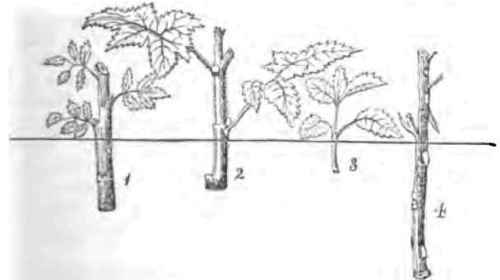
Such are the general principles for our guidance in this method of propagation; but in order to illustrate more clearly the care required with different kinds of cuttings, the accompanying figures are introduced. No. 1 may be considered a representation of a rose cutting made from part of a flowering 6hoot, after the blossoms fade and the wood approaches maturity. There is a considerable portion of accumulated alimentary matter in the branch, and since all its parte are comparatively matured, there will not be much to lose by surface evaporation. Such a cutting will root in the open air, without any covering or protection, if planted where the mid-day sun will not shine on it. And it may be remarked in passing, that rose cuttings put in during August and September on a sanity, shaded border, will root without much further care. No. 2 is a fair representation of a Pelargonium cutting in August; at that season the growth is matured, and leaves comparatively inactive. In a somewhat shaded situation in the open air, cuttings of these plants, taken as in the figure, will root very successfully; they may even be planted in a situation fully exposed to the suir, provided that a Blight shading be afforded for a week or ten days in bright weather.
No. 3 represents a young shoot taken from a plant in fall vigor of growth; and many plants will root most readily when the shoots are in this condition. In this case the greatest care is required; every part of it is soft, succulent, and immature; the careful retention of the leaves is most important, as upon their preservation the root-forming process depends; at the same time, they are not to be excited into active growth,, but must be retarded in a comparatively cool atmosphere, while the soil in which they are placed should be warmed. The air surrounding the leaves must be kept moist to prevent evaporation from their surfaces; shading will also be necessary to prevent rapid decomposition of the gases in their structural formation, and the soil should not be saturated with water, or the succulent stems will decay; at the same time, sufficient moisture should be present to supply absorption, and the more completely these conditions are secured, the greater the certainty of success. No. 4 is a cutting of gooseberry, made of young wood after growth has matured. Currants, grapes, and many other deciduous plants are propagated in this way. Here there is no foliage to exhaust the cutting, and it may therefore be placed out in full exposure at once.
The portion inserted in the soil wilt be amply sufficient to absorb a supply of moisture equal to the loss by evaporation from the exposed surface.
The best time to plant cuttings of this description is in early fall, as soon as the leaves fade, or even before that, if the wood is matured. Selecting a well-drained soil, the cuttings are inserted; the warmth of the ground during October will excite root growth, and many of them will form roots before winter sets in. To prevent heaving by frost, (which, however, will rarely occur to an injurious extent in drained soil,) a covering of leaves or strawy manure should be placed between the rows as a protection; cuttings of this kind, planted in early fall, will gain a season's growth over those inserted during the following spring.
Various methods are adopted to secure the conditions required, in order to propagate by cutTings. Those who have extensive requirements usually have a structure on purpose, where bottom heat is procured by means of hot water in pipes or tanks, of which there are many modifications. Those who have a greenhouse may form a suitable propagating shelf by inclosing a portion of the heating channel, whether flue or pipes, at the warmest end, so as to form a tight chamber, with the heater running through it. Usually there is a front shelf in greenhouses, over the heating apparatus, so that by simply inclosing a space below it a bottom heat can be secured. Ventilators should be provided; some close to the floor of the house, others higher up, so that the heat may be used in the atmosphere of the house when necessary. For all ordinary purposes this arrangement is amply sufficient, and much may be done in a small space of this kind, under proper management.
Frames, or hotbeds, afford a suitable arrangement; much care, however, is required to keep the heat at a proper medium. Where fermenting or decomposing materials are the source of heat, damp is the greatest cause of failure in these hot frames, proceeding from the decay of the manure. Leaves decay slowly, so that a more mild, uniform, and lasting heat will be produced by mixed leaves and manure, than by manure alone. The Waltonian case, figured and described in a former volume of the Horticulturist, is admirably arranged for propagating; the cuttings are inserted in sand over a pan of water heated by a lamp when necessary. There have been various modifications of this case made of late years; one exhibited before the Pennsylvania Horticultural Society, which received the name of "The Plantarium," is a useful stand for plants in sitting-rooms; and by a slight alteration, would be exceedingly well adapted for propagating delicate rooting plants.
Cuttings may be safely transmitted to a great distance in hermetically sealed glass bottles; they have grown after being several weeks so packed. A very little water is placed in the bottle.
Continue to:


My Books

