


The Real Monument To Downing
Description
This section is from "The Horticulturist, And Journal Of Rural Art And Rural Taste", by P. Barry, A. J. Downing, J. Jay Smith, Peter B. Mead, F. W. Woodward, Henry T. Williams. Also available from Amazon: Horticulturist and Journal of Rural Art and Rural Taste.
The Real Monument To Downing
Mr. Editor: I was greatly interested to see the representation of the monument erected in the grounds of the Smithsonian institute, in your last volume, and though I should, with you, have greatly preferred that it should have been placed over his grave, I too, as one of the interested, acquiesce. Perhaps you and your readers will be pleased to see the figure of the real monument erected to his memory. It is at Newburg, in the church ground, where I have frequently visited it with interest; and I consider it a most perfect memento in all respects, characterized by the best taste, such as he knew so well how to inculcate in whatever he undertook.
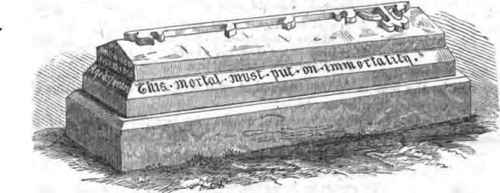
MONUMENT TO THE LATE A. J. DOWNING, IN THE CHURCH CRMETERY AT NEWBURG, N. T.
The inscription is - "This mortal must put on immortality." "Be not dismayed, I am thy God".
Bitter was the day, and bitterer still was the blast, that whirled around .me, as with shivering hands I scraped away the snow which had buried in its folds, as with a winding sheet, the above inscriptions; and yet cheerless and desolate as were the feelings inspired by the scene around me, they did not compare with the deep sorrow with which I well remember I saw entombed here all that was mortal of our lamented friend. I shall not soon forget that summer day, when still stunned by the horror of his sudden death, I witnessed that solemn and impressive service amidst those trees and flowers that he had planted and loved so well, and which seemed, in their abundant gratitude, to bloom more sweetly for his hands than for any other. His death was so sudden, and his burial followed so hard upon it, that one could scarcely realize that even here, into that blooming paradise, the destroyer had come.
It seemed to have been the desire of his friends that the last known and seen of him on earth should be as lovely as was his life. As he was born among flowers, so among them he lived and was buried.
In the careful culture of his beautiful home, he never permitted any evidence of neglect. Every fallen leaf, even, was constantly removed; so in his death there was no evidence of decay, in the full beauty and prime of manhood; without a spot or blemish was he stricken down; neither old age, nor sickness, nor misfortune had laid their heavy hands upon him, but like a beautiful meteor he disappeared; and many years must roll on ere those who admired and loved him will have forgotten his brightness.
The adoption of the texts as above must be deemed every way satisfactory, and more in accordance with proper feeling than any elaborate effort of the Muse; and yet there have been successes; I am tempted to quote two examples, which in their sentiments seem to apply to the departed. The first is the Epitaph on John Dryden, by the Bishop of Rochester.
This Sheffield raised, to Diyden's ashes just, There fiz'd his name, and there his laurell'd bust. What eke the Muse in marble might express, Is known already; praise would make it less..
Hogarth's is in the proper spirit, and applicable in some respects: -
Epitaph on Hogarth, by Garrick.
If genius fire thee, reader, stay;
If nature touch thee, drop a tear; If neither move thee, turn away,
For Hogarth's honored dust lies here.
Many will be the feet in future years that will wend their way to this shrine of one greatly endeared to a large circle.
Well, indeed, in Downing's instance, might the beautiful words of the poet have been applied, as his coffin disappeared among bis trees. And now -
"Linguenda tellus et dormus et plaeens, Uxor, neque haruni quas celis arborum, Te prater invisas cupressos, Ulla brevem dominum sequetur".
Which, literally translated, would read thus: "The world must be given up, and home, and the gentle wife; and not one of all these trees you have cherished, except the envious cypress, shall follow thee, their short-lived master, to the grave".
Continue to:


My Books

