


Downing's Ever-Bearing Mulberry
Description
This section is from "The Horticulturist, And Journal Of Rural Art And Rural Taste", by P. Barry, A. J. Downing, J. Jay Smith, Peter B. Mead, F. W. Woodward, Henry T. Williams. Also available from Amazon: Horticulturist and Journal of Rural Art and Rural Taste.
Downing's Ever-Bearing Mulberry
This truly distinguished fruit, so different from the other American Mulberries by its rich, subacid taste, was obtained from the seed of the Multicaulis by our worthy and experienced pomologist, Chas. Downing, some twelve years ago, in his experimental grounds, near Newburgh. The tree is very vigorous, hardy, and productive. Its foliage is large and fine, making it altogether an ornamental as well as a very useful tree. It comes into bearing the third or fourth year, and the fruit increases in size as the tree attains a more mature condition. The fruit ripens in succession, from the 1st of July to the beginning of September, producing a never-failing crop of the most luscious fruit, highly valued by all who have had an opportunity to taste it, and making a fine dessert, and a most delicious pie or pudding fruit.
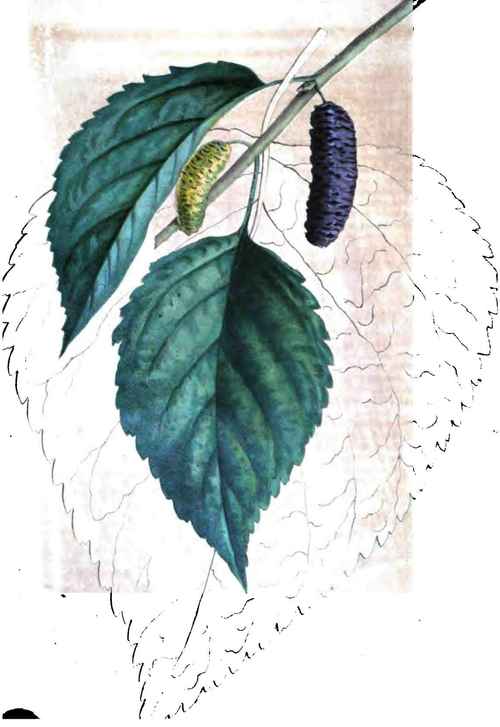
Downing's Everbearing Mulberry.
Size of the fruit from over one inch to one inch and a half in length - about half an inch in diameter; larger under good, rich cultivation. Color, purplish-black, with small, fine grains, of a delightful, rich, subacid taste. The outline of the leaf is that of a middle-sized one.
Continue to:


My Books

