


Chapter 34. On Roses For The Garden
Description
This section is from the book "Beautiful Gardens - How To Make Them And Maintain Them", by Walter P. Wright. Also available from Amazon: Beautiful Gardens: How To Make And Maintain Them.
Chapter 34. On Roses For The Garden
A new era has dawned for those who love good and beautiful garden Roses. It was ushered in in a manner almost dramatic. A seafaring man brought from the Far East a singular Rose. It had small, rosette-like flowers, borne in great clusters, and of the richest crimson. Its foliage was small and shining, borne on long, thick canes, which bespoke the rudest vigour. The seafarer did not know that he had a floral treasure. He probably thought no more of it than he would have done of a green parrot. It passed from his hands into others', and still was regarded, if not without admiration, at all events without insight. Then the inevitable happened. A plant so extraordinary could not be bandied about the country for ever without arousing attention. A man came along who combined great knowledge of Roses with trained commercial instincts. He saw, he bought, he propagated, and in 1893 "Turner's Crimson Rambler" was introduced to the Rose world.
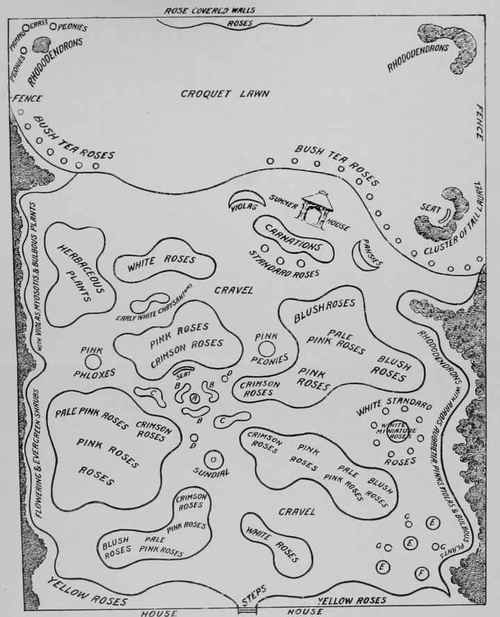
Fig. A Pretty Flower Garden, Mainly Of Roses (Small Beds, A To G, May Be Carnations)
There never was a more remarkable example of the completeness with which Nature can sometimes remedy the short-sightedness of mankind than the revolution effected by this plant. Numerous societies devoted to the Rose existed, but their influence was confined within very narrow bounds - those of the show tent. They did little or nothing for the Rose as a garden flower. Their work was good in its own limits, but it lacked breadth of view. The narrowness of outlook which invariably distinguishes specialists - at least in the gardening world - was conspicuous in their operations. The result was that the hall-mark of supreme excellence became attached to varieties which, while undeniably beautiful as exhibition flowers when specially grown and dressed, were of no value for the garden. And so a false standard grew up. Useless Roses were set on a pinnacle, and men without the remotest idea of beautifying a garden were elevated into leading rosarians.
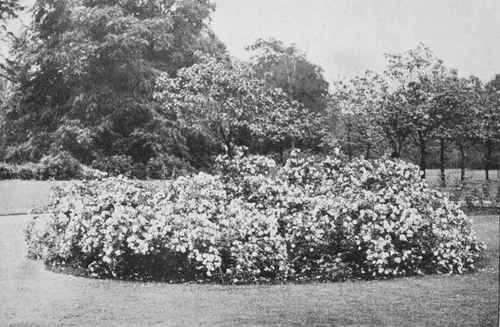
Fig. A bed of the Yellow Polyantha Rose Electra.
For a long time the public endured this sort of thing. It duly planted expensive varieties which proved to be worthless, and it gave unstinting hero worship to the great men of the Rose world. But its gardens remained bare of Roses, except for a week or two in the year. It was the advent of Crimson Rambler, with all its glorious garden possibilities, which altered this. And there were no half measures about the change. Garden lovers flung forth the pampered favourites of the show board, and would have given similar shrift to the leading "rosarians" themselves had not the latter mended their ways. Of course, they yielded tardily, reluctantly, but public opinion was so overwhelming that they were compelled to give a grudging assent to the demand that garden Roses - true garden Roses - should henceforth be recognised as equally worthy of official recognition with show sorts.
The prodigious success of Crimson Rambler led to the introduction of a large number of other brilliant and free flowering Roses. Arches, porches, arbours, pergolas, fences, banks were covered with the brilliant trusses of the new favourites. Dorothy Perkins (second only in popularity to Crimson Rambler), Euphrosyne, Ards Rover, Psyche, Leuchtstern, and Carmine Pillar, with dwarfer, yet still vigorous, varieties like Bardou Job, Griiss an Teplitz, and Alister Stella Gray, were soon spreading fast. The beautiful Penzance Briers grew more rapidly in favour. The invaluable Wichuraiana varieties rambled over stumps and banks. Old, half-forgotten but beautiful Roses like Felicité Perpétue and Bennett's Seedling were again brought into the sunshine of popularity. Free flowering, if small-flowered, Roses such as Fellenberg, Electra, and The Dawson were considered worthy of introduction. Moreover, the rank and file of Teas and Hybrid Teas were carefully tested, to yield varieties calculated, by their freedom of growth and floriferousness, to give good garden effects.
The net result of this great movement in the way of popularising decorative Roses has been to add immensely to the beauty of the garden. Instead of having Hybrid Perpetuals blooming merely for a week or two in July and September, we have rambling, creeping, and bedding Roses of the best types in flower continuously for many months. Material for the house vases has increased in proportion.
Here at length, then, we find the Rose playing that dominating part in the flower garden which its proud position as the Queen of flowers demands. In some instances poor culture leads to disappointment; in others supports of too artificial a nature impair the effect. All Roses appreciate substantial soil, liberal feeding, moisture, sunshine, and brisk breezes. Double dug and freely manured soil is indispensable. Root drought, heavy shade, and stagnant air are all bad. Even Crimson Rambler, with all its marvellous vigour, will not thrive in a dry place.
The show grower's thoroughness in the way of pruning must not be practised with strong-caned Garden Roses. Ramblers, Penzance Briers, and pillar Roses generally need the old canes removed when they become barkbound, but younger wood only needs its soft, unripe tips to be cut away. It must be remembered that most of these Roses, like dear old Maréchal Niel and William Allen Richardson, produce their flowers on outgrowths from the ripened canes, and hard pruning would therefore be wasteful. The only case for cutting back is when a thicket of canes exists. In such cases a few of the strongest should be left untouched, others shortened to two-thirds of their length, and the remainder to one-third. This produces perfect pyramids of bloom right to the ground. Felicité Perpétue, and most of the lovely Penzance Briers (but not Lord and Lady Penzance) thrive under this treatment.
Continue to:


My Books

