


Part 69. Mixed Plant Fibers
Description
This section is from the book "Plants And Their Uses - An Introduction To Botany", by Frederick Leroy Sargent. Also available from Amazon: Plants And Their Uses; An Introduction To Botany
Part 69. Mixed Plant Fibers
Part 69. Mixed fibers consist of slender strands including both bast and wood so intimately united that it is difficult to separate one from the other. Such compound strands form the framework or skeleton of leaves, of many stems, and of certain fruits. The extraction of mixed fibers is commonly an easy matter from the fact that they are for the most part surrounded only by material so soft as to be readily removable. In other cases there is so little material beside the fibers that isolation of the latter is unnecessary for many purposes. Manila, pineapple fiber, southern moss, straw, rush, maize-fiber, broom-corn, rattan, bamboo, coir, and vegetable sponge will serve as examples.
Manila, sometimes called "manila hemp," is obtained from the fleshy leafstalks of a banana-like plant (Fig. 219) grown almost exclusively in the Philippine Islands. The fiber is extracted by scraping away the surrounding soft parts with a dull knife. Both a coarse and a fine fiber are thus obtained, the latter coming from near the edge of the stalk. The former is much stronger even than the true hemp, and makes the best of cordage. It is highly valued also for mats, bagging, and sail-cloth, while from old ropes of it is made manila paper. Manila bagging serves for stiffening plaster of Paris in making the building material known as "staff" which is extensively used for the ornamentation of temporary structures such as those of the Columbian and Pan-American Expositions. The fine fiber is woven by the natives into beautiful fabrics.

Fig. 219.-Manila Hemp Plant (Musa textilis, Banana Family, Musaceoe). Plant, flowers, and fruit. (Kew Bulletin.)-A tree-like perennial herb from the underground stem of which arise huge leaves whose overlapping stalks make a trunk 6 m. or more in height, and support not only the immense leaf-blades but the heavy cluster of flowers and fruit; leaves pale beneath; flowers inconspicuous, covered by reddish bracts; fruit green, filled with numerous seeds. Native home, Philippine Islands.
The leaves of the pineapple (Fig. 111) yield a similar fiber of extraordinary strength and fineness. From the finest of this is made the celebrated pina or pineapple-cloth of the Philippines-said to be the most delicate and perhaps the most costly of vegetable textiles.
The fiber extracted from the stem of the so-called southern moss (Fig. 220) by retting is strikingly like horsehair in appearance and stiffness, and is largely substituted for it as a stuffing in upholstery. The whole plant also is used as packing material.

Fig. 220.-Southern Moss (Tillandsia usneoides, Pineapple Family, Bromeliacece). A, plant in flower, growing attached to bark. B, flower, enlarged. C, flower, cut vertically. (Wittmack.)-Perennial herbaceous air-plant hanging from trees to a length of 1-2 m., without roots, covered with grayish scales through which water is absorbed; flowers yellow; fruit dry; seeds hairy. Native home, Southern United States to Brazil.
The straw of wheat, rye, barley, oats, and rice (Figs. 1-12) contains so little material besides the fibers, that the whole may be used for many purposes. This straw forms a valuable material for packing, filling of mattresses and the like, thatch, plaiting for straw hats, baskets, and mats; and for coarse paper and pasteboard. What is commonly known as straw matting-the best sort used in place of carpet is most generally made of the stems of the rush shown in Fig. 221.
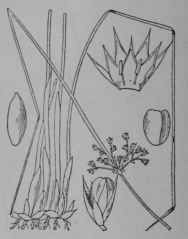
Fig. 221.-Rush (Juncus effusus, Rush Family, Juncaceoe). Plant in flower, 1/2. Calyx, corolla, and stamens. Fruit. Seed, edge and side views. (Britton and Brown.)-Perennial herb 3-12 dm. tall, smooth throughout; flowers greenish; fruit dry. Native home, North America and Eurasia.
Coarse mats are sometimes made of the husks of maize (Fig. 15) which contain strong mixed fibers similar to those of the straw of the other cereals. These fibers and others like them from the stem and foliage leaves are extracted and put to many uses of which the most important is paper-making.
Broom-corn (Fig. 222) yields the tough, springy material from which most of our brooms and whisk brushes are made. This consists of the slender branches of the flower-cluster, ripened and deprived of their fruit. Each branch or stalk is little more than a bundle of mixed fibers.

Fig. 222.-Broom-corn (Andropogon Sorghum, Grass Family, Gramineoe). A, flowering top of wild form, known as Johnson grass (A. halepensis) from which broom-corn and the various other cultivated sorghums are believed to have been derived. B, flowering top of a cultivated form (var. vulgaris) which differs from the form used for brooms (var. technicus) mainly in having a more compact flower-cluster. B♂, B♀, staminate and pistillate spikelets, enlarged. D, bract. K, fruit. G, lodicules. (Reichenbach.)-Annual 2-3 m. tall; stem solid; flowers concealed by bracts; fruit a grain. Native home, Mediterranean Region (?).
Coarse brush material, as for street sweepers, is afforded by the similarly fibrous stems of the rattan (Fig. 223). When split or peeled they serve especially well also, under the name "reed," for basketry, wickerwork, cane seats, etc.

Fig. 223, I.-Rattans (Calamus spp., Palm Family, Palmacece). Plants showing their method of climbing over trees by means of grappling hooks at the end of the leaves. (Selleny.)-Woody vines sometimes attaining a length of 100 m. or more; leaves dark green above; flowers rosy or greenish; fruit polished. Native home, Tropical Asia and East Indies.

Fig 223, II-Rattans. Flowering and fruiting top (Calamus adspersus). A, seed. B, same, cut vertically. C, flower-cluster sheath (of C. Bangka). (Blume.)
The stems of bamboo (Fig. 224) are used widely for similar purposes, and for an almost endless number of other uses. In eastern countries the bamboos form the main dependence of the people in supplying a large share of their needs.

Fig. 224.-Bamboo (Bambusa vulgaris, Grass Family, Gramineoe). Plants in leaf. A, cluster of spikelets. B, spikelet with stamens protruding. E, flower. (LeMaout and Decaisne, Knuth.)-A tree attaining 26 m. in height; stems hollow; leaves rough; flowers concealed by bracts; fruit a grain.
In tropical regions generally the coconut palm (Figs. 34-36) is also depended upon for an immense variety of uses-far too many to be here enumerated. Fibrous material obtained from the leaves has important domestic uses, but the fiber of greatest value is that known as coir, which is obtained from the nut husks by rotting away the softer material. Coir makes cordage of extraordinary lightness and elasticity especially valuable for cables and running rigging. Its most familiar use is for door-mats and other matting subject to very hard wear.
Fibers somewhat similar to those of the coconut husk form a network through the pulp of the sponge cucumber (Fig. 225). These when removed from the ripe fruit form the "vegetable sponge" which druggists sell for bathing purposes. In Japan it is used also in the manufacture of hats, as stuffing for saddles, etc.

Fig. 225.-Vegetable Sponge (Luffa cegyptiaca, Gourd Family, Cucurbitaceoe). Tip of vine showing leaves, tendrils, and young flowers, 1/3. Staminate flower, with corolla spread open. Pistillate flower, cut vertically. Fruit, 1/9. Same, cut across. (Redrawn from Duthie and Fuller.)-Annual vine; leaves rough; flowers yellow; fruit 30-100 cm. long, greenish with ten darker ribs. Native home, tropics of the Old World.
Continue to:


My Books

