


105. Eucalyptus Risdoni
Description
This section is from the book "A Research On The Eucalypts Especially In Regard To Their Essential Oils", by Richard T. Baker, Henry G. Smith. Also available from Amazon: A Research On The Eucalypts And Their Essential Oils.
105. Eucalyptus Risdoni
(Hook. f. in Hook. Journ., vi, 477, and Fl. Tasm., i, 133, t. 24.) Risdon or Drooping Gum.
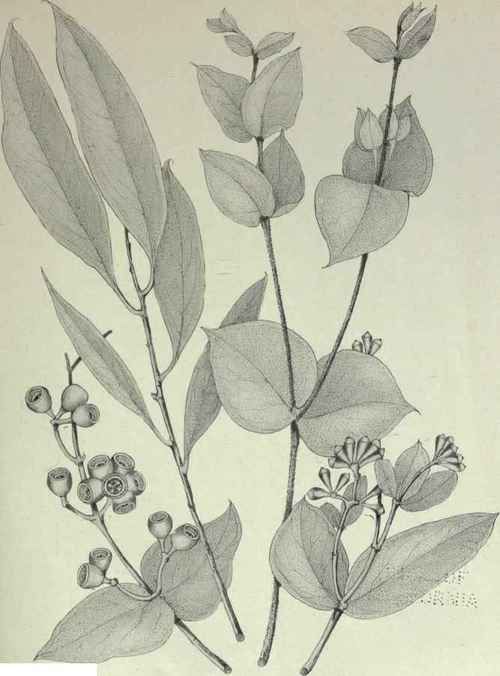
Systematic. - A small or medium-sized tree, with a smooth, deciduous bark, and glaucous foliage, inflorescence, and branchlets. Leaves very variable in size and shape, either opposite, sessile, connate, ovate, cordate, acuminate, thick, with recurved margins, about 1 1/2 inch long, or alternate, ovate-lanceolate, lanceolate and sometimes measuring 6 inches long, occasionally shining; venation fairly distinct, lateral veins oblique, spreading, distant; in the lanceolate leaves the tendency is in the direction of phellandrene oil venation; intramarginal vein well removed from the edge and showing a looping arrangement. Peduncles axillary, 3 to 4 lines long, terete or angular, bearing six to nine fairly large flowers. Calyx tube pyriform, 3 lines in diameter, 5 lines long; operculum depressed, hemispherical, shortly acuminate.
Fruit. - Sub-globose, truncate, sometimes contracted at the orifice, or pear-shaped; rim truncate to countersunk; valves not or scarcely exserted; 4 lines in diameter.
These fruits could not easily be confounded with any others, although those with the countersunk rim resemble E. obtusiflora.
Habitat. - Southern Tasmania.

REMARKS. - The life history (if one may use the expression in this connection) of this Eucalyptus is identical with that of the mainland species E. dives, Schau., in that it flowers and fruits when quite a small shrub, and when all its leaves are in the opposite, sessile, and cordate form. Singularly enough, both Hook. f. and Schauer founded their species on the shrubby form only, and in the case of E. dives it was not till shown by this research, that the mature trees were identified. Hook. f. figures and describes (loc. cit.) what has since been shown to be the primary stage of growth of his species, the mature trees of which are recorded by Bentham in his "Flora Austra-liensis," iii, 203, as var. elata on material collected by Gunn. The dried material of the early and mature forms of this tree, when compared, would easily mislead one not acquainted with the trees in the field. "Mueller unites E. Risdoni altogether with E. amygdalina," but our results agree with those of J. D. Hooker and Oldfield, and in no way do we see so close an affinity between these two trees.
ESSENTIAL OIL. - The results obtained with the oil of E. Risdoni were recorded in the first edition of this work. The yield of oil then obtained was 1.35 per cent.; saponification number for ester and free acid = 27.1; cineol
Plate LX.
W Marshall. ,del.
Eucalyptus Risdoni. HooK.f. Risdon or Drooping Gum
64 per cent, in the fraction, determined by the phosphoric acid method, and 95 per cent, distilled below 1980 C. It contained phellandrene, and was exceedingly rich in cineol for a phellandrene-bearing oil.
To enable the investigation to be more complete, material was obtained for distillation of the reputed E. Rhdoni var. data, from Mount Wellington, Tasmania, collected in August, 1912. The results show the oil to be in agreement with those of the ordinary form previously determined.
Material for distillation of the so-called E. amygdalina var. hypericifolia, was also obtained by Mr. L. G. Irby, near Hobart, Tasmania, in April, 1912, under the direction of Mr. Rodway. The results with this oil were practically identical with those of E. Risdoni, and as the botanical features were also in agreement with that species, we consider it to be E. Risdoni. The chief characteristics in the oil of E. Risdoni are that it contains over 55 per cent. of cineol when determined by the resorcinol method; a somewhat large amount of phellandrene; belongs to the "peppermint" group, as it contains some piperitone; has a somewhat high saponification number by boiling, and a low one by the cold method; gives over 90 per cent, distilling below 1950 C, and has scarcely any objectionable volatile aldehydes. Both amyl-alcohol and amyl-acetate were detected.
The crude oil of E. Rhdoni (supposed variety elata) from Mount Wellington, Tasmania, was lemon-yellow in colour, and responded to all the tests and requirements recorded above. The yield of oil was 1.52 per cent. Specific gravity at 150 C. = 0.9061; rotation aD - 14.1°; refractive index at 200 = 1.4670, and was soluble in 3 volumes 70 per cent. alcohol. The slightly larger amount of phellandrene, and correspondingly less cineol at the time, accounts for the slight differences in rotation, gravity, and solubility, to those previously recorded.
On rectification, the usual amount of acid water and volatile aldehydes came over below 1730 C. (corr.). Between 173-1840, 82 per cent. distilled, and between 184-195°, 11 per cent, distilled. These fractions gave results as follows: -
First fraction, sp. gr. at 150 C. | = | 0.8995; rotation aD - 16.6; refractive index at 20° = 1.4647. | |||
Second | " | " | " | = | 0.9010; rotation aD - - 9.3°; refractive index at 200 = 1.4610, |
The cineol was determined by the resorcinol method, the result indicating 58 per cent. of that constituent in the crude oil. The saponification number for the esters and free acid by boiling was 21.3; and in the cold, with two hours' contact, 5.5.
The supposed variety hypericifolia gave a light amber-coloured oil, having a somewhat pleasant odour; the average yield was 1.24 per cent., and the oil agreed in all respects with the requirements for that of E. Risdoni.
The specific gravity of the crude oil at 15° C. = 0.9045; rotation aD - 14.6°; refractive index at 20° = 1.4656, and was soluble in 5 volumes 70 per cent. alcohol. The saponification number for the esters and free acid by boiling was 23.8; and in the cold, with two hours' contact, 3.9. It is thus evident that the main ester in the oil of E. Risdoni is not geranyl-acetate.
On rectification, only a few drops of acid water and volatile aldehydes came over below 173° C. (corr.). These aldehydes had no objectionable odour. Between 173-198°, 94 per cent. distilled. This had specific gravity at 15° C. = 0.8991; rotation aD - 15.4°. and refractive index at 20° = 1.4637. The comparative absence of high-boiling constituents is worthy of notice.
The cineol was determined by the resorcinol method in the large fraction, and calculated for the crude oil; the result was 56 per cent.
if these results are tabulated it can be seen how closely the oils agree in general characters, and, allowing for the slight increase in cineol and less phel-landrene at the time of distillation, with the type E. Risdoni also.
Supposed variety elata. | So called variety, hypericifolia. | |
Yield of oil ....... | 1.2 per cent. | 1.24 per cent. |
Rotation aD ....... | - 14.1° | - 14.6° |
Specific gravity at 15° C........ | 0.9061 | 0.9045 |
Refractive index at 20° C........ | 1.4670 | 1.4656 |
Cineol by resorcinol ....... | 58 per cent. | 56 per cent. |
Saponification number, hot method ....... | 21.35 | 33.8 |
Saponification number, cold method ....... | 5.5 | 3.9 |
Boiling, between 173-195° .......................... | 93 per cent. | Bet. 173-98° = 94 per cent. |
Solubility in alcohol ....... | 3 vols., 70 per rent. | 5 vols., 70 per cent. |
By the rapid phosphoric acid method the cineol was 46 per cent. when calculated for the crude oil.
Material of trees growing at Strickland, Tasmania, was obtained in August, 1912. The oil distilled from the leaves of these trees showed them to be E. Risdoni also, and it responded to all the tests required for the oil of that species. The yield of oil was 1.5 per cent.; specific gravity at 150 C. = 0.9079; rotation aD - 9.9°; refractive index at 20° = 1.4677; and was soluble in 5 volumes 70 per cent, alcohol. The cineol, determined by the resorcinol method, was 58 per cent. when calculated for the crude oil. The saponification number by boiling was 21.1; and in the cold, with two hours' contact, 6.6. The presence of amyl-acetate in the portion first distilling was also indicated by the pear-like odour, after the aldehydes had been removed, and this was further intensified after acetylation.
The results of this later investigation were published by us in the Proc. Roy. Soc, Tasmania, October, 1912.
Continue to:


My Books

