


Massage: Chronic Joint Sprains Or Stiffness From Injury
Description
This section is from the book "Lessons on Massage", by Margaret D. Palmer. Also available from Amazon: The Book Of Massage: The Complete Stepbystep Guide To Eastern And Western Technique.
Massage: Chronic Joint Sprains Or Stiffness From Injury
In chronic joint troubles, such as old sprains or stiffness from any injury, the local circulation and secretion are decreased, therefore the joint is manipulated in order to bring blood to it and favour secretion.
The treatment of these joints is different to the foregoing ; they are not painful to the touch, therefore massage movements are applied vigorously from the first.
Hot and cold applications are sometimes used in connection with massage. Soaking the part in hot water or hot fomentations are useful before kneading and passive movements. The: muscles above and below the joint require attention, as they have suffered from inaction, and must be nourished and strengthened to act on the joint.
The movement of the joint is painful, and fortitude is called for in both operator and patient—in the one to enable her to cause exquisite misery, in the other to bear it.
A joint should not be flexed or extended till massage has been applied.
When up and about, various devices are used to fix the body of the patient. If a stiff shoulder, the patient may sit sideways on a chair with the healthy arm over the back, thus fixing the trunk and placing the other shoulder in a good position for grasping the scapula.
To move a stiff elbow, the patient sits with the back against the wall.
To flex a stiff knee, the patient sits on a high seat which admits of the leg going back, the thigh is fixed by one hand placed above the knee and the leg pressed backward with the other hand, or when the knee is somewhat bent, an easy way to gain movement is for the operator to place her foot on the foot of the patient and exert pressure in that way. The patient may be instructed to do active movements after this wise : Standing behind a chair with hands grasping the back, both knees are bent as far as the stiff one can be made to go ; this should be done many times. A stiff ankle can also be exercised in this way.
Should adhesions have been recently broken down under anaesthetic, gentle movements should be used at first, as in sprains, as the conditions are somewhat similar. Injury to a joint is sometimes followed by neuritis and rapid wasting of the adjacent muscles. The first object then is to restore tone to the muscles.
In stiff hip-joints the glutei muscles are wasted, and require vigorous kneading and tapotement, the joint to be manipulated as in Chapter VII. The adductors to be well kneaded, etc., also finger-kneading across the top of the thigh. All the rotators of the hip-joint are inserted into or near the trochanters. Abduction is generally the most difficult movement to get. It is necessary to have the pelvis held by another in order to fix it.
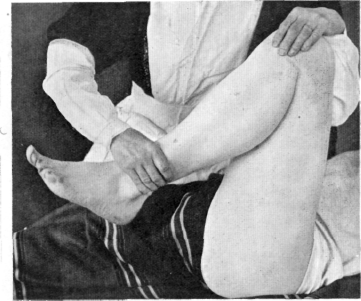
Fig. 107. —Flexing the Thigh.
After dislocation of the shoulder or fractured humerus, the deltoid, supra and infra spinatus, and the pectorals are found to be wasted, and require as much care as the joint itself. In some cases the movement of the joint is perfect, but the patient cannot raise the arm because of the weakness of the wasted muscles. Nutrition must be brought to them before passive movements are used, as it is worse than useless to force muscles to do what they have not strength for. The folds of the axilla require attention.
If there has been downward dislocation of the shoulder, care must be exercised in abducting the arm when giving passive movements.
Continue to:


My Books

