


III. Treatment Of Scoliosis. Part 2
Description
This section is from the book "Massage And Medical Gymnastics", by Emil A. G. Kleen. Also available from Amazon: Massage and medical gymnastics.
III. Treatment Of Scoliosis. Part 2
Measurement is performed thus : - First those points of the trunk which are to be measured are marked upon the patient's skin with Indian ink. These are: seventh cervical vertebra; the whole line of the spinous processes as far as the coccyx (upper point of the line between the buttocks); on the scapula two points, viz., the lower angle and the angle where the spine of the scapula curves forward as the acromion process. Bulging of the ribs should be marked in its most prominent part; the anterior superior iliac spine on both sides.
The patient is next placed in the apparatus and the pelvis is fixed; the length of the body and the position of the head is read off and the latter fixed. The position of the shoulders is then measured, the two side-contours of the body from the axilla to the great trochanter, seventh cervical vertebra, and the points characteristic of the curve; the height above the foot-board of the prominence of the ribs, both anterior superior iliac spines, and, if necessary, the height of the iliac crest. All these points are marked on squared paper according to the figures which the assistant has taken down in the protocol, and are joined by straight lines. In this way the "measurement diagram" is made, of which Fig. 159 is an example.
Each square corresponds to 1 sq. cm. For reading the height a scale is marked on the left, the "standing scale," which gives the distance above the footboard; on the right there is another, the "sitting scale," which gives the height above the sitting plane.
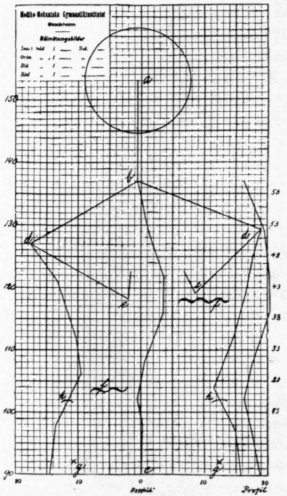
Fig. 159.
Point c is the coccyx. Through this point the vertical middle line may be considered to be drawn upward. The head a is represented by a circle, the upper point of which gives the height of the crown of the head (in this case, therefore, 161.3 cm. above the foot-board, 84.3 cm. above the sitting plane), and the right and left sides give respectively the distance of the temples from the middle line (78 and 9.1 cm.). Point b represents the spinous process of the seventh cervical vertebra (height 137 and 60 cm. respectively; frontal deviation 0.6 cm. to left). The crooked line be is the line of the spinal column (i.e., the line of the spinous processes); d and e indicate the acromion process and the angle of the scapula. The waved lines/indicate the position of the angles of the ribs; g is the anterior superior iliac spine and h the iliac crests.
By taking new diagrams from time to time definite data are obtained showing the progress of the case. To facilitate the comparison these new diagrams may be drawn with different coloured pencils on the same paper.
What is the value of such a diagram? Taking for granted that the measurements are carefully and accurately made, a point which necessitates a great deal of experience and much practice,* the diagram gives us a reliable and graphic representation of the deformity as far as it expresses itself at the points measured. The latter is a limitation which must not be forgotten, but which naturally does not apply only to this method of measuring, but to all others. The part of the diagram which is of most importance is the "spinal line," but one must always remember that this line indicates the position of the spinous processes, not of the bodies of the vertebrae. Now we know that in all lateral curvatures there is a tendency to rotation of the vertebras round a vertical axis, viz., that the bodies deviate more from the mid-line than the spinous processes. The vertebral column (by which I mean the line of vertebral bodies as distinct from the line of spinous processes, which is here called the spinal line) thus forms in the frontal plane an arch with greater deviation from the mid-line, or, more correctly, greater curves, than the spinal line. However, as we possess (apart from Rontgen-rays) no means of directly defining the position of the spinal column, we must content ourselves with the spinous processes. This is, in the majority of cases, sufficiently accurate in practice, as both lines, for the purpose with which we are now concerned, sufficiently coincide. But there are cases where other conditions lead one to suppose that this is not the case, e.g., when the angles of the ribs are prominent while the corresponding part of the spinal line is straight or even slightly bent to the opposite side. Bulging of the ribs definitely indicates a rotation of the vertebral bodies to the same side, with a corresponding side-bending of the spinal column. In such a case the treatment must naturally be directed towards the condition of the spinal column, and not towards that of the spinal line.
* A measurement such as has been described ought to be done in four minutes after the pelvis is fixed.
However, quite apart from the relative infrequency of the cases where this takes place, this does not lessen the value of the measuring, but only points to the fact that this must be completed by further examination of the patient, particularly in order to estimate to what extent the spinal line may be considered an exponent of the spinal column. The picture itself gives us an idea in this direction, if we examine the position of the angles of the ribs marked upon it in their relation to the spinal line. For ordinary practical purposes such a marking of their position is sufficient. With this apparatus we are not able to obtain any particular picture of the configuration of the chest in horizontal section; at least, not without further data. For this purpose a special measuring apparatus, the "cross-section measurer," is constructed for use in those cases where it is desirable to have a careful record of this condition.
The above measurement of the patient naturally does not constitute the whole examination. This includes the investigation of other conditions important to a thorough knowledge of the case, such as the condition of the back on bending forward and sideways, the amount of straightening on hanging by the head or arms, the condition of the muscular system, heart, lungs, etc. Finally, it may be pointed out that treatment by Zander's orthopaedic gymnastic apparatus for many cases may be carried out without using such a measurement diagram. The prescription for the treatment in these cases must be worked out more in detail, as the patient, with the back uncovered, must be tested upon the apparatus in order to find out the correct position. The diagram is therefore not only of value in diagnosis, but also in prescribing the treatment; in other words, the special positions for the various apparatus may be written down with absolute certainty that their effects will be exactly what is aimed at. The apparatus is all supplied with scales constructed under the supposition that a diagram is used similar to that described above. The measuring apparatus and the gymnastic apparatus go together, historically and for use; they are, so to speak, different sides of the same thing, and each loses some of its value if separated from the other.
The apparatus used for scoliosis treatment are some which belong to the general apparatus, as well as some specially constructed for the purpose. These latter are divided, according to their method of working, into two groups : K. apparatus for passive correction, which by means of constant pressure corrects the curves, and in that way stretches the shortened soft parts; L. apparatus for active corrective movements, by means of which the spinal column is actively mobilised on the one hand, on the other those muscles are strengthened which have a corrective effect. As all the apparatus, so far as method of working is concerned, belong to one of these two groups, the different apparatus used in the treatment of scoliosis will be described under these groups.
Continue to:


My Books

