


III. Treatment Of Scoliosis. Part 7
Description
This section is from the book "Massage And Medical Gymnastics", by Emil A. G. Kleen. Also available from Amazon: Massage and medical gymnastics.
III. Treatment Of Scoliosis. Part 7
L2 (Fig. 173) is not really an apparatus, but a support arrangement for some free active movements. It consists of two padded plinths, at the end of one of which is a foot support resembling the ancient "stocks," in which the feet are firmly fixed. The patient lies with his feet supported in the stocks, thus giving himself support for the various exercises, his trunk resting on the front plinth, which is 1ower. The most usual movements in this position are : -
Forward-Lying Holding
The patient is in Forward-lying position and raises the trunk just so much that it is horizontal.
Forward - Lying Back -Raising
The trunk is raised from the above position still higher in an arch as far as it will go.
Right Or Left-Side-Lying Holding
The patient lies on either side and raises the trunk to a horizontal position.
Right Or Left-Side-Lying Side-Flexion
From the position above described Side-flexion is given so that the trunk is flexed in an arch upward as far as possible.
Half (Right Or Left)- Side-Lying Holding Or Back-Raising
The patient lies half-way between Forward-lying and Side-lying, his thighs resting on a padded board placed obliquely on the plinth. The exercise is given either as a Holding or as a Back-raising.
Lying Trunk-Raising
The patient lies on his back and raises himself up to Sitting position.
During all these movements the arms are held in Hips-firm position, or in Neck-firm if the exercise is to be made stronger.
The different uses and effects of these various movements are as follows: - Forward-lying exercises are used for the symmetrical exercise of the spinal muscles, Forward-lying Holding when there is a risk of increasing lordosis by movement. Side-lying exercises are used for single curves, to strengthen the muscles on the convex side. Half-side-lying exercises, especially Holdings, are used in double scoliosis to exercise the muscles on the convex side of the lumbar curve without affecting those of the dorsal curve, which could not be avoided in pure Side-lying Holding. Lying Trunk-raising strengthens the abdominal muscles.

Fig. 173.
L3. Pelvis-carrying to Side (Fig. 174). - The patient sits on a board like a little carriage which runs sideways on rails. To the carriage are fixed two straps running in both directions parallel to the rails, and then bending downward over a pair of pulleys, each supporting at its end a weight plate. To these plates are attached loose iron plates of different weights, by which means each plate is loaded and the carriage is drawn sideways. The upper part of the patient's body is fixed in the middle of the apparatus with side supports, which can be placed horizontally at different heights and widths, both of which are fixed under the arm-pits. When the patient grasps the handles of the side supports, the trunk is firmly fixed against the back and side supports. The patient sets the carriage in motion by moving the pelvis over to one side, at the same time drawing up the weight plates (from which the resistance is derived), and then allows the weight to draw the carriage back to starting position.
This movement is used in those cases of scoliosis in which the trunk leans over to one side of the pelvis. The muscles which come into exercise are those maintaining the upright position, i.e., a correct position between the upper and lower part of the trunk. If the patient sits it does not matter if the trunk is corrected over the pelvis or vice versa. For reasons of construction the latter is the method used in this apparatus. If the upper part of the trunk leans over to the right, the left weight plate is loaded and draws the pelvis over to the left. During the movement the patient pushes his pelvis actively over to the right as far as possible - further than the mid-line of the upper part of the body, which is fixed - so as to strengthen those muscles which correct the faulty position.
The movement may also be used with advantage for dorsal curves without any trunk displacement. The upper part of the trunk is then fixed by means of the side supports right down to the maximum point of the curve, and the movement aims at correcting the displacement between this point and the pelvis.

Fig. 174.
A few remarks may be made about the prescription of this movement. The vertical scales which mark the height of the side supports refer to the distance from their upper edge to the seat. The horizontal scales give the distance between these side supports and the centre of the apparatus. In writing the prescription one thus makes use of the height of the patient's sitting level in the diagram, and from this one arranges the position of the side supports to produce the required effect.
Figs. 175 and 176 explain the use of the apparatus in the above two eases. a denotes the side supports, s the sitting-board, v the weight plate; the arrow denotes the direction of the movement. As is seen in the first case, only two of the upper side supports are used. In the second case, where the upper part of the trunk must be fixed lower down, the lower side support is used, which is on the side of the dorsal convexity. The prescription reads thus: - For Fig. 175:

Fig. 175.
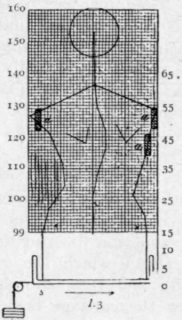
Fig. 176.
L3, left | B45 - 14 / 0 | No. 5 (weight) |
For Fig. 176:
L3, right | B 54 - 17 / R 46 - 15 | No. 8 (weight) |
In both formulae the figures above the line denote the side supports and those below denote the lower ones. B means both sides; R means right. The first figures denote the height above the stool, the last figures the distance from the mid-line.
Continue to:


My Books

