


III. Treatment Of Scoliosis. Part 6
Description
This section is from the book "Massage And Medical Gymnastics", by Emil A. G. Kleen. Also available from Amazon: Massage and medical gymnastics.
III. Treatment Of Scoliosis. Part 6
B4. Hip-downpressing is the converse of B3. The apparatus has a lever provided with a "tread-iron," which is pressed upward by the weight lever of a shunting mechanism. The patient places his foot on the tread-iron, and by pressing it down overcomes the resistance of the apparatus. In the treatment of scoliosis this apparatus is used for lowering one hip; the knee is kept extended the whole time while the hip is raised and lowered. The effect is analogous to that of A2, i.e., it exercises the lumbar muscles of the opposite side, and is sometimes used for lumbar curvature.
C5. Standing Trunk - raising (Fig. 150) (in Leg-lean-stoop-standing position). - The patient is put into a harness, which, with a strap running over a pulley, is fixed to the free end of the weight lever of the apparatus. By raising the trunk and bending it backward the patient lifts the weight lever, which gives the required resistance. The muscles of the back are strengthened, and the movement may sometimes be used in the treatment of scoliosis.
C6. Trunk-side-flexion (Fig. 169). - The apparatus has a padded curved back, against which the patient leans in sitting position, while he grasps its forward projecting end with his bent arms. The curved back moves round a sagittal axis and is connected, by means of a shunting mechanism, with a weight lever, which tries to turn the curved back to the right or left as required. The patient bends the trunk to the opposite side, thus raising the lever, which gives resistance, and then during the negative phase of the movement gives way to the pressure of the curved back and returns to starting position. The muscles of one side are strengthened, and simultaneously the spine is flexed. It is used for C curvatures, of course towards the convex side of the curve.
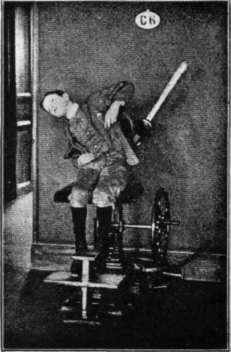
Fig. 169.
C8. Pelvis-rotation (Fig. 170). -
The patient sits on a stool which rotates round a vertical axis; his thighs are fixed to it by a cross-strap. The upper part of the body is fixed by the patient grasping with his arms a curved horizontal support for the back as in C6.
In the vertical axis of the seat is a shunting mechanism with weight lever, which rotates the seat either to right or left according to the coupling of the screw. The movement has an active and a passive phase. In the passive phase the patient allows the apparatus to rotate his pelvis to one side, and in the active phase he turns as far as possible to the other side while the machine offers resistance. The movement is used either for both sides to increase the mobility of the spine and to strengthen the trunk muscles, or for one side when the shoulder girdle is rotated in reference to the pelvic girdle. In the latter case the exercise is given for one side only, so that those muscles only are exercised which bring the shoulders over the pelvis.
C10. Neck-raising, Head-side-flexion (Fig. 171). - The resistance for these different exercises is given by means of a "head-plate" with a handle placed against the head (neck, or one side). The plate is fastened with a rope which first runs horizontally and later bends over a pulley downward to the free end of a weight lever. When the head is flexed in the direction above described the rope stretches and lifts the lever.
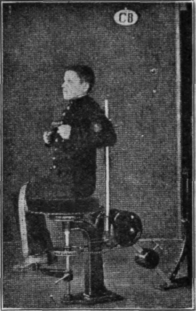
Fig. 170.

Fig. 171.
This movement is chiefly used for those neck muscles that are in action, e.g., in Neck-raising for kyphosis. The secondary effect in this movement lies in the static contraction it causes in the back-muscles. In Head-side-flexion the muscles of the trunk on the same side work statically; in Neck-raising the muscles of the spine right down to the iliac crests of both sides (in standing position right down to the legs) also work statically. These secondary contractions may have either good or bad results in regard to the treatment, although in gymnastic therapy they either are of small practical importance or, as in kyphosis with lordosis, they may be directly harmful. In kyphosis the upper muscles of the back must be strengthened, but the secondary contractions of the Muscles in the lumbar region arc contra-indicated on account of lordosis. The advantage may be obtained without harm by choosing, not the standing position, but either a sitting position strongly - inclining - backward, or forward-leaning with suitable support. In both cases the secondary contractions in the lumbar region are prevented, since they then lose their raison d'etre, which is to fix the trunk in regard to the pelvis.
We now have to deal with the apparatus constructed specially for scoliosis treatment.
Cll. Lying Neck-raising and Head-side-flexion. - The apparatus is so constructed as to allow the above-mentioned head movements to be given in such a position that the secondary contractions of the lumbar muscles in Neck-raising and of the side muscles of the trunk in Head-side-flexion are excluded. The apparatus consists of a padded board, slanting almost as in K3, on which the patient lies either forward (in Neck-raising), supporting himself with his elbows as described and shown below in L7, or on one side (in Head-side-flexion). Resistance is given by means of a cushion placed at the back or side of the head, connected with a weighted lever under the reclining board.
Ll. Combination of A3 and Dl (Fig. 172). - The apparatus is so arranged that the movement A3 can be taken in a sitting position. While in the above-mentioned apparatus the resistance is given by a weight fixed to a lever which is lifted by drawing down the arms, in Ll the weight is the patient himself, who sits on the board which is moved by the lever and pulls himself up. When the lever is raised the board slants sideways and raises the pelvis on one side. The exercise is thus a combination of active and passive correction. The active part is the arm movement, and the rules given in A3 hold here also; it may also be combined with A2, in which the one arm (that of the convex side) performs an arm-downdrawing with one handle, while the other arm with an A2 club is stretched upward at the same time. The passive correction takes place in the lumbar region by means of the inclination of the pelvis. In left lumbar curves the patient must sit with his right side towards the pole where the axis of rotation of the lever is to be found. When the lever is raised the left side of the pelvis is lifted more than the right, whereby the lumbar region is pressed to the right, and simultaneously the arms draw the upper part of the body to the left. To increase the effect of the exercise on the lumbar curve a pressure cushion is placed on the patient's left side at the maximum point of the curve and fixed by a strap to a pair of uprights fixed to the lever close to its axis of rotation. When the lever rises the straps draw the cushion to the right, thus giving a corrective pressure in the lumbar region. This method of using Ll may be called "ordinary," when the movement is given in the "right" direction. There is also an "extra-ordinary" method, when the exercise is apparently given in the "wrong" direction, viz., when in a left lumbar curve the movement is given, not to the right, but to the left; the patient therefore sits turned to the opposite side. This method is used for a very low lumbar curve when the lower spinal region lies obliquely in regard to the sacrum, or, as we say, there is an "inclination" towards the pelvis. The angle of inclination to the pelvis on the convex side is acute and that on the concave side obtuse (an angle between a horizontal line drawn from the upper edge of the sacrum). To reach the lowest parts of this curve the patient must be so placed that the hip on the concave side is raised during the movement. In this case the side-pressure cushion, which would prevent this effect being obtained, is not used, but the arms are allowed to draw the body freely over in the opposite direction. The spine is thus drawn to the right, while the pelvis is inclined to the left. An attempt is thus made to equalise the two angles, i.e., to straighten out the angle of inclination between the pelvis and spine, and so to restore normal conditions.

Fig. 172.
Continue to:


My Books

