


Head and Neck Movements
Description
This section is from the book "Massage And Medical Gymnastics", by Emil A. G. Kleen. Also available from Amazon: Massage and medical gymnastics.
Head and Neck Movements
These movements take place in the joints between the cervical vertebrae and in the atlanto-occipital joint. Practically they take place round three axes (frontal, sagittal and vertical), so that we divide them into Flexion and Extension (neck-raising) round the frontal, Side-bending round the sagittal, and Rotation round the vertical axis.
Reach-grasp-sitting
Hanging
Arch-hanging
Lying
Stretch-leg-forward-lying
Heave-grasp-standing
Neck-Raising (And Eccentric Forw
bending).
Reach-grasp-sitting, or Reach-grasp-standing, Neck-raising (Fig. 88). - The gymnast stands at the side of the patient and lays one hand over his forehead at the roots of the hair; the other grasps the occiput. The patient now carries the head backward against the resistance of the gymnast, who then bends it forward against the resistance of the patient. Repeated five to six times, and is finished by the gymnast, when carrying the head forward for the last time, letting it remain in the starting position.
N.B. - In neck-raising it must be noticed that the patient first holds the chin strongly drawn in and carries the cervical spine back, at the same time raising it vertebra by vertebra. Only when this is done is the head bent backward in the atlanto-occipital joint, when the chin is carried forward and upward. Forward-bending begins by first stretching the atlanto-occipital joint so that the chin is once again drawn in, when the head is carried forward and downward, so that the chin comes down against the sternum.
Hanging-neck-raising (Fig. 89). - The gymnast grasps the patient's occiput with one hand as in the previous exercise; the other supports the patient at the shoulders or abdomen. Sometimes combined with Leg-parting (without resistance), when the patient carries the legs apart at the same time as the head is bent backward.
Arch-Hanging Neck-Raising
Like the preceding.
Lying Neck-Raising
The patient lies on the back on a plinth, the head beyond the edge. The gymnast, sitting, grasps the back of the patient's head with both hands.
Movement similar to the preceding.
Str.-Leg - Forw.- Lying Neck - Raising (Fig. 90). - The gymnast, in walk-standing position in front of the patient, grasps his occiput with both hands, while the patient's hands are supported on the gymnast's shoulders.
Hips-firm (or Wing-)st. Heave-grasp-st.
Neck-raising.
The gymnast stands in front of the patient, grasps his occiput with both hands, and supports his elbows against the patient's shoulders during the movement.
The working muscles are: - (a) Those muscles which go from the upper dorsal vertebrae to the cervical vertebrae (Cervicalis Ascendens, Transversalis Cervicis, etc.).
(b) Those muscles which go from the upper dorsal vertebrae and cervical vertebrae to the occiput (Splenius Capitis, Trachelo-Mastoid, Complexus, Rect. Capitis Posticus Major and Minor, etc.).
(c) Trapezius.
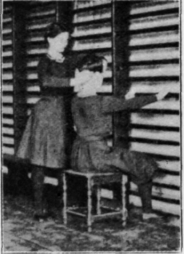
Fig. 88.
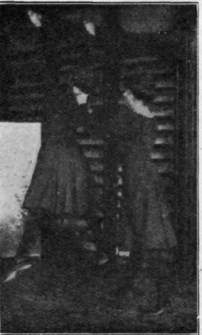
Fig. 89.
Effects And Uses
(a) Because the blood supply to the working muscles is increased, the movement depletes the head. It is also given after massage to the neck muscles.
(b) Joints of the cervical vertebrae are loosened.
(c) Carriage of the head is improved because the neck muscles are strengthened and shortened. On this account it is used in treatment of kyphosis. (N.B. - When the last effect is aimed at the forward-bending must be taken only to the starting position so that the muscles only work "in shortening.")
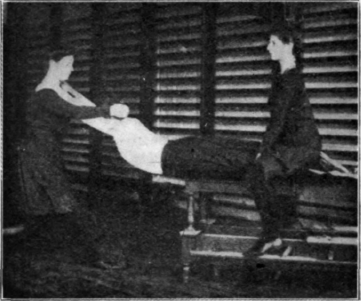
Pro. 80.
The Effects Of The Various Starting Positions
Reach-grasp-sitting and Reach-grasp-standing fix the trunk well. Most used.
Lying also fixes the trunk very well. Used for children.
Str.-leg-forw.-lying, Hanging, and Arch-hanging are used in treatment of spinal curvatures.
Free-standing
Reach-grasp-standing
Reach-grasp-sitting
Lying
Crutch-standing
Talk-grasp-standing
Hcad-side-bending (and -raising).
Free-Standing Head-Side-Bending
Free exercise. The gymnast bends the head alternately to each side. (N.B. - Avoid rotation.)
Reach-Grasp-Standing And Reach-Grasp-Sitting Head-Side-Bending (And -Raising)
The gymnast stands behind the patient and grasps his head at the temples. The movement itself may be done in three different ways.
(a) The patient bends the head alternately to right and left three to six times against the resistance of the gymnast.
The muscles work concentrically, and the whole range of movement is traversed. This form is used when the only object is to exercise muscles and joints.
(b) The gymnast bends the head to the side against the resistance of the patient, who then raises it to the starting position "against the resistance of the gymnast. Movement is repeated three to six times to each side.
Muscles on the convex side of the cervical spine (= that side from which the flexion takes place) work eccentrically and concentrically in lengthening, i.e., in the outer part of the range of movement. It is used when one wishes to exercise innervation to the muscles, e.g., in the treatment of chorea, etc.
(c) The patient bends the head to the side against the resistance of the gymnast, who then takes it back to the starting position against the resistance of the patient.
Muscles on the side of the cervical spine towards which the flexion takes place work concentrically and eccentrically in shortening, i.e., in the inner part of the range of movement. This form is used when one specially wishes to shorten the muscles of one side. Naturally given to one side only.
Lying Head-Side-Bending
Patient on the back as for Neck-raising. The movement is carried out in the same way as the preceding.
Crutch-Standing And Talk-Grasp-Standing, Head-Side-Bending
Given in the same way as Reach-grasp-st. Head-side-bending. They are used in treatment of curves in the cervical region.
Standing
Reach-grasp-standing Reach-grasp - sitting Lying
Head-rotation (Fig. 91).
Given and used in the same way as Head-sidc-bending in the corresponding positions, except that rotation is done instead of bending.
Hips-firm-standing Reach-grasp-standing Reach-grasp-sitting Lying
Head-rolling.
Hips-firm (or Wing-st.) Head-rolling. - Free exercise. The patient rolls (circumducts) the head both ways eight to twelve times. (N.B. - Movement must be taken to the extreme limit of the range of movement. Rotation of head avoided.)
All the muscles of the neck take part in the movement.
Used for neck rheumatism and stiffness. Reach-grasp-st. and Reach-grasp-sitting, Head-rolling. - Usually pas-sive. The gymnast's position and grasp, as in Neck - raising. Movement may be done in two ways : - (a) Like the preceding (as large circles as possible, evenly and smoothly). Usually finished by Neck-raising. Used in this way partly to loosen the joints of the cervical spine, partly to help the venous circulation of the neck and thus deplete the head.
(b) Beginning with small circles which by degrees get larger and then smaller again, when the time, originally rather slow, becomes very slow indeed. About twenty circles each way. No neck-raising to follow. This modification is used in treatment of sleeplessness.
Lying Head-Rolling
Position and grasp similar to Lying Neck-raising. Used for children.
Continue to:


My Books

