


Leg Movements. Part 5
Description
This section is from the book "Massage And Medical Gymnastics", by Emil A. G. Kleen. Also available from Amazon: Massage and medical gymnastics.
Leg Movements. Part 5
Effects Of The Various Starting Positions
(a) Reach-grasp-standing facilitates the movement, partly because balancing is unnecessary, partly because the patient can help with the arms.
(b) Reach-grasp-instep-support-standing causes double work for the muscles, because the whole weight of the body is carried by one leg. But it is not so strongly depleting from the head, nor so strongly repleting to the pelvis.
Wing-standing is more difficult than the preceding, partly because balancing is necessary, and partly because there is no help from the arms.
Stretch-standing is still stronger because of the resistance given in rising. Used in treatment of scoliosis to educate the sense of correct holding of the back (it is then performed slowly and with careful correction of the holding, but with little or no resistance).
Stretch-grasp-arch-instep-support-standing is the strongest. It is often used by Brandt when a strongly repleting effect on the pelvis is desired (arch position combined with strong work for leg muscles).
Abdominal and Lumbar Pressure produces a mechanical stimulation of the walls of the alimentary canal, so that peristalsis is increased.
F. Combined Flexion and Extension in Hip.
High-reach-grasp-standing Side-grasp-standing {really half-wg., half-yd.-gr.-st.)
Leg-swinging forward and backward.
High-Reach-Grasp-Standing Leg-Swinging
Patient stands on a stool by the boom or peg-post, and swings first one leg and then the other several times forward and backward as far as possible. The supporting leg must be held straight and the trunk erect.
Side-Grasp-Standing, Leg-Swinging
Performed like the preceding, but patient generally stands on the floor and swings the leg nearest to the support. When the leg swings forward the movement takes place in the hip joint of the moving leg, but when it swings back to or slightly behind the frontal plane the movement takes place in the hip of the supporting leg, while a compensating bending in the lumbar spine (with convexity forward) allows the trunk to maintain the upright position. The movement thus takes place in both hip joints and the joints of the lumbar spine. The working muscles are : -
(a) Flexors and extensors of the hip joint.
(b) Abdominal muscles.
(c) Muscles of lumbar region of spine.
Effects And Uses
(a) Because muscular action is facilitated by the pendulum movement of the leg, it is not so strong, and on this account the movement is used when the strength of the muscles for some reason is lowered, e.g., in treating paralyses.
(b) Mobility of the joints is increased.
High-Reach-Grasp-Standing Leg-Backward-Drawing And forward carrying (Fig. 66). - The gymnast stands behind the patient and lays one hand on the hip of the moving leg for support, and with the other grasps the ankle at the malleoli. The gymnast draws back the leg against the resistance of the patient, who then carries the leg forward a foot-length or more in front of the supporting leg, against the resistance of the gymnast. Repeated three to five times with each leg. Patient's arms and legs held straight throughout the movement and the trunk erect.
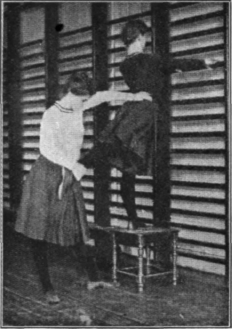
Fig. 66.
The movement takes place chiefly in the hip of the supporting leg and in the joints of the lumbar spine; only the last part takes place in the hip of the moving leg.
The working muscles are : -
(a) The extensors of the knee of the moving leg (statically), to keep the knee extended.
(b) The extensors of the hip of the supporting leg (eccentrically and concentrically).
(c) Abdominal muscles, especially the straight and the oblique (eccentrically and concentrically).
(d) Flexors of hip of moving leg (concentrically and eccentrically).
Effects And Uses
Because the abdominal muscles work it aids peristalsis somewhat, but otherwise the exercise has no special effect. It is used as a combined abdominal and leg exercise in general gymnastic treatment.
G. Movements chiefly for Abductors of Hip.
Crook-half-lying Knee-parting and -inpressing (Fig. 67). - -The gymnast stands at the side of the patient's knees or in front of his feet and puts his hands on the outer side of the knees. The patient carries the knees outward against the resistance of the gymnast, who then presses them together against the resistance of the patient. Repeated four to six times.
It is sometimes combined with "Pelvis-lifting" which is performed by the patient strongly extending both hips, raising the pelvis so that he comes to rest upon the plinth, supported only by the neck and upper part of the back and the feet. The movement is then performed in this position.
The working muscles are : -
Glut. Med. and Min., but the Gemelli and Pyriformis also take part. They work concentrically and eccentrically. It depletes the abdominal and pelvic organs, especially when combined with Pelvis-lifting, because this causes strong work for the extensors of the hips and back.

Fig. 67.
Half-lying Hanging
Leg-parting and -inpressing.
Half-Lying, Leg-Parting And -Inpressing
The gymnast stands in front of the patient and grasps him at the ankles. The patient carries the legs outward against the resistance of the gymnast, who then presses them together against the resistance of the patient. Repeated three to six times.
If two gymnasts are working (Fig. 68) they stand at the side of the patient's legs, which are supported against their thighs. They should be so placed that the movement can be performed without the foot which supports the patient's leg being moved from its place.
It is only distinguished from the preceding movement in that the gymnast has a longer lever. It is used, therefore, for strong patients.
Continue to:


My Books

