


I. Positions Derived From The Standing Fundamental Position
Description
This section is from the book "Massage And Medical Gymnastics", by Emil A. G. Kleen. Also available from Amazon: Massage and medical gymnastics.
I. Positions Derived From The Standing Fundamental Position
A. By changing the Position of the Legs.
Close-standing
1. Close-standing. - Arises by rotating the legs inwards in the hip joints, so that the inner borders of the feet touch.
The working muscles are : -
The inward rotators of the hip, viz., Tensor Fasciae Latae and the anterior fibres of Gluteus Medius and Minimus.
Effects And Uses
(a) Because the axes of the ankle joints are parallel, the body more easily falls forward than in the fundamental position, so that the calf muscles have increased work in maintaining the position.
(b) Mobility of the hip joints is increased, by relaxing the ligaments in front of the joint. On this account it is used for trunk-rotations when it is also desired to exercise the hip joints and their rotators.
(c) The base is diminished, so that the position becomes less steady, and thus the line of gravity falls outside the base with the slightest deviation from the position. For this reason first one muscle and then another must work incessantly to bring the line of gravity to the middle of the base. This is done partly by reflex action, partly consciously, and the position thus gives exercise to the reflex apparatus, while at the same time it compels the patient's attention, since for the sake of equilibrium he must continually send considered impulses to one and another muscle or group of muscles.
This is the case with all positions where the base is diminished, and they are called on this account by a common name, "Balance positions," and are used : -
(1) To compel the patient's attention to the movement (e.g., with excitable children or dull patients).
(2) For general disturbances of innervation, e.g., in ataxy, to exercise innervation.
(3) To produce a general gentle muscular action.
Toe-standing
2. Toe-standing (Fig. 38). - It arises by plantar flexion of the ankle joint, i.e., lifting the heels as high as possible from the ground.
The body then only rests upon the balls of the toes, and the base is considerably diminished.
The working muscles are : -
The calf muscles. They work first concentrically to take the position, and then statically to maintain it.
Effects And Uses
The same as in balance positions.
Knee-bend-standing or Curtsey-standing
3. Knee-bend-standing or Curtsey-standing. - Arises by lowering the trunk till the leg and thigh form a right angle with each other. Dorsal flexion at the ankle joint takes place along with flexion of the hips and knees. The knees are separated on account of the axes of the ankle joints, which form an angle opening backwards. (N.B. - The lowering of the trunk is caused by gravity, while the working muscles control the movement by eccentric action, after which they maintain the position by static action.)
The working muscles are : -
(a) The calf muscles.
(b) The extensors of the knee.
(c) The extensors of the hip, especially the Glutei. Effects and Uses. - (a) Exercise of the working muscles.
(b) Depletes the head and other parts of the body because so many leg muscles are used.
(c) Stretches the calf muscles.
Is used very little in medical gymnastics. But it may be of use in after-treatment of fractures of the malleoli to increase the mobility of the ankle joint. It may then be done on one side only.
Toe-curtsey-standing
4. Toe-curtsey-standing. - Arises by combination of the two previous positions.
The working muscles, effects and uses are the same. This position is also good exercise for double-sided innervation, and is therefore used in treatment of scoliosis or a tendency to it.
Walk-standing
5. Walk-standing. - Is taken by moving one foot about two foot-lengths forward in the sagittal plane, maintaining the same angle between the feet.
(In educational gymnastics this position is called Walk b standing to distinguish it from Walk a standing, which arises by moving the foot forwards and outwards.)
Most of the leg muscles work in taking and maintaining this position.
Effects And Uses
(a) The base is lengthened in the sagittal direction, so that equilibrium is more stable in this plane. It is therefore used where movement takes place in a forward or backward direction, e.g., in 2 (double) Plane Arm-carrying.

Fig. 38.
(b) Stretching of the soft parts around the hip joint is increased at the back of the anterior leg and on the front of the posterior leg, which helps to fix the pelvis. It is used for many trunk movements to give the working muscles a firm origin, as in forward-bendings; to increase the stretching of soft parts on the back of the hip joint of the anterior leg, as in the treatment of sciatica.
Stride-standing
6. Stride-standing. - Is taken by moving one foot two foot-lengths to one side, the angle between the feet remaining the same.
The working muscles are most of the leg muscles.
Effects And Uses
(a) The base is enlarged in a lateral direction, so that steadiness of position is increased in the frontal plane.
(b) By stretching the adductors and some of the ligaments of the hip joint the pelvis is fixed. It is used on this account partly in movements which require steadiness in the frontal plane, partly for trunk movements, e.g., active Trunk-rolling, etc.
Crook-half-standing
7. Crook-half-standing. - Is taken by flexing one hip so that the thigh and trunk form a right angle, while the leg hangs loosely down, also at right angles with the thigh, and the foot is plantar flexed.
The working muscles are : -
(a) Flexors of the hip of the raised leg (Ilio-psoas), first concentrically, then statically.
(b) Abdominal muscles, statically to fix the origin of the above-mentioned muscles on the pelvis.
(c) Back muscles, to counteract the tendency of the abdominal muscles to bend the body forward.
(d) The extensors of the supporting leg (Glut. Max., Semi-tendinosus, Semi-membranosus, and Biceps), to prevent the body falling forward at the hip joint owing to the weight of the flexed leg.
(e) Most of the muscles of the supporting leg.
Effects And Uses
(a) Exercise and development of all the working muscles.
(b) Balance exercise, through diminishing the base (see Close-standing Position).
(c) Increased peristalsis, owing to associated movement between the abdominal muscles and non-striated muscles of the alimentary canal.
(d) Repleting to the pelvis, owing to work of Ilio-psoas (according to Thure Brandt).
Step-standing
8. Step-standing. - Similar to the above position, but the raised foot is placed upon a stool or something of the kind.
The working muscles are the same, but after taking the position no special muscle action is required to maintain it.
Effects And Uses
The soft parts in the region of the groin on the side of the raised leg are relaxed, so that the position is sometimes used when stretching of these parts must be avoided, e.g., after appendicitis, pelvic troubles, operation scars, etc.
Instep-support-standing
9. Instep-support-standing. - Is taken by bending one knee and allowing the ankle to be supported by some apparatus behind the patient, as a stool. The bent leg is usually carried slightly back.
Effects And Uses
(a) Makes an exercise harder, because the weight of the body is chiefly supported by one leg (double work for these muscles.)
(b) Pelvis is fixed owing to stretching of Rectus Femoris of the bent leg and of the ligaments in front of the hip joint.
Major Thure Brandt often used this starting-point for Knee-bendings, to increase their repleting effect to the pelvis. The increased stretching of Rectus Femoris tilts the pelvis forward in the hip joint and produces a strong arch position, which, according to Brandt, has the above effect (see Arch Position).
Heel-support-standing
10. Heel-support-standing. - Is taken by placing one foot on some apparatus in front, so that the heel rests on it. The knee is extended.
Effects And Uses
(a) Makes exercise more difficult, because the body is supported only on one leg.
(b) Produces increased stretching of the soft parts at the back of the raised leg. Is used specially in Forward-bending, in order to produce a strong stretching of the sciatic nerve.
Fall-out-standing
11. Fall-out-standing (Fig. 39). - In medical gymnastics the position chiefly used is that called in educational gymnastics Fallout b standing. This is taken by moving one foot three foot-lengths forwards or backwards in the sagittal plane, maintaining the same angle between the feet. At the same time the body falls forward and the front knee is bent until it comes to be over the point of the toes. The trunk and the fully-extended posterior leg must be in a straight line.
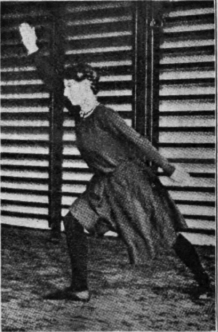
Fig. 39.
In order to take up and maintain this position a large number of muscles must be brought into action, especially the back muscles, more particularly those in the lumbar region on the opposite side to the posterior leg. The position is therefore used in treatment of scoliosis, to correct a curve in the lumbar region with the convexity on the opposite side to the posterior leg.
If the arm which corresponds to the anterior leg is stretched up as much as possible and held in a line with the trunk and posterior leg (the other arm extended slightly backward), the muscles in the upper region of the back are in this way made to work strongly on the opposite side to the upward-stretched arm. This modification of the position is therefore used in treating double curves : Right (arm)-stretch (Left leg backward) Right Fall-out-standing position for a double curve, with the upper convexity to the left and the lower to the right.
Continue to:


My Books

