


I. Movements in Humero-Scapular Joint. A. Abduction and Adduction (round the sagittal axis)
Description
This section is from the book "Massage And Medical Gymnastics", by Emil A. G. Kleen. Also available from Amazon: Massage and medical gymnastics.
I. Movements in Humero-Scapular Joint. A. Abduction and Adduction (round the sagittal axis)
Sitting Arm-Carrying-Outward And -Inward
The patient's arm is flexed to a right angle in the elbow joint. The gymnast with one hand grasps the patient's hand, with the other gives resistance at the elbow, while the patient alternately carries the arm outward to the horizontal and inward. Repeated three to five times.
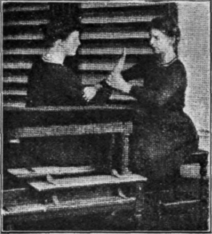
Fig. 76.
Sometimes taken passively to improve mobility in a stiff shoulder. In this case the shoulder is fixed by one of the gymnast's hands or in some other way.
The working muscles are : -
In abduction : (a) Deltoid (for movement in humero-scapular joint).
(b) Serr. Magnus and lower part of Trapezius (on the acromioclavicular joint). They all work concentrically.
(c) Upper part of Trapezius (statically to fix sterno-clavicular joint).
For adduction : (a) Pect. Major and Lat. Dorsi.
(b) Teres Major.
(These work chiefly on the humero-scapular joint.)
(c) Rhomboids (on acromioclavicular joint).
(d) Pect. Minor and lower part of Trapezius (work on sternoclavicular joint).
No special effect besides exercise for muscles and joints.
Used when these are to be exercised, e.g., after paralyses and in treatment of accidents to the shoulder joint.
Standing 2 (Double) Arm-Lifting-Sideways
Usually taken as a free movement (without resistance). In this only the abductors are used (concentrically and eccentrically).
Effects And Uses
The chest is expanded as in taking Yard-standing position.
Used on this account as a gentle respiratory exercise, which may be taken by the patient himself as a so-called "between movement."
Continue to:


My Books

