


C. Rotation (round the vertical axis)
Description
This section is from the book "Massage And Medical Gymnastics", by Emil A. G. Kleen. Also available from Amazon: Massage and medical gymnastics.
C. Rotation (round the vertical axis)
Sitting Arm-rotation-outward-inward (Fig. 77). - If possible the patient's arm must be abducted to horizontal plane. Elbow flexed to a right angle. The gymnast's one hand grasps and supports the elbow, the other gives resistance at the wrist, while the patient turns the arm alternately in and out. Repeated three to six times. Can also be given as passive movement, either with the above holding or with that for single arm-rolling.
The working muscles are: -
In outward rotation, Infraspinatus and Teres Minor; in inward rotation, Subscapularis,Teres Maj., and Lat. Dorsi.
Effects And Uses
No special effect besides exercise for muscles and joints.
Combined Rotation in Humero-scapular and Radio-ulnar Joints.
(Half-wing-half-) yard-sitting Arm-rotation with rod (Fig. 78). - The patient grasps the rod (a short one about 1/3 metre long) in the middle; the gymnast grasps both ends. The gymnast gives gentle resistance while the patient turns the arm alternately out and in. Wrist joint held well extended throughout, and grip of rod must be firm.
Used as a good arm exercise in general gymnastic treatment, and especially to exercise muscles of rotation and the joints. (N.B. - All movements for fingers, hand, etc., can be given with concentric and eccentric muscle action if specially required.)

Fig. 77.
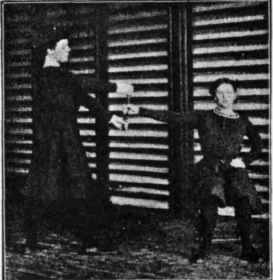
Fig. 78.
D. Rolling.
Sitting Single-arm-rolling (Fig. 79). - Passive movement.
The gymnast stands in stride-st. position at the side of the patient, whose arm, flexed to a right angle, he grasps from in front and below so that the thumb lies in the bend of the elbow, while the patient's forearm lies along that of the gymnast. With the other hand he fixes the patient's shoulder (thumb behind, fingers in front). The patient's arm is now rolled (circumducted) in as large circles as possible in both directions. If the gymnast throughout the movement gives a little drawing out in the direction of the upper arm the movement will go better and more comfortably. It is used specially in treatment of stiff shoulder. (N.B. - If movement in the humero-scapular joint is very limited, mobility in the other joints of the shoulder may be so increased that they take its place. In this case the shoulder would not be fixed.)
2 (double) Arm-rolling (see Combination of Movements in all Joints of Shoulder).
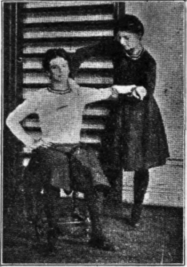
Fig. 79.
Continue to:


My Books

