


III. Combination Of Movements In All Joints Of Shoulder
Description
This section is from the book "Massage And Medical Gymnastics", by Emil A. G. Kleen. Also available from Amazon: Massage and medical gymnastics.
III. Combination Of Movements In All Joints Of Shoulder
St. 2 Arm-carrying-forw.-upw.-outw.-downw.; St. 2 Arm-carrying-outw.-upw.-outw.-downw. - Free movements. Done in time with breathing three to six times. (N.B. - When the arms have reached stretch position the patient makes an attempt to raise them a few centimetres higher. These movements can also be done as swingings. They are then done quickly, and their effect is stronger.)
Effects And Uses
Like the preceding group. Respiratory exercises, which the patient can do by himself as "between movements."
Here I will shortly recall the effects of respiratory exercises on the body : -
(a) They increase the supply of oxygen and the output of C02, and thus assist the general metabolism in the body.
(b) They help the systemic circulation through the increased negative pressure in the thorax accompanying inspiration.
(c) They help the systemic circulation by alternate lengthening and shortening of the blood vessels of the lungs and the consequent pumping of blood.
(d) They stretch adhesions which may be found between the lung and the thoracic wall, or they prevent the formation of such.
(e) They increase mobility in the joints of the ribs, so that respiration is facilitated.
On this account respiratory movements are enormously used in medical gymnastics, both in the treatment of lung and heart diseases and in general disturbances of nutrition. It is an unbroken rule that a table of medical gymnastic treatment must be introduced and finished with a respiratory exercise.
Yard-walk-standing
Yard-fall-standing
Yard-stoop-leg-lean-standing
Yard-stride-sitting
Yard-stoop-stride-sitting
Yard-leg-forward-lying
2 (double) Plane - Arm carrying (Fig. 81).
The gymnast stands in walk-standing position in front of the patient and grasps his forearms as near the wrist as possible. The patient resists while the gymnast carries the arms forward to "reach" position, and then carries the arms back as far as possible against the resistance of the gymnast.
Repeated three to five times. (N.B. - Patient's shoulders must be kept low throughout. Arms are carried in the horizontal plane.)
The working muscles are:' - (a) For the movement itself, posterior fibres of Deltoid and the back shoulder muscles (Trapezius, Rhomboids, and Lat. Dorsi). They work eccentrically and concentrically in shortening (in the inner part of their range of movement).
(b) To maintain the position, and to fix the origins of the above-mentioned muscles, the extensors of the back and hips, statically.
(c) Triceps (statically) to hold the elbows extended.
Effects And Uses
Thorax is expanded and position of the shoulders corrected. It is used especially in treatment of "flat chest," kyphosis and round back, and many deformities of the thorax, also in general gymnastic treatment as a good combined arm and back exercise. It also has a depleting effect on the abdominal and pelvic organs.
Yard-sitting Heave-sitting Stretch-sitting Stretch-half-lying 2 (double) Arm-rolling.
Yard-sitting or high-ride-sitting 2 Arm-rolling (= Circling) (Fig. 82). - The gymnast, standing behind the patient and supporting him in the back, grasps his elbows and carries his arms in large circles forw.-upw.-outw.-downward. Movement is repeated six to ten times and is given in time with respiration, when, as is usually the case, it is given as a respiratory exercise. If the circles are made very much larger the movement resembles passive 2 Arm-carrying in sitting position forward-upw.-outw.-down-ward. It expands the thorax by stretching the Pectorals and Lat. Dorsi.
When the movement is given to heart patients the arms as a rule are not carried above, or only slightly above, the horizontal plane, and not so far backward that any definite fixing of the thorax arises. If it is given to help circulation the arms are carried in rather smaller circles and in quicker time. Repeated fifteen to twenty times.
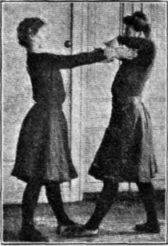
Fig. 81.
Heave-sitting 2 Arm-rolling (= Flying) (Fig. 83). - The gymnast stands on a stool behind the patient, supporting the back with his knee, or more correctly with the front of the lower part of his thigh. The gymnast and the patient grasp each other's wrists and forearms, and the patient's arms are rolled first in one direction and then in the other fifteen to twenty times in rather quick time. Used for aiding circulation and to loosen the joints.
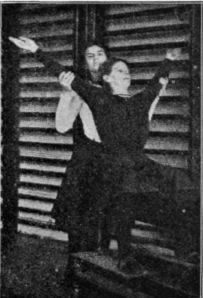
Fig. 82.
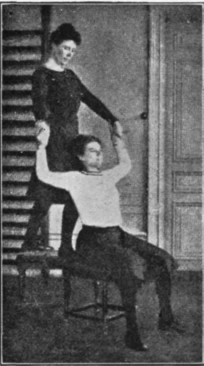
Fig. 83.
Stretch-Sitting 2 Arm-Rolling
Position of gymnast like the preceding. The patient and gymnast grasp each other's thumbs (really the metacarpal bone of the thumb), and patient's arms are rolled in small circles in both directions. Usually finished by 2 Arm-bd.-str. (N.B. - Patient's hands are really only carried straight up and down, the elbows being slightly bent and stretched; at the same time describing a circular path, so that the rolling takes place both in the wrist and shoulder joints.)
Stretch-Half-Lying 2 Arm-Rolling
Given as the preceding. Both these last forms of the exercise are often used to loosen stiff shoulders.
Continue to:


My Books

