


IV. Exercises For The Rotators Of The Trunk. Part 2
Description
This section is from the book "Massage And Medical Gymnastics", by Emil A. G. Kleen. Also available from Amazon: Massage and medical gymnastics.
IV. Exercises For The Rotators Of The Trunk. Part 2
Free movement. The patient turns himself alternately to the left and right. The muscles (rotators of the trunk and pelvis) work as described above, only concentrically. It is usually performed slowly, but may be done quickly. It is then called "Quick Alter-nate-Trunk-turning" and necessitates strong work for the muscles and stronger stretching of the ligaments and capsules of the joints. Quick turning is usually done in Stride-standing starting position. For Alternate-Trunk-turning, Close-standing or Stride-standing position may be used.
Wing-Neck-resthigh-ride-sitting Alternate-Trunk-turning.
Resistance exercise. Gymnast behind patient. The pelvis is firmly fixed by the starting position, so that the movement is confined to the trunk muscles.
Wing-Close-Sitting Alternate-
Trunk-turning (Fig. 105). - The gymnast stands in front of the patient and fixes the knees firmly between his own, but avoids coming too near to the patient. Otherwise like the preceding. It is much used because it is so easily arranged.
Wing-Stoop-Stride-Sitting
Alternate - Trunk-Turning
Gymnast in front of patient. Stoop position must be maintained throughout. Depletes abdominal and pelvic organs (see General Effects of Trunk-rotations).
Heave-Stretchstoop-stride-sitting Alternate-Trunk-turning (Fig. 106).
Gymnast on a stool in front of patient. Grasp round each other's wrists or forearms. Rotation must be pure. It is usually given so that the back muscles have most of the work (see above, General Effects). It has a strongly depleting effect on the abdominal and pelvic organs. Usually "Heave position" is used.
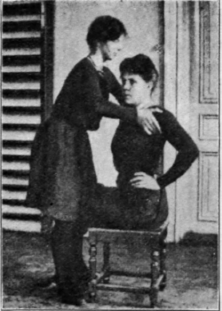
Fig. 105.
Wing-Neck-restknee-stride-standing Alternate-Trunk-turning.
It is best for the patient to take the starting position on a plinth. The gymnast stands behind in step-standing position and supports the patient's sacrum with his knee. It is often given in strong arch position, when the pelvis is pushed forward and the strongest resistance is given in front of the shoulder, which the patient turns forward. (N.B. - The patient must not be pressed down, but instead a slight stretching must be given in the long axis of the trunk. The pelvis is not so well fixed in this position, so that the rotators of the pelvis are also brought into action. Has a repleting effect on the pelvis, especially when given in strong arch position.)
Wing -Leg-Forward-Lying Alternate -Trunk-Turning
Gymnast in front of patient. Pelvis not fully fixed, so that the rotators of the pelvis also take part in the movement. Used in the treatment of scoliosis to increase mobility in the joints and also to exercise the back muscles.
Wing-Close-Standing Alternate-Trunk-Turning
Best given as Forward-turning. The side of the patient's foot is supported on the side from which forward-turning takes place by a piece of wood or by the gymnast's own foot. Hip joints as movable as possible, so that the rotators of the pelvis take a large part in the movement.
Heave-. Stretchgrasp-close-standing Alternate -Hip-rotation Gymnast in front of patient. Grasp with one hand in front of the hip at the Ant. Sup. II. Spine, with the other hand behind the opposite hip. The movement is usually given by method (B), hut the pelvis is rotated instead of the trunk; sometimes also by (D)
(Fig. 107).

Fig. 106.
(see general description of Trunk-rotations).
The characteristic of this exercise, when taken in this starting position, is that the body is fixed above by grasp-standing, as well as below by its weight and the friction of the feet on the supporting area. The result is that, while the rotators of the pelvis work in the same way as in ordinary trunk-rotations, the attachments of the rotators of the trunk become reversed, so that their upper or proximal end becomes the origin. Another result is that the rotators of the trunk and pelvis, as it were, change partners, so that the right rotators of the pelvis work with the left rotators of the trunk, when the pelvis is turned to the left by the gymnast and turned forward again by the patient. This is easily understood when one remembers that the left side of the pelvis is first separated from and then approaches the lower border of the right side of the chest, and consequently the muscles going between these two points (i.e., the left rotators of the trunk) are brought into action, while the right rotators of the pelvis work as in ordinary trunk-rotation. When the movement to each side has been completed the same muscles have worked as in Wing-close-standing Alternate-Trunk-rotation, but because they have been combined in a quite different manner the innervation, i.e., the work of the nervous system and its exercise, has been entirely different. The patient can use much more force and overcome much greater resistance in Alternate- Hip-rotation because the origin of the rotators of the trunk is so firmly fixed by the starting position.
It is used as a variation from trunk-rotations, and given by method (D) and to one side only, in order to correct the position of the pelvis in some forms of scoliosis.

Fig. 107.

Fig. 108.
Wing-High-Ride-Fall-Turn-Sitting Forward-Turning (Fig. 108)
The patient is first placed in Wing-high-ride-sitting position on a high plinth. The gymnast stands behind and with his right hand grasps the patient's right shoulder from below as in Backward-drawing; the left hand goes from above and in front under the patient's left arm and is placed, with the dorsal surface against his back, between the angles of the scapulae. The patient's head rests against the gymnast's left shoulder. The gymnast now moves his left foot backward, lets the patient fall back till about half-way between the vertical and horizontal planes, and rotates him to the left so that he comes to be in High-ride-fall-turn-sitting position. (N.B. - The patient's back must be supported.) Against the resistance of the gymnast the patient turns the trunk forward, maintaining the fall position, and then resists while the gymnast turns him back to the starting position. Repeated three to five times to each side, naturally with change of grip.
Continue to:


My Books

