


The Meaning Of Massage And Its Technique. Continued
Description
This section is from the book "Massage And Medical Gymnastics", by Emil A. G. Kleen. Also available from Amazon: Massage and medical gymnastics.
The Meaning Of Massage And Its Technique. Continued
For such knowledge, besides the above-mentioned studies, the power of palpation is necessary; skill in this respect is the masseur's most difficult task, and can only be acquired and maintained by practice. (The examinations which specially concern the masseur are mentioned later.)
The manipulations which are met with in massage have been classified in very different ways. Many of the scientific exponents of massage are, however, fairly well agreed in distinguishing four different classes of manipulation, which are generally denoted by French names, and are: -
1. Effleurage = stroking.
2. Friction = rubbing with pressure.
3. Petrissage = pinching, rolling, kneading.
4. Tapotement = blows, slapping, hacking, beating, clapping, shaking, vibration. Effleurage (Figs. 1 - 5) consists of centripetal strokings performed with varying strength generally over a large surface of skin, and with a large surface of hand; with the flat hand, with the ulnar or radial portion of the hand, with the thenar eminence, with the base of the hand, with thumb and forefinger, generally with one hand at a time, but sometimes with both hands together (as when a limb is grasped). Effleurage is a form of massage very frequently used and has a therapeutic aim which constantly recurs in practice. The chief function of effleurage is to hasten the circulation in the blood and lymph vessels; it is therefore often performed over the more important veins, where these are easily affected, as in the front of the neck and in the extremities. Thus in general massage (as in other forms of massage) stroking over the veins of the extremities is used in the form of long strokes from the wrist to the proximal end of the upper arm, or from the foot up to the fold of the groin.

Fig. 1.

Fig. 2.

Fig. 3.
In local massage also one often uses effleurage over the superficial veins to hasten the circulation within a comparatively small area. In both cases the stroking is given with very moderate pressure. Again, when one makes use of stroking to press the blood and lymph out of a whole muscle group one uses rather more strength in the manipulations.
Figs. 1 and 2 show effleurage of the leg as it is performed in general massage. Fig. 1 shows the hand of the masseur gliding up over the calf and approaching the popliteal space. When the hand has reached the popliteal vein and effleurage is to be continued over the veins of the thigh, the hand is turned so that the fingers are directed to the outer side of the thigh (Fig. 2), in order to continue the effleurage right up to the groin without risking coming in contact with the external sexual organs.
Fig. 3 shows a method of performing effleurage over the front of the forearm, the thumbs gliding over the outer side, the other fingers over the inner side of the patient's arm, at the same time going over the large veins in that situation.
Fig. 4 shows another method of performing effleurage of the forearm. In this the tips of the fingers are towards the outer side of the arm while the base of the hand moves along its inner side.
Fig. 5 shows effleurage over the shoulder-joint, e.g., after a dislocation. The masseur, with both hands flat, performs a circular stroking movement, one hand passing over the front, the other over the back of the shoulder with moderate speed and strength on both sides.
Friction is rubbing with pressure, generally performed over small areas, with the palmar surface of the last phalanx of the thumb or of the three middle fingers, but also may be performed in other ways, e.g., with the base of the hand or with the whole palm. Friction is used chiefly to hasten retrogressive changes in inflammatory products, infiltrations and exudations, to press into the outlying lymphatics the disintegration products, and so to promote their absorption. The direction of this manipulation is therefore unimportant, but it is generally necessary to use firm pressure. This is generally possible, but not always. When friction is performed over the eye or over inflammatory products in the abdomen and pelvis, it is obvious that it must be performed with very moderate pressure.
Fig. 6 shows friction as it should be performed for rheumatic infiltrations of the neck in the upper part of trapezius or occipitalis. The masseur presses in on the affected parts, performing a small movement with the apposed tips of his three middle fingers.
Fig. 7 shows friction performed by the thumb on the knee-joint over an infiltration in its capsule, an affection called by Swedish doctors "capsulitis."

Fig. 4.

Fig. 5.

Fig. 6.

Fig. 7.

Fig. 8.
Fig. 8 shows friction performed over the left supraorbital nerve for rheumatic interstitial neuritis. It is a small matter whether one prefers to use the palmar surface of the last phalanx of the thumb . or of the three middle fingers.
Fig. 9 shows friction with the palmar surface of the last phalanx of the middle finger above and through the eyelid for opacities in the cornea. The fingers perform a small movement from side to side with as much pressure as may be given without risk.
Fig. 10 shows friction in a case of sciatica due to muscular inflammation, performed with the palmar surface of the last phalanges of the three middle fingers, over the gluteal muscles, which in these cases are often the seat of rheumatic infiltrations. Fig. 11 shows friction performed with the base of the hand in a case similar to that shown in Fig. 10. It is a form of technique seldom seen but not objectionable.
Fig. 12 shows friction with the base of the hand over infiltrations in the back muscles. The remark in reference to Fig. 11 applies also to this.
Fig. 13 shows friction over rheumatic infiltrations in the back muscles given with the whole palmar surface of the hand, a method less often used but very useful in cases of widespread infiltrations.
It is obvious that since all massage manipulations vary in form and may be performed in different ways with the same effect, and since effleurage and friction in particular have to some extent the same object, in that they promote absorption, there must be various transition forms between the two. But generally speaking, effleurage is performed over a large surface of skin and less pressure is used than in friction.
Petrissage consists of rolling, kneading, and pinching. Its physiological effects resemble those of friction in that it promotes absorption of the products of inflammation, and those of tapotement in that it is a form of muscle stimulus. These react to a pinch as to a blow by a local contraction and thickening.
Fig. 14 shows petrissage over the upper border of trapezius, which is a favourite situation for rheumatic muscle infiltrations. The masseur grasps the muscle between his thumbs behind and his fingers in front and lets his hands perform a series of pinching or wringing movements.
Fig. 15 shows petrissage of the forearm as it is usually given in general massage. The masseur holds one hand on the front, the other hand on the back of the forearm, and kneads the muscle masses by a movement of one hand against the other.

Fig. 9.

Fig. 10.
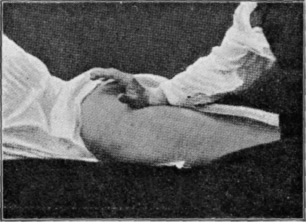
Fig. 11.

Fig. 12.

Fig. 13.

Fig. 14.
Fig. 16 shows the same procedure on the upper arm. By their movements against each other the masseur's one hand works on the flexors, his other on the extensor muscles.
Figs. 17 and 18 show petrissage of triceps on the upper arm. In Fig. 17 the masseur holds his thumb on one side, his fingers on the other side of the muscle mass; in Fig. 18 the manipulation is performed by means of pinchings between the four fingers and the base of the hand; the latter form is much more seldom used than the former. Altogether, petrissage is a form of massage less often used than effleurage and friction. Used as in Figs. 14 and 17, the manipulation has a diagnostic as well as a therapeutic value, since one can in this way palpate and recognise muscle infiltrations.

Fig. 15.

Fig. 16.

Fig. 17.
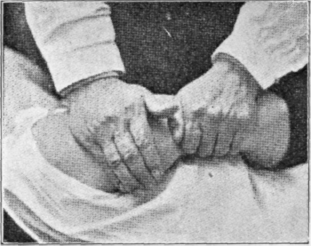
Fig. 18.
Continue to:


My Books

