


Tapotement
Description
This section is from the book "Massage And Medical Gymnastics", by Emil A. G. Kleen. Also available from Amazon: Massage and medical gymnastics.
Tapotement
Tapotement (Figs. 19 - 22) consists of manipulations which aim essentially at mechanical stimulation of muscles or nerves; these manipulations are all characterised by their blow - like nature and are named as already mentioned, hacking, beating, shaking, vibration.* We work upon the skeletal muscles by beating them all over with the closed fist, by hacking them at right angles to their long axis with the ulnar border of the hand (Fig. 20), or, especially in the case of small thin muscles, as the extensors of the forearm, flicking them with the dorsal surface of the fingers generally held slightly apart (Fig. 21). By shakings performed from side to side with one hand on each side of the patient's abdomen we affect both the muscles of the alimentary canal and its nerve elements. By hackings or vibrations over the head or spine we can mechanically stimulate the cerebro-spinal centres within their bony covering. By chest clapping we stimulate the vagus and consequently produce slowing of the heart-beat and pulse. We affect nerve trunks by percussion or vibration along their course, and lastly, we can stimulate the nerve endings in the skin by different kinds of tapote-ment, e.g., by blows with the flat hand or with different instruments.
* Vibrations are, by some authors, considered as a special fifth group of manipulations. They are distinguished however from other forms of tapotement merely by the greater frequency of the blows in a given time and by the smallness of the movement. They aim at a similar stimulation and produce similar effects. When vibrations are given by instrumental means on mucous membranes which are difficult to get at by means of the fingers (see later) they are really a substitute for frictions..
Fig. 19 shows back hackings in standing position as performed by Swedish gymnasts; tapote-ment given with the ulnar border of the masseur's hands, the fingers being parted.
Fig. 20 gives a picture of tapotement of the back in general massage. The hands are slightly supinated and strike the back with part of their dorsal surface. The hands go up and down several times on each side of the spine. Tapotement is often given also over the spine.
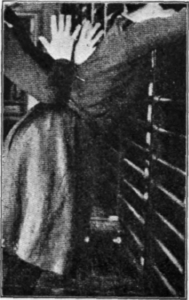
Fig. 19.
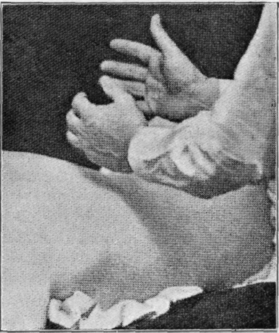
Fig. 20.
Fig. 21 shows a method of performing tapotement on the dorsal surface of the forearm. The masseur, with fingers held apart, flicks the thin extensors of the forearm with their dorsal surface.
Fig. 22 shows a method occasionally used by giving vibrations without instrumental aid over the posterior nerves on each side of and quite close to the spine. The three middle fingers of the masseur's left hand go down the left side of the patient's spine, the three middle fingers of his right hand down the right side, giving a series of small quick blows. This manipulation requires much practice.
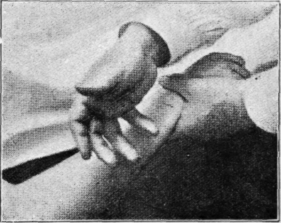
Fig. 21.
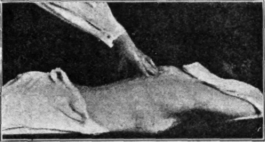
Fig. 22.
Generally speaking, massage as a whole is performed best by hand, and no instruments exist or can ever be produced with which one can, even approximately, perform the various manipulations that go to a massage seance as well as by the hands.
But it cannot be denied that in some cases one may with advantage make use of instruments. Certain forms of tapotement and especially vibrations are performed much more smoothly, quickly, and strongly by means of instruments than by hand.
A great number of cheap, efficacious and durable vibrators are now in the market - the "Veni-vici vibrator," the "Auto-vibrator," the "Medical vibrator," etc. Of Zander's well-known and ingenious apparatus most are concerned with gymnastics, but several with massage, and among the latter those which aim at vibrations are, beyond a doubt, those which best fulfil their aim.
Some masseurs use india-rubber balls provided with handles and long or short levers. An instrument for tapotement looks like a thimble with such a ball at its point. At one time a "palate" was used, a round flat wooden slab on a lever with a handle, to stimulate the skin by repeated blows. At some of the Swedish seabathing places different kinds of seaweed, chiefly Fucaceae, are used for the same purpose.
Continue to:


My Books

