


Chapter IX. The Use Of Apparatus For Exercise
Description
This section is from the book "Massage Its Principles And Practice", by James B. Mennell. Also available from Amazon: Massage It's Principles and Practice.
Chapter IX. The Use Of Apparatus For Exercise
As we have already seen, almost every form of exercise may be classed, more or less, as an assistive or resistive exercise, and the description of mobilisation as a sequel to massage is, therefore, not complete without some account of the exercises which are most frequently used as a complement to massage work.
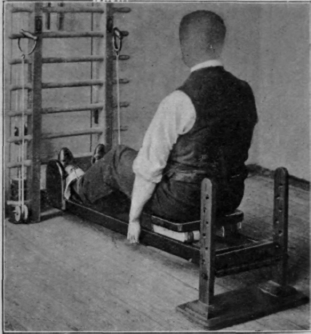
Fig. 49. - The first position for exercise on the sliding-seat. Foot-piece loose.
The vast majority of Swedish exercises are commonly referred to as "free" exercises: in reality many of them depend very largely for their success on the action of gravity assisting or resisting the movements performed. For educational and remedial purposes they would be perfect were it not for two great disadvantages. The first is that it is difficult to inspire the uneducated with sufficient zeal either to master or to perform them efficiently; and the second is the difficulty of securing an efficient teacher. A perfect knowledge of what are commonly called Swedish Remedial Exercises does not render the teacher efficient, unless there has been at least a firm grounding in Swedish Educational Exercises.
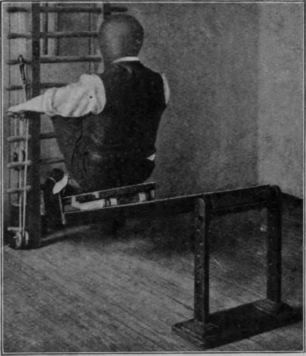
Fig. 50. - The last position for exercise on the sliding-seat. Foot-piece fixed and flexion of the knee assisted by the pull of the arms. It is evident that this position affords an admirable introduction to the high curtsy sitting position.
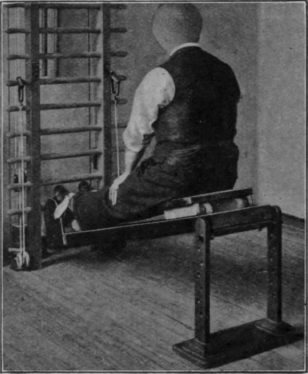
Fig. 51. - The same as Fig. 50, only showing assistance given by the patient to secure full extension.
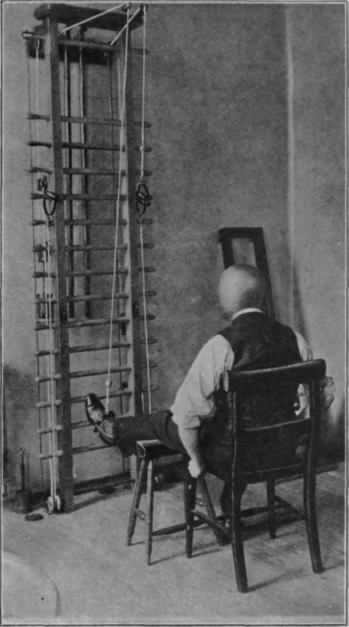
Fig. 52. - To show the first exercise with the weight and pulley for re-educating the quadriceps. Note that this muscle is doing no active work at all, provided the weight is adequate to counteract completely that of the limb below the knee.
Unfortunately it is not universally recognised how hard it is to give good or even efficient instruction in any form of Swedish exercise, remedial or educational. The amount of knowledge, skill and tact which are essential qualifications in those who would gain proficiency in the art of teaching "exercises" is, as a rule, grossly under-estimated, and it must also be realised that proficiency without practice is impossible. Mere knowledge is useless, and not every one who can pass an examination can teach, though this is the essential function of a medical gymnast. The strain of the concentration required for good teaching is very great. The greatest care and discrimination should be exercised in selecting a medical gymnast, and if only medical men would familiarise themselves with the work done under the generic term of "massage" they would soon learn to discriminate between good and bad, to their own great advantage as well as to that of their patients. They would also learn to accord the deep respect that is only the just due of the accomplished medical gymnast.
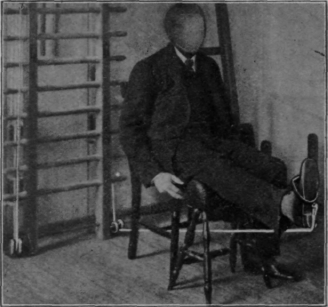
Fig. 53. - Exercising the quadriceps with weight and pulley while sitting. Note that the muscle is now called upon to contract strongly.
It is impossible not to realise that there was something very human in the old villager, who informed the doctor about to prescribe for him, "I likes summat black as stinks." So, too, there is somewhere in human nature a desire to see the result of work performed; and, especially with the uneducated, there is a sense of satisfaction in seeing a weight ascend, in response to a pull on a cord which passes over a pulley. So much is this the case, that a patient who is content to spend twenty minutes in the performance of this exercise will frequently refuse to spend five if requested to use a roller-towel instead!
Also it is more simple to teach patients to graduate their exercises with the use of apparatus than without it, and there is, in the use of apparatus, the spirit of opposition that incites to accomplishment, which is absent in feats entailing perhaps greater skill and effort where no apparatus is used.
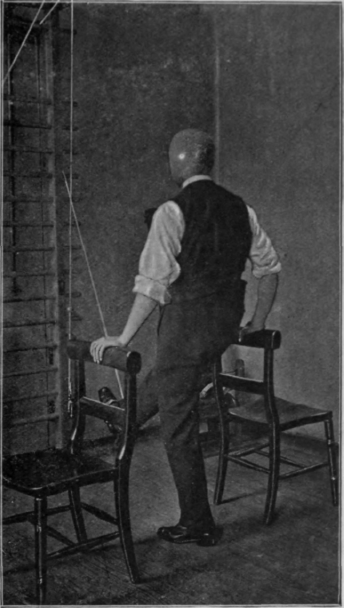
Fig. 54. - To show assistive exercise for the flexors of the hip. Increase of weight gives resistive exercise for the extensors. Note that not only are certain muscles in the limb attached to the apparatus being exercised. The patient is called upon to do valuable balance work on the other limb. Hence it may well be wise to attach the sound limb to the apparatus in order to train, re-educate and exercise the injured limb.
But the more simple the apparatus, the better will be the result.
Continue to:


My Books

