


Chapter XIII. Fractures of the Lower Extremity. Fractures Of The Neck Of The Femur
Description
This section is from the book "Massage Its Principles And Practice", by James B. Mennell. Also available from Amazon: Massage It's Principles and Practice.
Chapter XIII. Fractures of the Lower Extremity. Fractures Of The Neck Of The Femur
When speaking of elderly patients who have sustained an impacted fracture of the neck of the femur, Lucas-Championniere was always emphatic that more people die as the result of treatment by immobilisation than of the injury. When undertaking treatment by mobilisation and massage it is essential to remember that, if the patient is one of advancing years, the reflex arc is very soon and very easily tired. Hence massage must be reduced, as in children, to a minimum; while mobilisation takes a part in the treatment of these fractures that nothing can replace. It is surprising to find how much movement can be administered, after a few minutes of gentle stroking, to a limb that is held absolutely fixed and rigid by muscular spasm. The relief of the movement is very great: it indicates the subsidence of the cramp and its accompanying pain. It is usual for these fractures to be impacted, and the following remarks are based on the assumption that impaction has taken place.
Massage should begin with surface stroking from hip to foot. In a few minutes the free hand will find that the toes can be moved without pain, a little later the ankle begins to move, and as soon as this has received a fairly full dose of mobilisation attention may be given to the knee. The disengaged hand is placed under the knee, and the most gentle attempt is made to elevate it and to let it fall again every time the massaging hand passes over it. No movement will take place at first, but before long it will be felt. As soon as it has been raised sufficiently a pillow is placed beneath the knee, and then flexion and extension may be performed by supporting the ankle (see Fig. 82). In ten minutes or so foot, ankle, and knee may have been mobilised freely, and this of necessity entails some movement of the hip. If all has gone well so far, the hand under the ankle may now raise the leg, and support is given as shown in Fig. 35, p. 77. All movements of the hip should now be performed slowly and carefully, care being taken while giving internal rotation, as this movement invariably causes pain. In fact, the patient is unlikely ever again to be able to perform this movement, owing to the external rotation of the shaft in its relation to the head of the bone. The limb is next placed at rest, very slightly bent over a cushion, and the patient is instructed to attempt various movements of the trunk, commencing with raising the shoulders and gentle turning movements. Any pain that these may cause may be relieved in a few moments by massage. Following this routine it should be possible to sit the patient up in bed for short intervals on the second day and to get her - the accident usually occurs in women - on to a chair or couch (keeping the limb horizontal) on the third day. The foot may be allowed to hang down in a week, and it is possible to plan a multitude of simple devices to encourage the full restoration of the movements. Some patients can walk immediately after the accident - it is not uncommon for them to do so, as the intensity of the pain is lost for the moment in the shock of the accident - and it is not till later that their real suffering commences. Thus the patient may be encouraged to stand on the sound leg and swing the injured limb gently to and fro, and slowly to carry out the plan for restoration of function mapped out in the chapter on the re-education in walking.
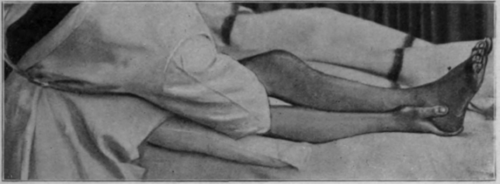
Fig. 82. - To show another method of mobilising the knee during the early stages. The right hand of the masseur alternately raises and lowers the foot.
Continue to:


My Books

