


Massage And Splintage In Orthopaedic Surgery. Part 3
Description
This section is from the book "Massage Its Principles And Practice", by James B. Mennell. Also available from Amazon: Massage It's Principles and Practice.
Massage And Splintage In Orthopaedic Surgery. Part 3

Fig. 159. - To show how a forearm may be slung in supination without the use of a splint.
Adhesive strapping may be applied for this purpose over a thin layer of wool or a bandage (to prevent it sticking to the skin) (see Fig. 159), and the use of this tension is slowly reduced day by day. From the middle or end of the third week onwards the patient is instructed as to what he may or may not do from day to day (cf. Chapter XI (The Treatment Of Recent Injury By Mobilisation And Massage).), and the use of the sling is slowly discontinued for ever-increasing periods each day. On the faintest indication that trouble is arising, a return to the condition in statu quo ante is always possible, and, if gradation has been sufficiently well planned, little or no danger need be anticipated. It is well to repeat, however, that the danger-signals are increase of pain or tenderness, increase or reappearance of swelling, and decrease of mobility, active or passive.
Graduated decrease of splintage after fracture in the lower limb is not, however, so simple a matter, and increased freedom depends more on decreasing the time during which the limb is confined to the splint and on the use that is made of the ever-increasing periods of liberty. There are only two possible ways of decreasing the actual splintage. If the original splint passes above the knee it can be shortened so as to allow full flexion of the joint, and a movable plaster of Paris splint can always be weakened gradually for timorous patients by bending or twisting it. Moreover, a heavy splint can be replaced by one more delicately made.
The whole question of splintage must be under the control of the medical man. If the splint is applied to support a weak union, he must indicate to the masseur if he wishes the splintage to be disturbed for treatment. If this is his wish, then the fact that a splint is worn indicates that pressure or tension are liable to disturb the position of the fragments, so the utmost care must be taken during treatment to see that nothing untoward takes place. This can be ensured only if due attention is paid to the postural part of treatment already described in the section on recent injury (see Chapters XI. to XV. and XVIII.).
When a splint is applied to limit the movement of a joint, the masseur must be informed of the reason for the limitation before treatment is undertaken. Otherwise, sooner or later, attempts will be made to mobilise a knee which the surgeon is attempting to ankylose, or to leave at rest on the back-splint a knee at the one time above all others when mobilisation should be proceeding. Co-operation between surgeon and masseur is obviously imperative; responsibility rests on the surgeon.
If a joint is to remain ankylosed, every care must be taken during treatment of the rest of the limb to see that the posture of the part is such that none of our manipulations tend in the smallest degree to disturb the stability of the joint. Moreover, if the joint is not to function, there is little or no reason why we should devote any attention to the muscles which control the movements of the joint. In the case of a knee-joint, for example, the quadriceps requires no special training, nothing need be done to conserve its strength. The weight of the limb is supported on buttock and heel, and we proceed with our massage for circulatory effect, with the loosening of foot and ankle joints, and with the training of the muscles that control the movements of those joints. The back-splint is bound on regardless of everything save fixation and actual freedom of circulation.
If, on the other hand, the splint has been applied to limit the movements of the joint because the quadriceps is too weak to control extension, then it is of vital importance to pay the utmost attention to the fixation of the splint, otherwise the controlling bandage will compress the muscle we hope to restore unduly at one point, even though the main circulation through the limb is not obstructed. The result is that the nutrition essential to development is withheld, and the condition of weakness is perpetuated. The splint must in this case be fixed in such a way that no pressure whatever is borne by the lower fibres of the quadriceps, especially by the vastus internus. To ensure this, a splint much longer than is usually employed is essential. It must reach from a hand's breadth above the internal malleolus to rather less than that distance below the gluteal fold. It is firmly fixed in position by a broad band of adhesive strapping - the skin may be protected by wool or a bandage - either transversely across the patella or arranged as a figure-of-eight with the crossing at the patella (see Fig. 160). The lower end is then fixed securely with strapping or a bandage over a pad of wool. The light possible bandage, or a turn of adhesive plaster applied quite loosely at the upper end of the splint, is all that is then required to keep the splint in place. The quadriceps is thus free to perform voluntary contraction, and is subjected to no inimical pressure.
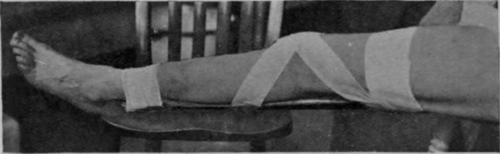
Fig. 160. - To show the application of a straight posterior splint to the back of the leg so as to avoid undue pressure on the vastus internus.
Electrical stimulation can be employed, without disturbing the splint if desired; even massage can be administered with a very fairly free hand if it is deemed inadvisable to remove the splint for treatment, and there is no interference with the circulation through any structure.
Continue to:


My Books

