


Massage And Splintage In Orthopaedic Surgery. Part 4
Description
This section is from the book "Massage Its Principles And Practice", by James B. Mennell. Also available from Amazon: Massage It's Principles and Practice.
Massage And Splintage In Orthopaedic Surgery. Part 4
Similar principles underlie the application of splints to control the movements of other joints. Take as antithesis to the last instance a jointed leather splint, worn to prevent lateralisation of a flail elbow. The patient has two chances of ever being able to discard his splint: first by arthrodesis, and second by the adaptive shortening of triceps and brachialis anticus. Everything, therefore, that can be done to strengthen these muscles should be encouraged, everything that in any way tends to impede their development is to be avoided, and, amongst other things, anything that tends to impede the circulation through them. In other words, the upper part of the splint should be applied as loosely as possible compatible with stability, and that is saying a good deal. A loose funnel is required rather than a glove-like-fitting case.
When splints are applied to control movements at a false joint, caused by non-union after fracture, the greatest care possible is essential when devising and applying them. To effect union an efficient blood-supply is the one essential. Let us beware, therefore, when arranging our splintage that we do nothing to impede the circulation.
Occasionally splints are applied to limit the movement of a joint so as to allow more readily the healing of some other structure. The danger which underlies this method of treatment is that the structure will suffer renewal of injury when mobility is once more allowed. It is wise, therefore, in these cases to treat the patient as one who is suffering from recent injury or an open wound, and to secure some freedom of movement every day.
The principle underlying the application of splintage in order to rest a weakened muscle is a triple one. First, the weak muscle must be free from all strain or tension when in a condition of relaxation. This does not mean that if an extensor is affected the joint controlled by the muscle must be put up in full extension, or, conversely, if a flexion is weak that no degree of extension is allowed. As a general guide we may take it that no inimical strain will be laid upon any muscle provided that splintage is so applied that movement can take place only through the inner third of the range of possible movement.
This leads at once to the second principle, namely, that the application of the splintage must be devised so that the weakened muscle may have perfect freedom for its activities when power is returning.
Third, the action of the antagonist must be limited. It is quite wrong to imagine that all action in the antagonistic muscles is inimical and must therefore be inhibited altogether. Far otherwise, indeed, for this would usually mean complete immobilisation, one of the great agencies by which we can lower the blood-supply to the part and so withhold from the weakened muscle the thing essential to recovery. Our aim, therefore, should be so to arrange the splintage that antagonistic movement can take place, but is limited to one-third (perhaps even to one-half) of the full range possible; while the muscles, which we hope to strengthen, are free to act through the inner third (or half) of the range of movement.
Let us see how these principles are applied to two common splints, namely, the shoulder abduction splint and the long cock-up splint. If the arm is abducted beyond 45° to 60° from the side, the strain on the deltoid is negligible when it is at rest and completely relaxed, and given suitable circumstances, e.g., when fully recumbent or when using a weight and pulley, the adductors are free to act throughout the outer half of the range of movement, and the abductors throughout the inner half. But these activities are possible only if the limb is not anchored to the splint, as, for example, by the sleeve of a coat or jacket. When this is done we ensure that any effort on the part of the muscles shall result in unproductive labour, truly a strong impediment. If, however, the limb is free to move on the splint, i.e., if it is applied over the jacket-sleeve, then there is every inducement for the deltoid to activate at constant intervals, and not only at those rare stated times when the sleeve is removed for set exercise.
Unintelligent use of the long cock-up splint for posterior interosseous paralysis is fraught with disaster. It can be transformed into one of the most crippling agencies. To be used aright it should maintain the wrist, not in full dorsi-flexion, but in about the position usually adopted when writing.
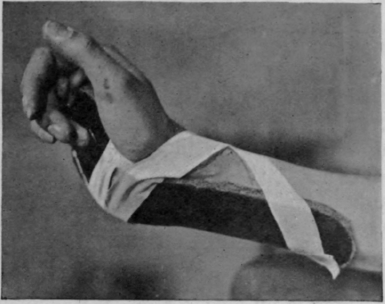
Fig. 161. - A short cock-up splint applied so as to exert as little obstruction as possible to the return of the blood in the veins on the back of the hand.
The metacarpo-phalangeal joints should rest at an angle of about 45° from the straight and, to be strictly accurate, it is probable that both inter-phalangeal joints should be perfectly free from the splint. The thumb should rest in a position of abduction and extension, and in such a plane that simple flexion of all its joints and of the little finger would suffice to bring the tips of the two digits into contact with each other. That is to say, it should be maintained in a position of opposition. Under no circumstances, save only in the presence of some such complication as ischaemic contracture of the flexor tendons, would any part of the hand distal to the metacarpophalangeal joints be attached to the splint. Moreover, the proximal part of the splint should be fixed as lightly as possible. Great care also should be taken to ensure that the fixing material - be it bandage or strapping - does not cross the back of the wrist transversely. If it does so, there is a grave risk of obstructing the venous return from the fingers. The best plan is to fix the splint by means of strapping, which is adherent to the angle of the splint and then passes obliquely across the back of the wrist and returns to the splint, having thus formed a complete figure-of-eight (see Fig. 161). This arrangement allows a freedom of movement of the long extensor muscles of the wrist within the inner half of the range of movement, and, if the inter-phalangeal joints are free, allows a considerable freedom of use to the hand.
Continue to:


My Books

