


Mobilisation with Active Movement. Part 2
Description
This section is from the book "Massage Its Principles And Practice", by James B. Mennell. Also available from Amazon: Massage It's Principles and Practice.
Mobilisation with Active Movement. Part 2

Fig. 46. - To show a simple method of reducing the action of gravity on the upper extremity while performing abduction. The hand should be supported by a sling round the neck, omitted in the photograph for the sake of rep-o-duction.
This may be done by placing the patient fully recumbent, the whole weight of the limb being supported by the couch. By means of gradually elevating the position of the couch on which the trunk and shoulders rest, the resistance to abduction and the assistance to adduction can be regulated to a nicety. Other ways of achieving a similar end are by giving manual assistance by the aid of the weight and pulley, or by some other device. The resistance to shoulder movements offered by gravity can be largely counteracted if the elbow is maintained in the acutely flexed position (see Fig. 46).
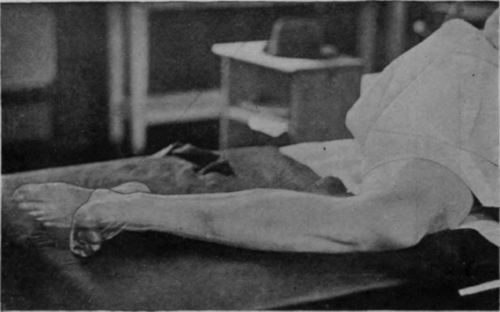
Fig. 47. - To show the position for free movement of the ankle. Movement of the toes in this position is also "free."
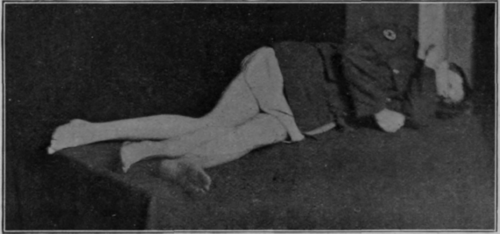
Fig. 48. - To show the position for free movement of the knee. If the patient's left thigh were drawn back, the knee well flexed, and if the right thigh were drawn forward, extension of the right knee would be assisted by gravity.
Free movement of the toes can be performed with the leg flat on its side on the couch.
Free movement of the ankle can only be performed with the patient lying on his side on a couch, the weight of the leg being supported on the couch or on a pillow (see Fig. 47).
Free movement of the knee necessitates that the patient should assume a position similar to that employed when giving free movement to the ankle. The only difference is that, in this case, it is better that the patient should lie on the injured side (see Fig. 48), though a little ingenuity will enable the movement to be performed when lying on the sound side.
Free movement of the hip is very difficult to secure in any position without assistance from some weight-bearing mechanism. Rotation is almost free when recumbent with the limb fully extended on a couch. By means of a weight and pulley flexion and extension can be rendered almost free when the patient is recumbent, while free adduction and abduction are rendered possible by simple suspension from a cord. As a matter of fact, swinging the whole extremity in the erect posture approximates very closely to a free movement, provided that movement does not exceed a few degrees from the perpendicular. Lying on the back with the knee drawn up so that the sole of the foot rests flat upon the couch, a few degrees of almost free adduction and abduction can be performed.
When making the first tentative experiments with free movement, the patient will often find that his endeavours are crowned with success more readily if the limb is placed in water, preferably hot. The probable explanation of the success of these adjuvants is that the water, by giving perfect and even support to all the parts immersed, removes every trace of external resistance to movement. The tendency of cold to render all movement more difficult by giving rise to a sense of stiffness is a natural phenomena: heat tends to relieve this sense, and movement becomes more easy. The effect of the swirling of the water, if an eau courante bath is used, is possibly comparable to the effect of the superficial stroking massage already described. An ordinary bath of hot water is generally as useful as any other form of bath.
It is well, whenever possible, to arrange that any free movement should be performed in combination with other movements as indicated when considering relaxed movements.
The value of the knowledge of the positions in which doses of true free movement can be administered is realised even less than the value of true relaxed movement. Yet a full appreciation is required as an essential foundation for re-education in cases of extreme weakness and of paralysis. Until these fundamental positions are studied and their value realised all early training must be faulty and progress thereby retarded. The first essential in muscle re-education is to devise something that the muscle, despite its enfeebled condition, can effect as the result of its contraction. The most simple actions any muscle can perform are those that are assisted by gravity. By postural change the assistance thus afforded can be reduced from a maximum to zero - the posture for true free movement - while further change in position adds gradually to the resistance afforded by gravity to the movement. Thus, and thus only, can early muscle re-education be scientifically gradated, and the keystone of the training is the knowledge of the neutral positions, or the positions in which alone true free movement is possible (see Chapter XIX (The Re-Education Of Muscle).).
2. Assistive Movement opens a wide sphere for inventive capacity in the individual masseur. The assistance given varies from the mildest possible touch to a finger, while the forearm floats in an arm bath, to a vigorous and long-sustained pulling process, while the patient himself is exerting the full power of normal muscle, with all the assistance that can be obtained from gravity and the body-weight.
Continue to:


My Books

