


Re-Education In Walking. Part 3
Description
This section is from the book "Massage Its Principles And Practice", by James B. Mennell. Also available from Amazon: Massage It's Principles and Practice.
Re-Education In Walking. Part 3
By this time more particular attention can be given to the strengthening of special groups of muscles by use of the weight and pulley. The most important exercise, and perhaps the most frequently overlooked, is that for the quadriceps, which is performed with the patient sitting, the cord passing under the chair and then under a stool placed in front of it on which rests the knee (see Figs. 52 and 53, pp. 105 and 106). The knee is alternately extended and flexed. All the other thigh muscles can be exercised most efficiently while standing on the sound leg. The hands should then, as a rule, rest on the backs of two chairs, between which the patient stands while facing or with his back to the apparatus (see Figs. 54 to 57, pp. 107 to 110), or with the hands resting on the back of a chair if standing "side-on" to the wall (see Figs. 111 and 112). As with all weight and pulley exercises, the severity must be gradually but steadily increased, either by adding to the number of movements or to the weight, or by holding the muscles in contraction while counting, or by increasing the range of movement. Assistive movement must precede resistive.

Fig. 111. - To illustrate an exercise for the adductors of the thigh. It is also either a relaxed or assistive exercise for the abductors according to the weight employed.

Fig. 112. - To illustrate the remainder of the exercise shown in Fig. 111.
The patient is now ready to begin to bear his body-weight, but he should be taught to do this gradually, otherwise he will lack confidence in the weakened limb.
The first stage in bearing weight upon the limb is the natural continuation of the "clawing" exercise which the patient has been performing seated on a chair. He places his hand on the seat, and then, with feet crossed and the outer borders in contact with the floor, he rises from the seat a few inches, supporting most of his weight on his hands (see Fig. 113). Day by day he rises higher and higher, and presently his hands leave the chair, with the result that the whole body-weight rests momentarily upon his feet. As he rises higher and higher the length of time steadily increases, till finally he stands upright.
The chair is now placed in front of him, and he supports much of his weight on its back. Taking the remainder of the weight on the outer side of the sound foot, he uncrosses the other leg and stands on his feet, which now rest side by side on the floor, the weight still being borne on the outer border. The first "free standing" exercise is now performed by simple knee-bending through a few degrees only (see Fig. 114).
Soon the patient stands on his sound limb, swings the other to and fro, and then, when the foot is falling from the front position, the heel is made to check the return by contact with the ground (see Fig. 115). With perseverance comes perfect coordination in the performance of this movement, and the power correctly to perform the first part of the natural walking step is restored.
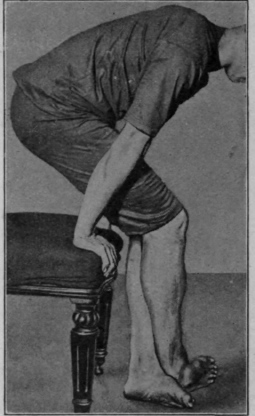
Fig. 113. - The third sitting exercise in the re-education of walking. Continuation of the "clawing" exercise. Note the body-weight is still partly supported by the arms.

Fig. 114. - To illustrate simple knee-bending. Note that the body-weight falls on the outer sides of the feet.
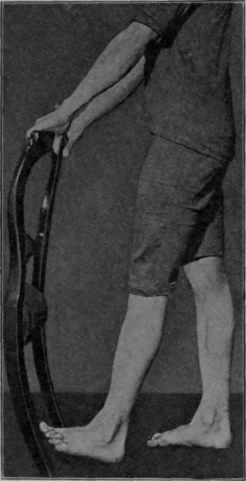
Fig. 115. - To show how the patient takes the first quarter of a full step. The left leg has been swung to and fro and is then checked in the position shown.

Fig. 116. - The second stage in taking a step. The patient then returns to the position shown in Fig. 115, and learns to "rock" to and fro.
The next stage is to perform this exercise once more, but now, as soon as the heel of the injured limb touches the floor, the body-weight is thrown forwards, the toes of the injured limb fall to the floor, and the heel of the sound limb is raised (see Fig. 116). Return to the status quo ante completes the exercise.
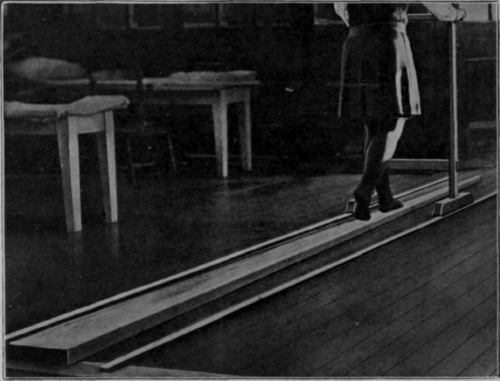
Fig. 117. - Practising "rocking" on the walking board. The latter is a mere adaptation of a boom, and the trolley replaces a balancing pole.
As soon as the patient can "rock" to and fro in this manner he can perform about three-quarters of a single complete step, but so far the injured foot has been in front. Now he must practise the "rocking" with the sound foot in front and that of the injured limb behind. The next advance is to withdraw the moral support of the chair-back, first by taking one hand off, then the other, and finally by moving the chair to a point where the patient is not able to touch it, but where he could do so without any difficulty whatever if emergency arose. A step and a half is now undertaken up to the chair, and then the return is made. This constitutes a more advanced form of "rocking."

Fig. 118. - To show the first position for ordinary tiptoe exercises.

Fig. 119. - The second position in tip-toe exercises. The weight of the body has been rolled across the transverse metatarsal arch.
Great care should be taken to ensure that in all walking exercises the feet are kept straight and that thereby the weight is thrown on the outer borders of the feet. It is also essential at this stage that the patient should be instructed to confine his efforts to the true "heel and toe" walking only. A line maybe drawn on the floor on which the patient must place his feet, or, better still, two lines are drawn, and in the space between them the patient walks. At the special surgical hospital at Shepherd's Bush the author has arranged a modification of balancing on a boom. A strip of thick wood is placed on the floor (broad at one end to give the patient confidence, narrow at the other) on which the patient performs the exercises. The place of the chair is taken by a trolley support (see Fig. 117).
Continue to:


My Books

