


2. Flexion And Extension
Description
This section is from the book "Massage And The Original Swedish Movements", by Kurre W. Ostrom. Also available from Amazon: Massage and the Original Swedish Movements.
2. Flexion And Extension
I. Foot. - The patient lying or sitting. The operator, grasping the ankle with one hand and the toes with the other, moves the foot up and down as far as the limits of the joint permit. Ten to eighteen times. It is used for deformities, and especially for stiffness of the Achilles tendon. (Passive and Duplicated Active.)
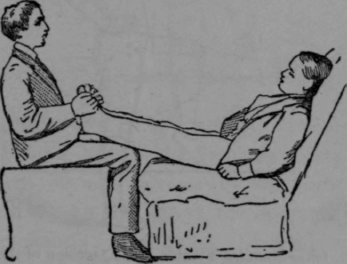
Fig. 67. - Flexion and Extension of the Feet.
The movement may also be performed on both feet at the same time, as demonstrated in Fig. 67.
II. Leg. - The patient is in a half-lying (see Figs, 70 and 71) or standing (see Fig. 69) position. The operator places one hand at the knee, the other either on top of the instep or underneath the sole of the foot.
The patient generally moves the limb up and down while the operator resists. (Duplicated Active.)
It may also be a passive movement, and is used for stiffness in the knee- and hip-joint, and for contraction of certain muscles.

Fig. 68. - Standing Flexion and Extension of the Leg.
In Fig. 68 we have demonstrated the single active, standing flexion and extension of the leg. Until the patient gets used to the exercise, it is safest to have him grasp something to support himself and prevent him from falling. The effect of this movement is not confined to the extremity only, but the abdominal muscles are strongly and effectively acted upon. It is therefore very valuable in the treatment of constipation and hemorrhoids.

Fig. 69. - Flexion and Extension of the Leg.
III. Arms. - The patient sitting. The operator, standing behind, grasps the patient's wrists, telling him to keep his elbows close to the body and to move the arms up and down, the operator making suitable resistance. Ten times. It is a circulatory movement. (Duplicated Active.)
IV. Arm - The patient sitting. The operator, standing in front, grasping the wrist with one hand and around the triceps muscle with the other, the patient moves the arm up and down, the operator making suitable resistance. Ten to fifteen times. The motion may also be passive, and is used for acting upon the joints and for certain local affections. (Passive or Duplicated Active.)
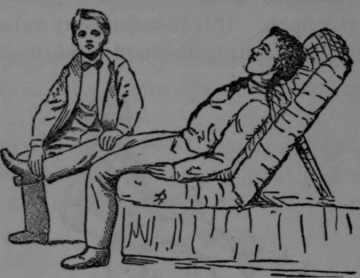
Fig. 70.
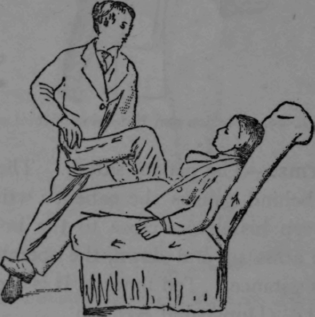
Fig. 71.
V. Hand. - The patient sitting. The operator, in front, takes the fingers firmly in one hand, the other grasping the wrist, and works up and down, about ten times. It is used for stiffness of the wrist and for writers' cramp. (Passive or Duplicated Active.)
Flexion and extension are used principally for regulating the circulation in certain parts and for relieving local congestion.
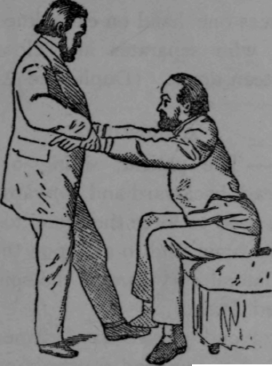
Fig. 72.
Continue to:


My Books

