


5. Raising
Description
This section is from the book "Massage And The Original Swedish Movements", by Kurre W. Ostrom. Also available from Amazon: Massage and the Original Swedish Movements.
5. Raising
I. Leg. - The patient lying flat on his back. The operator grasps the heel underneath, one hand supporting the knee on top and raises the extended leg upward. Ten times.
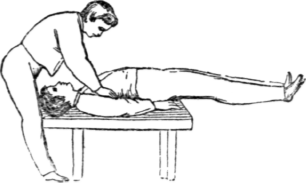
Fig. 86.
This movement may also be active and is used principally for sciatica and slight rupture.
II. Legs. - The patient is lying flat on his back with the limbs extended as shown in Fig. 86. The operator grasps over the shoulders and presses the trunk down, while the patient raises the limbs upward far enough to have them form a right angle with the trunk at the hip. The movement acts firmly upon the abdomen. (Duplicated Active.)
III. Body. - The patient sitting on a stool or a turned chair. The operator places his hands flat on the shoulder-blades. The patient, if strong enough, clasps his hands on the back of his head and bends forward, keeping the head up. He then raises his body up, with a strong resistance of the operator. It is used for deformities of the back (Duplicated Active.)
IV. Body. - The patient lying with hands clasped on the back of his head. The operator places his hands around the ankles, with thumbs inverted, and holds them firmly. The patient then rises slowly to a sitting position. There is no better movement for compressing the contents of the bowels. The movement may also be a general active, and is used principally for constipation. (Duplicated Active or Active.)
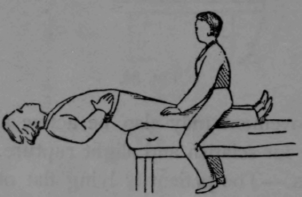
Fig. 87.
V. Body. - The movement may also be performed with the trunk extended from the lounge, as shown in Fig. 87 . It is then very effective, and should be used with great consideration.
VI. Body. - Another form of raising the body in standing position is demonstrated in Fig. 89. The operator is sitting in front of the patient and resists him firmly in his rising. (Duplicated Active.)
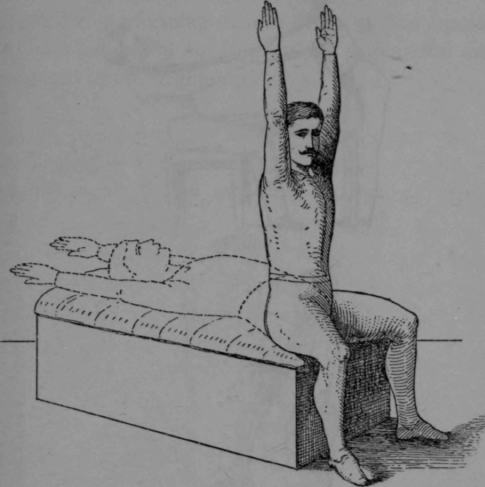
Fig. 88.
Body
The movement may also be performed as shown in Fig. 88. The patient is lying on a bed or couch the lower extremities out, feet on the floor and arms stretched. He is told to slowly rise to a sitting position. This exercise acts strongly upon the muscles of the back and upon the abdomen.
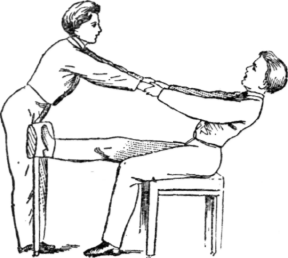
Fig. 89.
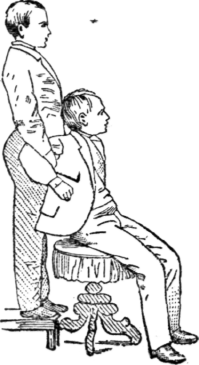
Fig. 90.
VII. Chest. - The patient sitting. The operator standing behind and placing his hands around the patient's armpits in front, raises the body slowly forward, upward and backward, describing a circle. This movement is always passive, and is used to assist respiration. (See Fig. 90.)
When performing this movement the operator should be careful not to press the patient too much forward in the beginning.
Continue to:


My Books

