


4. Bending
Description
This section is from the book "Massage And The Original Swedish Movements", by Kurre W. Ostrom. Also available from Amazon: Massage and the Original Swedish Movements.
4. Bending
I. Head. - The patient, sitting or suspended, bends the head backward and forward eight to ten times. It is used to force the blood to the head in anemia of the brain, and to act upon the muscles of the back in lateral curvature of the spine. (Active or Duplicated Active.)
In Figs. 73 and 74, we have demonstrated the active bending of the head forward and backward, and to the sides respectively. These are used when we wish to draw the blood from the head in plethoric individuals or when we wish to develop the neck. The patient resists himself while performing the movement.
II. Body (sideways). - Suppose a case of lateral curvature of the spine. If the right side is the originally affected one, the patient stands with his left arm straight up, close to the head. The operator, standing behind, places one hand on the right side, at the highest point of curvature, the other on the opposite hip; the patient bends slowly toward the side, thus acting upon the affected muscles.

Fig. 73.

Fig. 74.

Fig. 75.

Fig. 76.

Fig. 77.
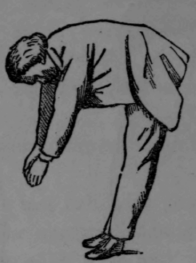
Fig. 78.

Fig. 79.

Fig. 80.

Fig. 81.
The movement may also be single active, as shown in Fig. 75.
Bending of the body sideways may also be performed in a sitting position (see Fig. 76), or as a single active movement from side to side as shown in Fig. 79. This is particularly recommended when we wish to act upon the liver or spleen. It should be performed slowly, otherwise the patient is apt to become dizzy.
III. Body (forward and backward). - The patient is standing with the hands on hips (see Fig. 77) or with the arms stretched (see Fig. 78). He bends slowly forward and backward, being careful to keep the heels together. (Active.)
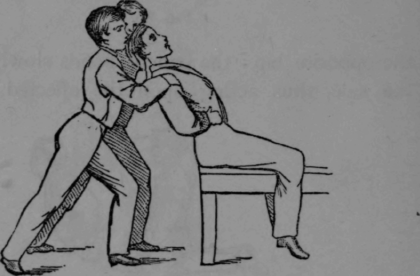
Fig. 82.
IV. Trunk (up and down). - See Figs. 80 and 81. This movement should only be used on strong individuals, it being very effective. (Duplicated Active.)
V. Trunk (backward). - The patient is sitting at the edge of a sofa or lounge. The operators stand behind and support as shown in Fig. 82. The patient bends his trunk backward while the operators resist, and the patient resists while the operators raise him up.
The support should be made firm, so that the patient feels confident in performing the movement. It is an excellent exercise to act upon the muscles of the back. (Duplicated Active.)

Fig. 83.
VI. Knee. - The operator stands behind the patient, as demonstrated in Fig. 83 and resists the patient rising. (Duplicated Active.)
VII. Knees. - The patient stands with the hands on the back of his head or supported as in Fig. 84. The patient is told to rise on his tip-toes, flex his knees as much as possible, rise up on the tip-toes and to regain standing position. The operator supports either as shown in Fig. 84 or with one hand on the chest and the other on the back. It may also be single active as shown in Fig. 85. This movement is called "Deep Knee-Bend."

Fig. 84.

Fig. 85.
Continue to:


My Books

