


Positions
Description
This section is from the book "Massage And The Original Swedish Movements", by Kurre W. Ostrom. Also available from Amazon: Massage and the Original Swedish Movements.
Positions
Movements may be given or performed in many different positions of the body. It is necessary to have a commencing, intermediate and terminating position. Ling said that to render any movement definite and exact, a point of departure, a point of termination, and the line through which the body or any of its parts must pass, are to be clearly determined, as well as the rhythm of the action itself.
There are in Ling's system five principal or fundamental positions - viz:
1. Standing,
2. Sitting,
3. Lying,
4. Kneeling,
5. Suspending.
Standing
In this position, the legs, trunk, and head are erect. The heels should be together and the feet should form right angles. The arms should be kept at sides. (See Fig. 33.)
Sitting
In this position the buttocks and the posterior part of the thigh rest against the chair or sofa. The legs, close together, form right angles with the thighs. The trunk and head should be erect. (See Fig. 34.)
Kneeling
The body rests upon the knees and the anterior part of the legs. The feet should be kept outside of the supporting part, as demonstrated in Fig. 35.

Fig. 33. - Standing Position.

Fig. 34. - Sitting Position.
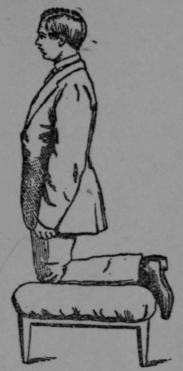
Fig. 35. - Kneeling Position.

Fig. 36. - Lying Position.
Lying
In this position, the patient's body rests against the sofa or bed with the head, the back, and the legs. (See Fig. 36.)
Suspending
In this position the patient is to grasp a horizontal bar that is elevated so that the feet do not touch the floor. There should be the same distance between the hands on the bar as between the shoulders. (See Fig. 37.) The position is very tiresome, as it, to a certain extent, prevents respiration and circulation, on account of the extension of the thorax. It should be used with great care; and if the patient is weak, support his sides until he becomes accustomed to it.
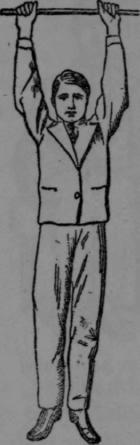
Fig. 37. - Suspending Position.
From each one of these principal positions Ling formed many derivatives or subdivisions of positions.
We only mention the most important, and the illustrations will enable the reader to fully understand them.
Continue to:


My Books

