


7. Turning
Description
This section is from the book "Massage And The Original Swedish Movements", by Kurre W. Ostrom. Also available from Amazon: Massage and the Original Swedish Movements.
7. Turning
I. Foot. - The patient sitting or lying. The operator puts one hand back of the ankle, the other grasping the toes and the front of the foot, and turns the foot from side to side. The movement is always passive, and is used chiefly for sprains and deformities.

Fig. 95.
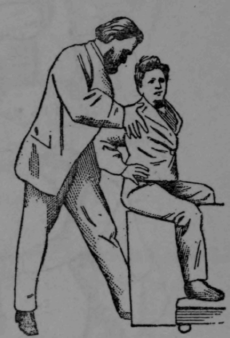
Fig. 96.
II. Leg. - The patient lying. The operator places one hand at the sole of the foot, the other pressing on the knee to keep the leg extended, thumbs inward, and moves the limb slowly inward and outward. The motion is used for stiffness in the hip-joint and for contraction of certain muscles. (Passive.)
III. Body. - The patient standing (see Fig. 95) or sitting (see Fig. 96), with hands on the hips or clasped on the back of the head. The operator, standing behind, places his right hand on one shoulder and his left in front of the other, and moves the patient to one side and back again, changing the position of the hands before turning to the other side. The movement is also duplicated active, and is used for congestion of the abdominal organs and for acting upon the great venous system. In Figs. 97, 98, 100 and 101 we have depicted certain modifications of turning of the body. The one shown in Fig. 101 should be used with great care, it being very effective, especially in the case of a woman.
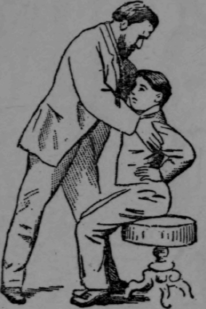
Fig. 97.
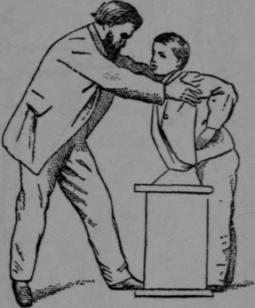
Fig. 98.
Fig. 99 shows how the turning of the body is performed as a single active movement. It acts strongly upon the abdominal viscera, especially upon the liver. The patient should be told to take deep breaths while performing the exercise.
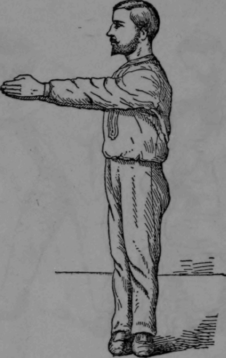
Fig. 99.
IV. Arm. - The patient sitting or standing. The operator, supporting the elbow with one hand and grasping the hand with the other, moves the forearm from side to side (pronation and supination). If the whole arm is to be turned, the operator must grasp the elbow to keep it extended. The movement is passive, and is used principally for stiffness in the joints and for relaxing the tendons and muscles in cases of after-operation.
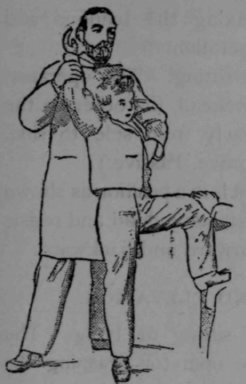
Fig. 100.
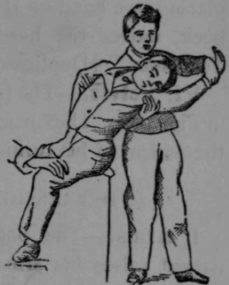
Fig. 101.
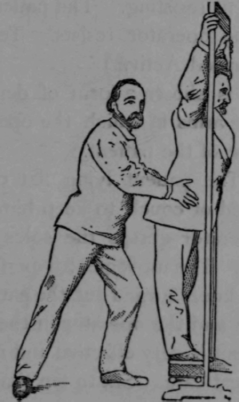
Fig. 102.
V. Head. - The patient sitting. The operator, placing one hand on the forehead, the other on the neck, moves the head slowly from side to side. Ten times. (Duplicated Active, Passive.)
VI. Pelvis. - The patient is in a position as shown n Fig. 102. The operator stands behind and resists the patient in his turning forward and backward.
Continue to:


My Books

