


Coccidium Oviforme
Description
This section is from the book "A Manual Of Pathology", by Guthrie McConnell. Also available from Amazon: A Manual Of Pathology.
Coccidium Oviforme
Coccidium Oviforme is an elliptical parasite that is rarely found in the intestines and liver of man, but is common in rodents. It has a distinct double capsule, is found within cells in which it undergoes rapid division. Frequently becomes encysted, and when taken into the intestine, the capsule is dissolved and the organism is set free.
Other less important parasites are the Paramoecium coli, an ovoid, unicellular organism about 7 to 10 µ long. Is surrounded by short cilia. Usually contains numerous large vacuoles. Is found in diarrheal feces.
The Trichomonas intestinalis is a pear-shaped organism about 10 to 15 µ long. On one side it has an undulating membrane provided with about 10 to 12 cilia. Is found in intestinal discharges in diarrhea, typhoid fever, and cholera.
The Cercomonas intestinalis is a pear-shaped parasite about 10 to 12 µ long. From its blunt end extends a single flagellum.
The Trichomonas vaginalis is an oval organism about 10 µ long. To one end are attached three long flagella, near the base of which is an undulating membrane provided with five to six cilia.
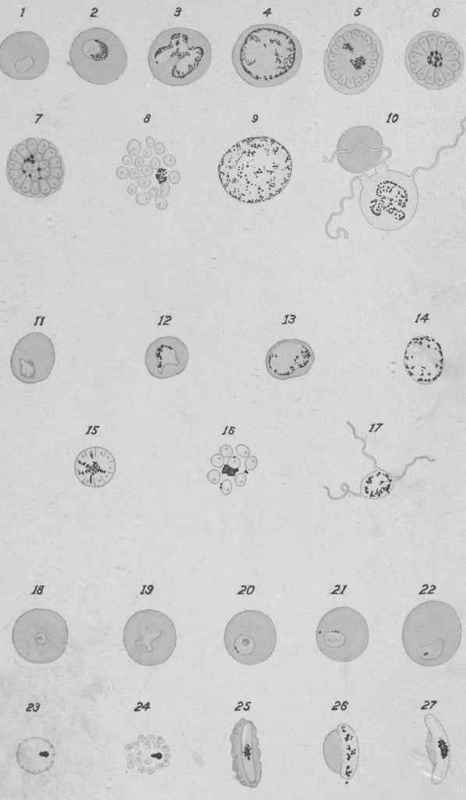
PLATE I. Various Forms of Malarial Parasites (Thayer and Hewetson).
Figs, 1 to 10, inclusive, tertian organisms; Figs, 11 to 17, inclusive, quartan organisms; Figs. 18 to 27, inclusive, estivo-autumnal organisms.
Fig. 1. - Young hyaline form; 2, hyaline form with beginning pigmentation; 3, pigmented form; 4, full-grown pigmented form; 5, 6, 7, 8, segmenting forms; 9, extracellular pigmented form; 10, flagellate form.
Fig. 11. - Young hyaline form; 12, 13, pigmented forms; 14, fully-developed pigmented form; 15, 16, segmenting forms; 17, flagellate form.
Figs. 18, 19, 20. - Ring-like and cross-like hyaline forms; 21, 22, pigmented forms; 23, 24, segmenting forms; 25, 26, 27, crescents.
It has been found in the urine as well as in the vagina.
Continue to:


My Books

