


Inflammatory Exudates
Description
This section is from the book "A Manual Of Pathology", by Guthrie McConnell. Also available from Amazon: A Manual Of Pathology.
Inflammatory Exudates
The products of inflammation are known as inflammatory exudates.
A Serous Exudate
A Serous Exudate is one that is composed of fluid that has escaped from the vessels. It contains few cells, occurs in very slight inflammations, and tends to coagulate spontaneously.
This fluid differs from the non-inflammatory transudate in containing a greater amount of albumin, and, therefore, being of a greater specific gravity. The amount of exudate depends largely upon the vascularity of the part.
A Fibrinous Exudate
A Fibrinous Exudate is one in which there is more or less fibrin present, which probably helps restrict the escape of the infecting agents. It is formed by the action of fibrin ferment acting upon fibrinogen or fibrin-forming substances in the presence of calcium salts. This ferment is yielded probably to some extent by all the cells of the blood, but particularly by the leukocytes. When they die, the ferment is formed and the fibrinogen is converted into fibrin. When the leukocytes are increased in number, the amount of fibrin is usually greater.
A Purulent Exudate
A Purulent Exudate is one in which there is a preponderance of escaped leukocytes. It may be found infiltrating the tissues or in a circumscribed area known as an abscess. This exudate is known as pus.
A Hemorrhagic Exudation
A Hemorrhagic Exudation is one that contains erythrocytes. It generally indicates that there has been a lesion of bloodvessels.
Pus is an opaque, yellowish, alkaline fluid, specific gravity about 1050. It is made up of pus cells, either living or dead polymorphonuclear leukocytes, and pus serum (liquor puris). Usually some degenerated tissue cells are present. According to whether there is blood, serum, or mucus as well, it may be sanions pus, seropus, or mucopus.
If the fluid portion is scanty, the pus may be creamy or cheesy; or ichorous if the pus is very thin, watery, and acrid.
An abscess is a circumscribed collection of pus. It is surrounded by an inflammatory zone incorrectly called a pyogenic membrane.
An abscess may be hot or cold. The first is the result of acute inflammatory changes. The latter is a chronic inflammatory process, and the fluid contained within it is not pus, but is made up of broken-down and degenerated tissues.
An embolic abscess is one that has followed the lodgment of a septic embolus.
Pyemic or metastatic abscesses are those resulting from pyogenic organisms present in the blood becoming lodged in the tissues and causing local purulent lesions.
The various steps occurring in the formation of an abscess due to bacterial infection are as follows: After the pus-producing organisms gain entrance they undergo multiplication without at first causing any reaction. In a very short time, however, the invaded area becomes congested, the leukocytes approach the wall of the blood-vessels, and degenerative changes in the neighboring tissue cells appear. There is a multiplication of the bacteria, the polymorphonuclear leukocytes escape from the vessels, and mononuclear leukocytes (small round cells) collect. The polynuclear leukocytes and other cells, including endothelial cells, take up large numbers of bacteria. More leukocytes appear until the tissue becomes densely filled by them. This is accompanied by a yet greater proliferation of the bacteria which extend along the lymph-streams into the region outside of the developing abscess. There is now a breaking down of the leukocytes, with the setting free of various ferments and a coincident destruction of the tissue of the affected portion.
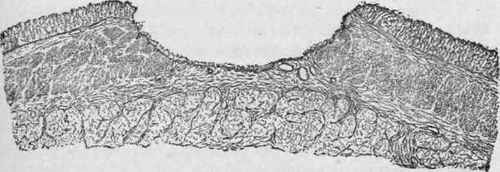
Fig. 24. - Chronic Ulcer of the Stomach, Showing a Section Through the Stomach Wall at the Central Part of the Round Ulcer (Delafield and Prudden).
The destruction of tissue that accompanies abscess formation is in consequence of there being an insufficient amount of nutrition, and is due also to the dissolving effect of digestive enzymes present in the liquor puris, probably derived from the broken-down leukocytes.
When the broken-down tissue has been cast off there remains a superficial lesion with loss of substance. This area is known as an ulcer.
A sinus is an inflammatory tract that is open at one end from which the exudate can escape.
A fistula is an inflammatory tract that is open at both ends. It is one that joins an internal cavity to the surface.
Continue to:


My Books

