


Lysins
Description
This section is from the book "A Manual Of Pathology", by Guthrie McConnell. Also available from Amazon: A Manual Of Pathology.
Lysins
Lysins are those antibodies that will cause the destruction of cells, and they receive various names, according to the type of cell acted upon. The destruction is known as lysis. Cyto-lysin is the general name of all the substances that destroy the cells. A bacteriolysin causes lysis of bacteria; a hemolysin, that of erythrocytes.
It has been found, for example, that a "hemolysin" can be produced by injecting defibrinated rabbit's blood into a guinea-pig. The serum of the guinea-pig will develop marked ability to dissolve blood-corpuscles from the rabbit. This action can be destroyed by heating the serum to 560 C, but the serum can be reactivated by the addition of fresh normal serum, as in it will be found complement. The immune serum will contain the amboceptor or immune body.
A. Foreign cells, blood, bacteria, etc.
B. Heated immune serum containing amboceptor, but no complement.
C. Unheated normal serum containing complement, but no amboceptor.
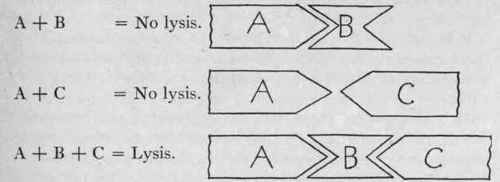
Fig. 78. - Diagram Representing Method of Combination of Antigen (A), Amboceptor (B), and Complement (C) in Producing Lysis.
In order to bring about the solution the three factors must be present. Experiments show that the complement cannot combine directly with the cell, but that there must be an intermediate substance, which is known as the amboceptor.
Continue to:


My Books

