


Predictions And Design Of New Anticancer Compounds
Description
This section is from the book "Chemistry Of Chelation In Cancer", by Arthur Furst. Also available from amazon: Chemistry Of Chelation In Cancer.
Predictions And Design Of New Anticancer Compounds
Is it a coincidence that a large number, if not most, of the anticancer agents reported have chelating ability as a common property? If this is fundamental to the cancer problem, it should be possible to show that certain chelating agents which are not antimetabolites are anti-tumor compounds. In some laboratories programs have been started along these fines. It is too early now to reach definite conclusions, but interesting preliminary results have been obtained.
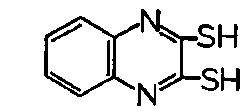
It was postulated that qumoxaline-2,3-dithiol (CVII) (which at the time did not exist) should easily form complexes with trace elements. This was synthesized and found to be highly specific for nickel. Given orally to Swiss-Webster mice, this compound retarded the growth rate of the Ehrlich ascites tumor.
(CVII)
The alpha-ketoaldehydes discussed in the section on miscellaneous anti-tumor agents is another case of predicted activity. The exploitation of the derivatives of glyoxal and especially the aminoguanylhydrazones and bis-thiosemicarbazones would lead one to expect that the bis-thiosemicarbazone of the original 2-keto-3-ethoxybutyraldehyde should also be active. This was found true quite recently.
Detailed suggestions for the future synthesis of more active compounds will have to wait for more information. Even now, however, the chelate hypothesis can produce useful ideas. For example, one can theorize that two as yet untried types of compounds should be considered, the disulfides (CVIII) and the azides (CIX).
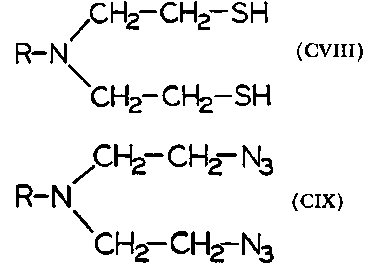
Molecules having the same spacial grouping of the nitrogen and sulfhydryl as is found in 6-mercaptopurine are related to β-mercaptoethyIamine, which was evaluated with limited success. The bifunctional compounds as suggested in CVIII may be more active.
Potential drugs which are chelating agents should be designed so that any difference between normal and tumorous cells can be exploited. Advantages should be taken of lower pH, lower calcium levels, and for some tumors, lower zinc levels. The tumor usually incorporates amino acids and nucleic acid precursors at a greater rate.
More phosphate derivatives should perhaps be made. Any antimetabolite made should be modified, if possible, to have a chelating center. Various azo dyes with a 2-OH group may also prove to be drugs which will have some anti-tumor properties, even though carcinogenic action may be negated.
The 2,2'-bipyridyl type should be further exploited. It has been found that many drugs with this spacing have anti-tumor activity, including amethopterin, bisguanyl hydrazones and o-phenylenediamine. Finally, specific chelators for various metals should be tried, as was done with the zinc chelator in cancer of the prostate.
Compounds without chelating groups, active against at least one experimental tumor, should be modified, keeping the following spacing in mind: between two atoms of carbon, or between one atom of C and one of N, O, S, P, there should be the following functional groups:

This will give rise to representative combinations like those in CX. Bifunctional molecules may be better than monofunctional ones. The groups should be close enough spacially to complex the same M.

Active anticancer compounds having terminal CH8 groups should be remade with -CH2OH or -CH2OCH3 replacements; perhaps even -CH2SH may be considered. Amino groups should be redesigned to fit the N-hydroxyl, imine, or N-oxide pattern. N-methyls should be transformed to N-hydroxymethyl. The acetylene group should replace an - SH group; 6-acetylenic-purine should be made.
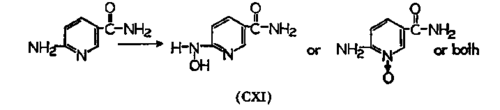
A few random examples may be suggested: a. 6-amino nicotinamide
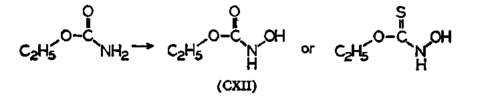
b. urethane
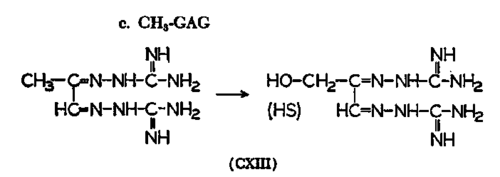
d. 6 M.P.
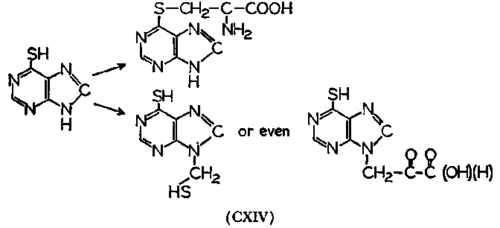
Compounds made should have some lipid solubility, and OH or NH2 may be made into OCH3, or NCH3 derivatives if necessary. Insolubility in water should be no deterrent in designing drugs. Surface active agents, per se, may not be useful unless they do get to cells and change their permeability to ions. Many of these compounds should be tested and then transformed into preformed chelates and tested again.
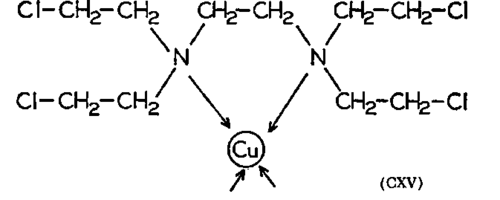
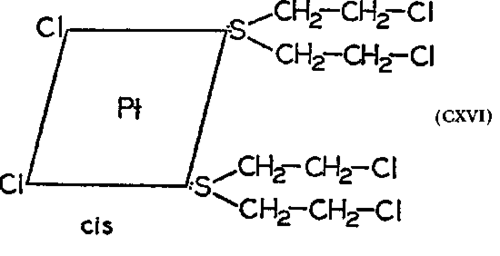
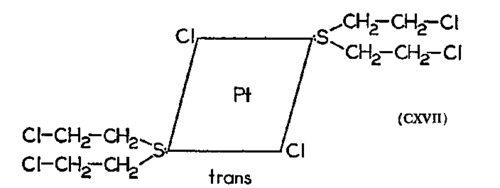
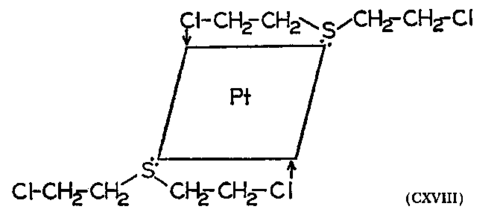
In spite of the many alkylating agents already made, only a few preformed chelates are listed. Ethylenediamine converted to a mustard was complexed with copper (CXV). The resulting molecule was quite toxic, perhaps due to the copper residue. Hydrolysis rates but not alkylating rates were retarded. Perhaps platinum or palladium derivatives should be made. Since thioethers have a strong tendency to unite with these metals, sulfur mustard complexes and chelates may prove useful. A reaction between K2PtCl4 and sulfur mustard would produce three isomers (CXVI) (CXVII) (CXVIII).
Continue to:


My Books

