


Cancer Chemotherapeutic Agents
Description
This section is from the book "Chemistry Of Chelation In Cancer", by Arthur Furst. Also available from amazon: Chemistry Of Chelation In Cancer.
Cancer Chemotherapeutic Agents
A considerable number of diverse agents have been tested for anticancer activity, and many have some retarding effect on growth of both human and experimental neoplasms. These effects, unfortunately, have been only of a temporary nature. Various theories have been proposed for their mechanism of action. With few exceptions, it should be noted that these carci-nostatic compounds are either chelating agents already or act by a postulated chelation mechanism.
Alkylating Agents
Alkylating agents have been extensively investigated for antitumor activity in experimental animals and man (207,491, 594) and have only been summarily and incidentally tried as carcinogenic agents.
For convenience, the alkylating agents are classified together. Their activity seems to be similar to that of radiation on biological materials, and they are therefore sometimes called radio-mimetic agents. The most extensively tested group of compounds can be considered derivatives of β, β-dichIorodiethyl-amine (XLV). These are later analogs of the original "sulfur mustard gas" (XLVI). The dichloroethylamines were the first anti-tumor agents to receive extensive clinical trial. Still today one of the most widely used drugs therapeutically is HN2, or mechlorethamine, the nitrogen mustard in which the R group is methyl. A vast number of variations on a theme have been made, but the variants are usually in the R group. Aromatics have replaced the methyl group and the p-aminophenyl-butyric acid analog; chlorambucil (XLVII) has also been extensively prescribed for use in patients. The advantage of this drug is that it can be given orally.


A logical extension of the chlorambucil structure would be the nitrogen mustard derivative of a naturally-occurring substance like phenylalanine. This compound was made and found active (339, 358). New derivatives are constantly being made, such as the mustards of various sugars. Efforts have been made to synthesize a derivative of nitrogen mustards with less toxic and vesicant action. Phosphate variants have been tried, but only cyclophosphoramide (Cytoxan) (XLVIII) has been extensively tested. It is now in general clinical use. Occasionally, variations of sulfur mustards are also tested.



The first attempt to explain the mechanism of action of the nitrogen mustards proposed the formation of an ethylenimine intermediate (XLIX). This strained three-member ring can either hydrolyze or alkylate some biologically important group. Either biochemical pathway leads to the formation of a chelating agent. The ethylenimine ring could be easily hy-drolyzed in situ and form a substituted ethanolamine, a chelating agent. Rates of hydrolysis and anti-tumor effects have been correlated and evidence for the actual formation of this hemi-mustard, the ethanolamine derivative, has been presented. Ethanol disulfides have also been proposed as hydrolytic products of sulfur mustards, and metal ions can influence these rates of hydrolysis. If the true mechanism of action of the nitrogen mustards primarily is the alkylation of either an amine, a thiol, a hydroxyl or a phosphate group of a nucleic acid or protein, a chelating agent of the dipyridyl type will then be formed (L). Cyclophosphoramide should also follow this biochemical pathway.

Compounds with chelating centers, in addition to those formed by the alkylating action, seem more active against tumors than similar molecules that do not possess the extra group. Phenylalanine mustard has the amino acid moiety which chelates (LI). Sugar derivatives like 2,6-bis(2-chloroethylamino)-D-mannitol dihydrochloride are also polydentates.

Evidence for chelate formation by alkylating agents first postulated in 1955 is now forthcoming. Sulfur and nitrogen mustards do alkylate nucleic acids, and guanine seems to be the purine base which receives the main attack. After treatment of DNA and RNA with nitrogen mustard (2-guanin-7-yl ethyl), methyl amine was isolated (LII). Direct evidence for metal interactions is still lacking, although addition of manganous chloride was found to reactivate spores inactivated by nitrogen mustard.

After the suggestion that nitrogen mustards may act through the ethylenimine intermediate, a number of compounds containing this grouping were tried as anti-cancer agents. The first clinically successful agent was triethylene melamine (TEM) (LIII). It is now seldom used.

As postulated for nitrogen mustards, TEM may also give rise to a metal chelating agent either in situ or by chemical reaction with a nucleic acid. It is also carcinogenic. All other ethylenimine derivatives conform to these chelation actions (83,144, 167, 573) as do the phosphoramides. The quinone imines of which Bayer E39 (LIV) is a representative (356,418, 551) can also act like a bidentate chelating agent, even before interaction with a nucleic acid or protein. If the amine of a protein is alkylated, a tridentate chelate is formed.
The imine urea derivatives can also be considered as potential metal complexing molecules, whereas trimethylol mel-amine is already a chelating agent.

(LIV)
The bisepoxides (LV) are also metal binding agents and can act as alkylating agents.

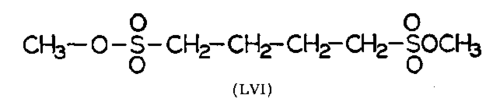
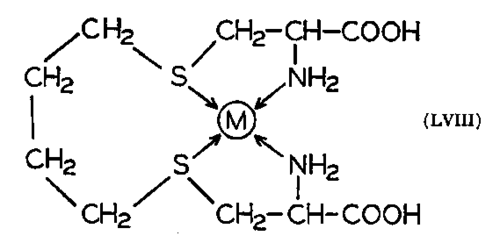
In the first draft of this monograph, only busulfan (Myleran) (LVI), a representative of the class of bifunctional sulfonic acid esters, was listed as the exception to the alkylating agents which fit into the chelating postulate. More recently, during a metabolic study, it was found that busulfan does form derivatives with cysteine. These can chelate similarly to penicillamine. The major portion or 60% of busulfan, however, is excreted as 3-hydroxytetrahydrothiophene sulfone (LVII). The busulfan-cysteine derivative (LVIII) formed just prior to the heterocyclic compound is a chelating agent.
Thus, with no exception, each of the alkylating agents can be considered to be either a chelating agent already or an alkylating agent which, forming after reaction with an amino acid, a nucleic acid fraction, or a protein, becomes a chelating agent. There is a dearth of information in the literature on the effect of these compounds on trace metals, or vice versa.

(LVII)
Continue to:


My Books

