


Folic Acid Antagonists
Description
This section is from the book "Chemistry Of Chelation In Cancer", by Arthur Furst. Also available from amazon: Chemistry Of Chelation In Cancer.
Folic Acid Antagonists
The forerunner of the folic acid antagonists was an L. casei factor which caused the regression of spontaneous breast tumor in mice. Later the factor was found to be pteroyl triglu-tamic acid. Folic acid, pteroyl monoglutamic acid (LIX), is a chelating agent. More than one portion of the molecule can bind metals.
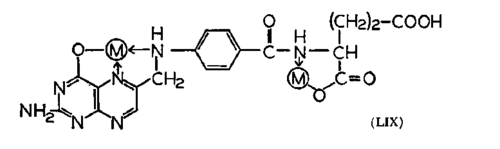
Various folic acid antagonists were tried in human leukemia with limited success; their main usefulness was for children. The first complete remission in acute leukemia was produced by the folic acid antagonist, aminopterin, wherein the 5-hydroxy group on the pteridine moiety was replaced by an amino group. This agent, like folic acid, can bind metals at two different functional parts of the molecule. In fact, with no exceptions, all of the folic acid derivatives are chelating agents. These include the N10-methyl derivative amethopterin, which is more effective than aminopterin in human choriocarcinoma but not as toxic, and the new phenyl dichloro derivatives which may also be more useful as carcinostatic agents as shown by data in rodent leukemias. Pteridine ring substituents seem to be promising too.
The mode of action of folic acid, its function as a precursor for tetrahydrofolic acid, and its role in transferring one carbon either as hydroxymethyl or formyl, or the role of its antagonists in the de novo purine synthesis has been adequately described elsewhere. It is of interest to note that the benzimidazole analog of folic acid, a dipyridyl type chelator, is similar in activity to folic acid, and that vitamin B12, a cobalt-containing vitamin, can partly reverse the anti-leukemic action of folic acid antagonists. The folic acid antagonists in the pyrimidine series will be discussed on page 56.
Continue to:


My Books

